


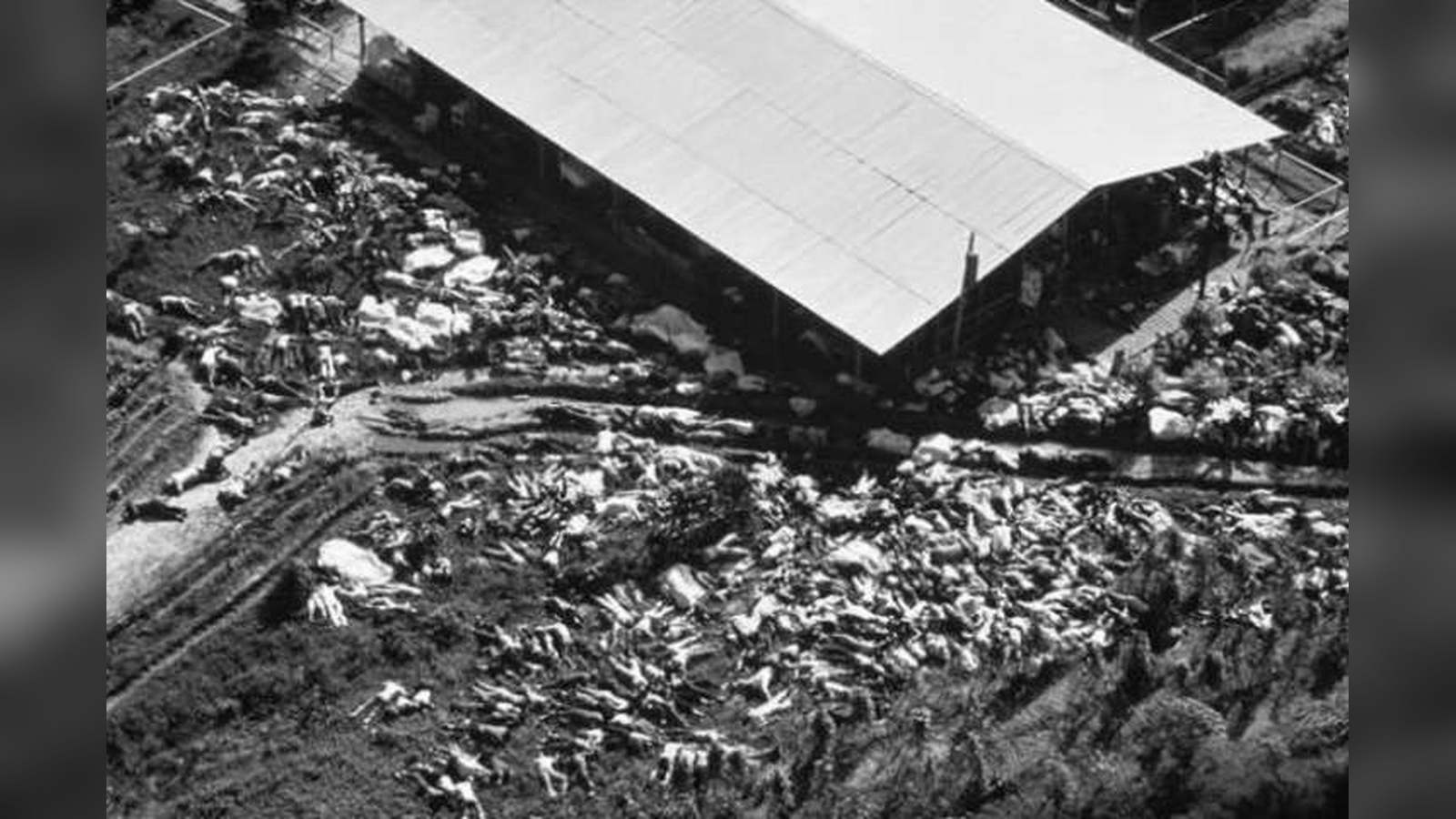
Looking down from a military helicopter over the dense rainforest of northwestern Guyana in late November 1978, the first aerial photographs captured an unimaginable vision: hundreds of human bodies in vivid red, blue, green, and yellow summer clothing spread like a patterned carpet around a makeshift wooden pavilion. This photograph records the immediate aftermath of November 18, 1978, at the Peoples Temple Agricultural Project—known to the world as Jonestown—where 909 American men, women, and children perished in one of the deadliest single losses of American civilian life in a non-natural disaster prior to September 11, 2001. By examining this horrific frame, we confront a haunting historical question: how did a movement founded on principles of racial integration, social justice, and communal care devolve into an isolated jungle compound where hundreds of families willingly or forcibly drank potassium cyanide?
What the photograph shows
In the photograph, the eye is immediately drawn to the central gathering space of the Jonestown settlement—an open-air timber-framed pavilion with a tin roof set against a broad clearing of red clay soil. Around this central structure lie rows of victims, predominantly lying face-down. Many bodies are clustered tightly together, with arms draped over spouses, children, and friends, reflecting their final moments of panic or communal solidarity. Brightly colored shirts, shorts, and dresses contrast sharply with the muted tones of the equatorial rainforest surrounding the clearing. Scattered near the perimeter of the crowd are wooden benches, plastic buckets, metal vats, and discarded paper cups and syringes that had held grape-flavored fruit drink laced with potassium cyanide, tranquilizers, and sedatives. Direct visual observation reveals no signs of battlefield destruction or physical blast damage; the scene bears the eerie orderliness of a ritualized, executed command under the sweltering tropical sun.
The moment behind the image
The tragedy captured in this photograph was triggered by the arrival of United States Congressman Leo Ryan, who flew to Guyana in mid-November 1978 accompanied by staff, journalists, and concerned relatives to investigate allegations of illegal detention, abuse, and brainwashing within the commune. On November 18, as Ryan’s delegation and sixteen Temple defectors prepared to depart from the nearby Port Kaituma airstrip, armed members of the Peoples Temple security detail opened fire. Congressman Ryan, three journalists—including San Francisco Examiner photographer Greg Robinson—and one defector were murdered. Realizing that the airstrip attack would bring immediate intervention by the United States government, cult leader Jim Jones summoned his followers to the main pavilion. Over the course of several hours, as recorded on a recovered 44-minute audio cassette known as the ‘Death Tape,’ Jones declared that security had been compromised and urged his followers to commit what he termed ‘revolutionary suicide’ rather than face military capture. Mothers fed the poisoned liquid to infants with syringes before drinking it themselves, while armed guards circled the pavilion to enforce obedience.
Photographer and provenance
The earliest photographs of the Jonestown scene were produced on November 19 and 20, 1978, as Guyana Defense Force officers, U.S. military personnel, and accredited news photojournalists gained access to the isolated site. Photojournalists such as Frank Johnston of The Washington Post, along with photographers working for the Associated Press, United Press International, Time, and Newsweek, documented the clearing from low-flying military aircraft and on foot. Initial media reports based on early ground counts estimated the death toll at approximately 400, because bodies had been stacked atop one another, particularly around the center of the pavilion where parents tried to protect their infants. Only when joint military body-recovery teams began lifting victims did the true count reach 909 inside Jonestown, plus four victims killed at the airstrip and four Temple members who died in Georgetown, bringing the total loss of life to 918. Distributed globally within hours via wire services, these photographs stunned readers worldwide and dominated newspaper front pages for weeks.
Historical context: From civil rights dream to jungle fortress
To understand how this scene came to be, one must trace the history of the Peoples Temple from its origins in 1950s Indiana. Founded by Jim Jones as an integrated Disciples of Christ congregation, the Temple championed civil rights, racial equality, and socialist community welfare during an era of intense racial segregation. Moving to Northern California in 1965 and expanding to San Francisco and Los Angeles in the early 1970s, Jones built an influential political following, drawing working-class families, idealist youth, and marginalized African Americans who saw the Temple as an authentic refuge from systemic oppression. However, behind its progressive public image, Jones enforced extreme psychological control through sleep deprivation, financial divestment, public beatings, and staged faith-healing demonstrations. When investigative articles exposing abuse began to surface in 1977, Jones convinced over 1,000 members to relocate to a remote agricultural tract in Guyana, promising an egalitarian paradise far from American capitalism. Instead, Jonestown became a high-security prison camp where Jones’s deteriorating mental health and addiction to prescription drugs culminated in paranoid middle-of-the-night drills known as ‘White Nights,’ which rehearsed the mass death ritual ultimately depicted in the photograph.
Why the image still haunts history
Decades after the photograph was taken, it remains one of the most chilling visual symbols of authoritarian psychological manipulation and human vulnerability. Unlike photographs of external disasters or military combat, this image documents the tragic internal collapse of an idealistic community under total institutional isolation. Looking past the sheer scale of the casualty count, the frame compels the viewer to remember that each colorful shirt represents an individual human life—a mother, a grandfather, a young child—who entered Peoples Temple seeking racial harmony and human dignity, only to be trapped in a fatal nightmare. The Jonestown photograph endures as a stark visual warning against the uncritical surrender of individual reason to charismatic authority.