


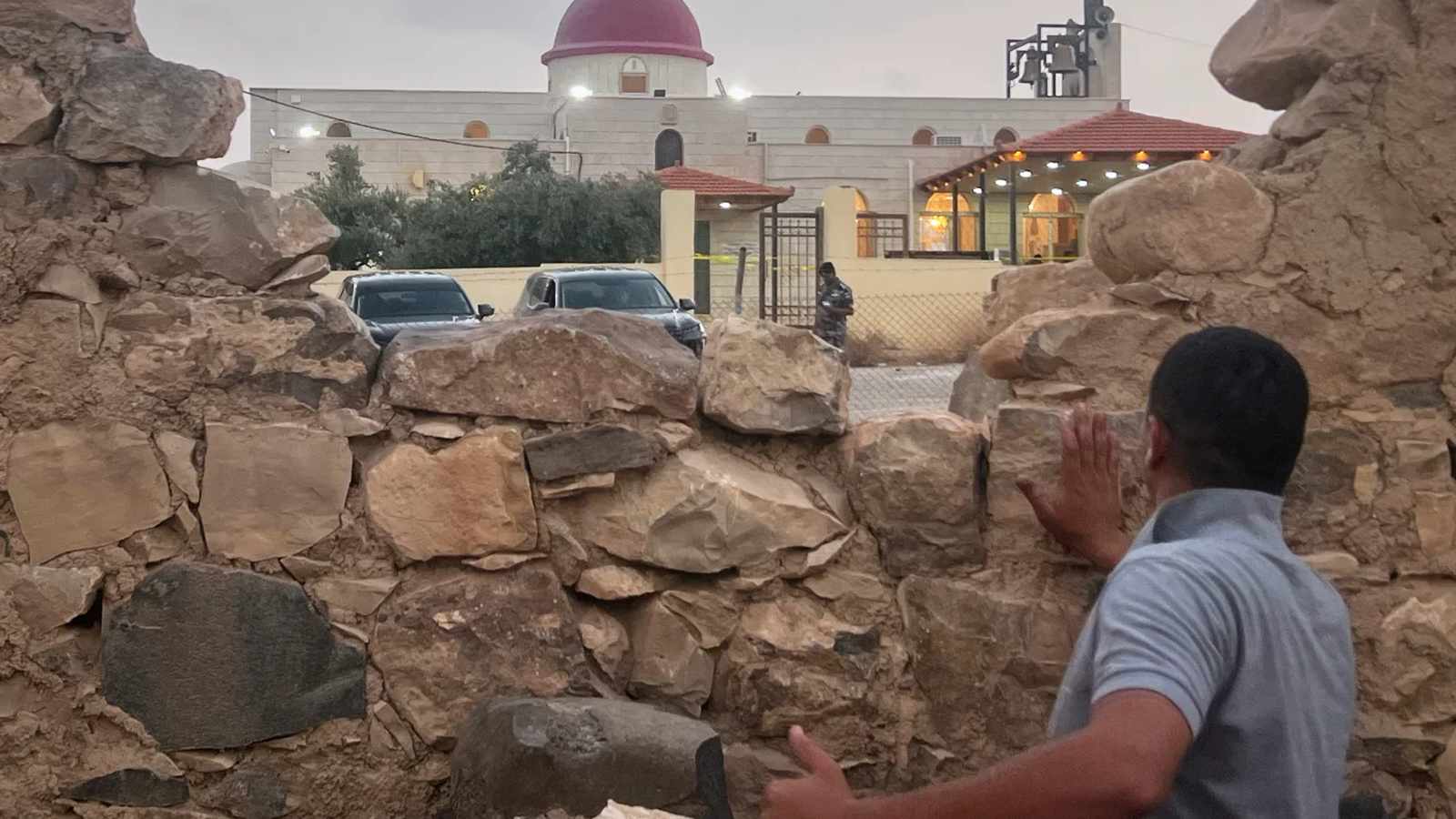
At least seven people were killed and 40 others wounded when armed attackers opened fire during a funeral service at a Greek Orthodox church in Jordan, NPR reported on Friday. The assault took place in Hamoud village within the Karak governorate, located approximately 90 kilometers (55 miles) south of the capital, Amman. Security forces and state authorities launched an urgent manhunt and investigation into the shooting, which targeted a minority Christian community gathering.
Surveillance footage broadcast on Jordanian state television captured the sequence of events outside the church. The video showed two apparent attackers approaching the building while armed with pistols, followed by a third individual carrying a semiautomatic rifle. All three suspects then advanced toward the church entrance before opening fire. Witness accounts from inside the building described scenes of immediate panic, with mourners attempting to take cover as intense gunfire erupted roughly 15 minutes after the funeral service commenced. Dorgham Halasa, a mourner present at the ceremony, recounted hearing heavy gunfire that sent attendees fleeing for safety. While some witnesses reported seeing up to four individuals involved, official security services have not yet confirmed the exact number of assailants.
Official Response and National Mourning
Following the attack, the Jordanian government declared three days of national mourning through the state-run Petra News Agency. King Abdullah II condemned the violence in a statement posted on social media, vowing that the kingdom would confront the terrorist act with the harshest legal penalties and visiting wounded survivors at Prince Ali Military Hospital. Prime Minister Jafar Hassan convened an emergency security meeting in Karak on Friday evening, characterizing the shooting as the product of blind extremism and terrorist ideology that requires strict legal countermeasures.
Healthcare officials confirmed that the wounded, numbering 40 people, were rushed to nearby medical facilities. Health Minister Ibrahim al-Budour stated that at least two of the injured individuals remained in critical condition. Security cordons were established around the church and surrounding streets as forensic teams collected evidence, including blood stains on the pavement and broken glass inside the sanctuary.
Regional Condemnations and Security Context
The massacre drew widespread international condemnation from across the Middle East and international bodies. Ahmed al-Tayeb, the grand imam of Al-Azhar in Cairo, denounced the incident as a heinous terrorist attack. Iraqi Foreign Minister Fuad Hussein contacted his Jordanian counterpart to express official solidarity, while United Nations Secretary-General Antonio Guterres issued a statement through a spokesperson condemning the violence and demanding accountability for those responsible.
The incident recalls previous security challenges in the region, most notably a 2016 series of attacks in Karak where gunmen ambushed police officers and tourists near the city’s historic Crusader castle, resulting in 10 deaths before security forces ended the standoff. Authorities have stated that ongoing investigations will determine whether the latest assault shares operational links with wider extremist networks.