


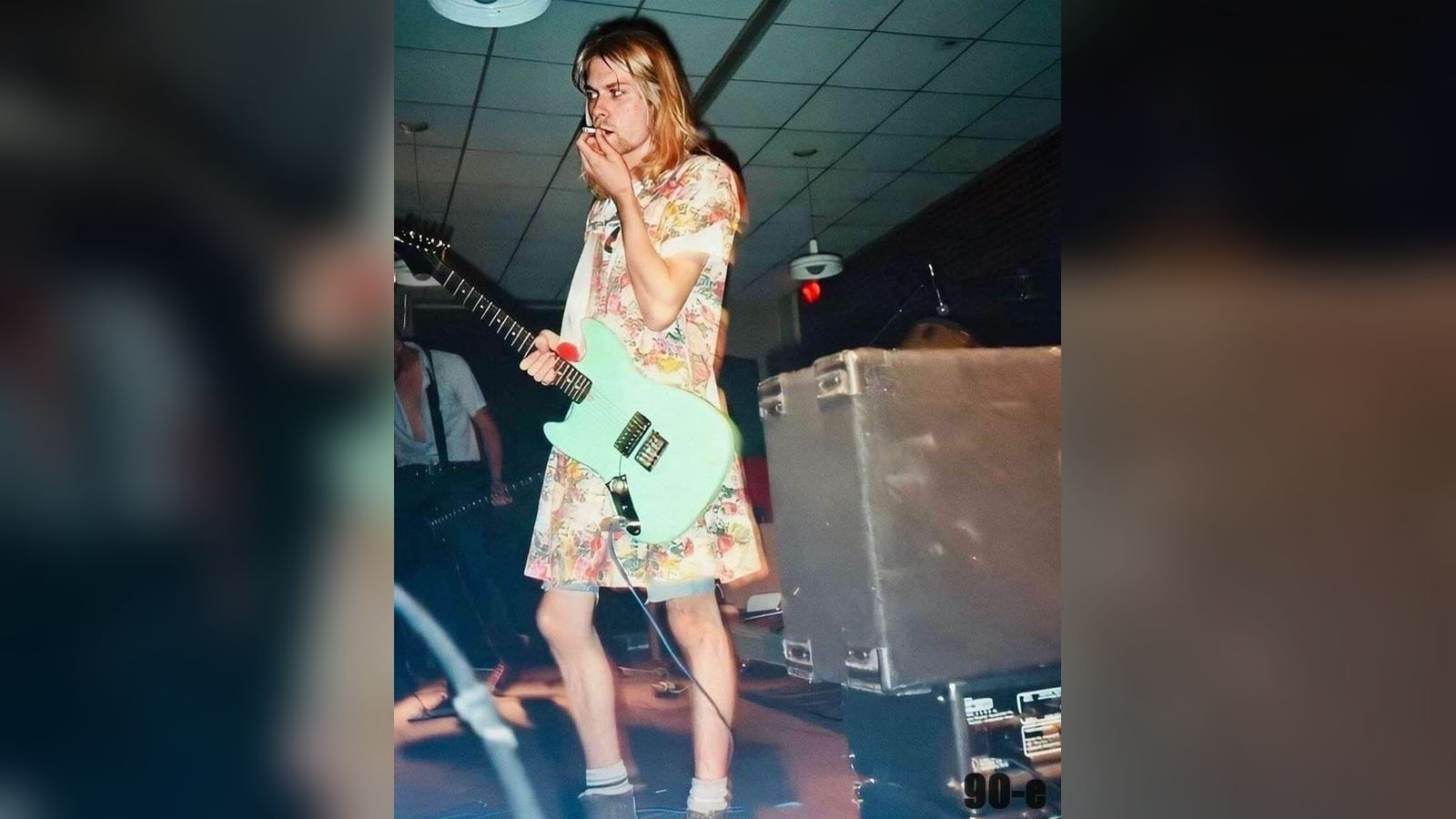
This photograph captures Kurt Cobain during a defining era of the Pacific Northwest underground, a moment when the Nirvana frontman used his rising visibility to challenge institutional sexism within the music industry. The image freezes an unpretentious yet resolute public stance, reflecting Cobain’s alignment with women-led musical collectives and the emerging riot grrrl movement. Through this frame, we examine not just a rock icon, but an artist actively confronting the exclusionary boys’ club mentality that dominated 1980s and 1990s rock culture. The visual anchor of the composition brings us face-to-face with a musician whose public persona was constantly negotiated between underground integrity and sudden mass celebrity.
What the photograph shows
The frame centers on Kurt Cobain, captured in a candid, unpolished setting characteristic of the independent punk circuit at the turn of the decade. His posture, casual attire, and intense gaze convey the raw authenticity that defined his early career before mainstream stardom reshaped his daily life. Visual observation reveals a musician completely detached from commercial gloss, immersed instead in the countercultural ethos of DIY spaces, fanzines, and underground advocacy. The background reflects the gritty, utilitarian spaces typical of regional club backstages, rehearsal rooms, and independent venues across Washington state where countercultural movements took root.
The moment behind the image
Taken around 1990, the photograph corresponds to a period of intense artistic and personal transformation for Cobain. Having recently recorded Bleach and begun collaborating with musicians like Tobi Vail of Bikini Kill, Cobain was deeply immersed in Olympia’s feminist punk circles. His relationships and friendships within these communities exposed him firsthand to the barriers female artists faced in booking shows, receiving press coverage, and navigating a male-dominated music press. This image encapsulates his vocal protests against discrimination and his insistence on sharing stages with groundbreaking female bands, challenging concert promoters and traditional audiences alike.
Photographer and provenance
While exact archival attribution for this specific frame often circulates within independent music histories and fanzine collections, it belongs to a vital body of visual documentation capturing the intersection of grunge and riot grrrl politics. Photographers working within the Pacific Northwest alternative scene during this era typically operated with minimal equipment, driven by documentation rather than commercial gain. The survival and circulation of such images speak to the enduring cultural archive preserved by fans, independent chroniclers, and archival researchers dedicated to the underground roots of alternative rock.
Historical context
By 1990, the underground music scenes of Seattle and Olympia were on the verge of a massive paradigm shift. Nirvana was transitioning from a regional Sub Pop act to a global cultural phenomenon, yet Cobain remained fiercely protective of his underground roots. He frequently used interviews, benefit concerts, and liner notes to champion underground female acts like L7, Babes in Toyland, and Bikini Kill. By speaking out against misogyny in punk and alternative spaces, Cobain challenged the mainstream rock tropes of machismo and alienation, directly confronting the very crowds that often misunderstood his message.
Why it still matters
Decades after its capture, this photograph remains a testament to an artist who refused to separate his art from his social convictions. Cobain’s early advocacy for female bands helped bridge the gap between underground feminist punk and mainstream alternative rock, inspiring generations of musicians to question industry norms. The image endures as a visual reminder of a complex frontman who used his brief time in the spotlight to elevate marginalized voices within rock and roll.