


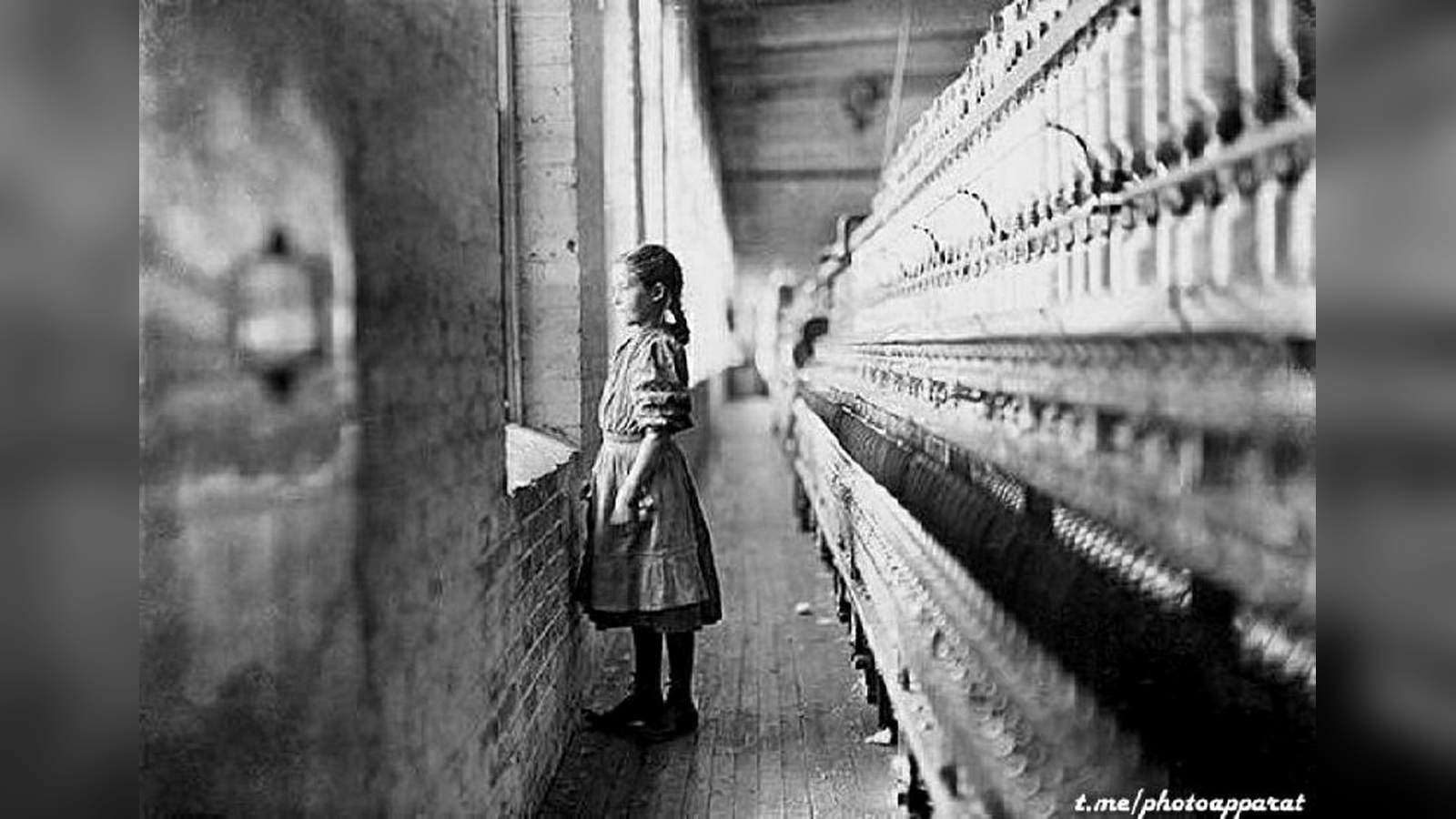
What the photograph shows
In this haunting 1908 photograph, a young girl—a ‘spinner’—stands amidst the mechanical chaos of the Whitnel Cotton Manufacturing Company in North Carolina. Her posture is deliberate, captured in a moment of stillness that feels suspended in time. She is positioned between the relentless, whirling bobbins of the textile machinery and a row of factory windows where natural light floods the frame. Her right hand, fingers curled, rests on the machinery, while her left hand is open on the windowsill. This composition creates a poignant visual metaphor of a child caught between industrial captivity and the distant, unreachable promise of freedom. Her clothing is shabby, reflecting the poverty that necessitated her presence in the mill, and her gaze, directed toward the photographer, carries a weight of resignation that belies her tender age. The lighting is crucial; the interior is dim, filled with the shadows of industry, while the window represents an external world she is effectively barred from inhabiting.
The moment behind the image
The photograph was not a candid snapshot but a carefully constructed scene. Lewis Hine, acting as a sociologist and photographer for the National Child Labor Committee (NCLC), frequently instructed his subjects to turn away from their labor to face his lens. In that brief moment, the repetitive, soul-crushing routine of her daily life was interrupted. Hine’s presence was a disruption. He was not merely recording a scene; he was creating a confrontation. The girl’s expression is one of coiled resignation; she understands her role in this ‘infernal machine’ is not merely a temporary chore, but a trajectory that threatens to consume her future. Before the shutter clicked, she was a cog in the machine; after, she became a symbol of a movement. The sound of the factory would have been deafening—a constant, rhythmic clatter of looms that made communication impossible, yet in this silent frame, the girl’s silence speaks volumes about the loss of innocence.
Photographer and provenance
Lewis Hine (1874–1940) was a pioneer of social documentary photography. A trained sociologist, he recognized that cold statistics were insufficient to move the American public. Commissioned by the NCLC to investigate the conditions of children in American factories, mines, and fields, Hine often had to use stealth and ingenuity to gain access to mills where owners strictly prohibited cameras. He would sometimes pose as a fire inspector, a Bible salesman, or a postcard photographer to get past the gates. His work was pivotal in shifting public perception, providing the ‘visual evidence’ that fueled the Progressive movement’s push for federal child labor laws. The provenance of this specific image is well-documented within the NCLC archives, now held by the Library of Congress. Hine’s meticulous notes, which often included the child’s age, the location, and the nature of their work, transformed these images from simple snapshots into rigorous sociological documents.
Historical context
At the turn of the 20th century, child labor was a pervasive reality in the United States. Hine’s photographs provided a shocking reality check for a public that had largely ignored the human cost of the Gilded Age industrial boom. By documenting children as young as ten working in humid tobacco fields or dangerous textile mills, Hine and the NCLC successfully mobilized public opinion. This era of reform was driven by thinkers like John Spargo, who in ‘The Bitter Cry of the Children’ argued that interrupting school with work caused lifelong impairment. Hine’s camera became the most potent weapon in this campaign, transforming abstract political arguments into visceral, impossible-to-ignore portraits of human suffering. The transition from woodblock illustrations in newspapers to the photographic evidence Hine provided marked a significant turning point in how Americans understood social injustice.
Why it still matters
The image remains a potent reminder of the fragility of labor protections. As contemporary legislatures in various U.S. states consider rolling back child labor laws—often citing economic necessity or the need for cheap labor—Hine’s work serves as a historical mirror. It challenges the viewer to look past the economic arguments and confront the human cost, reminding us that the exploitation of children is not a relic of the past, but a recurring threat that requires constant vigilance. In an age of digital saturation and AI-generated imagery, Hine’s authentic, direct connection to his subjects stands as a testament to the power of the camera to hold society accountable for its treatment of the most vulnerable. The girl in the window is not just a historical relic; she is a warning that progress is never guaranteed and that the rights of children are always subject to the pressures of profit.