


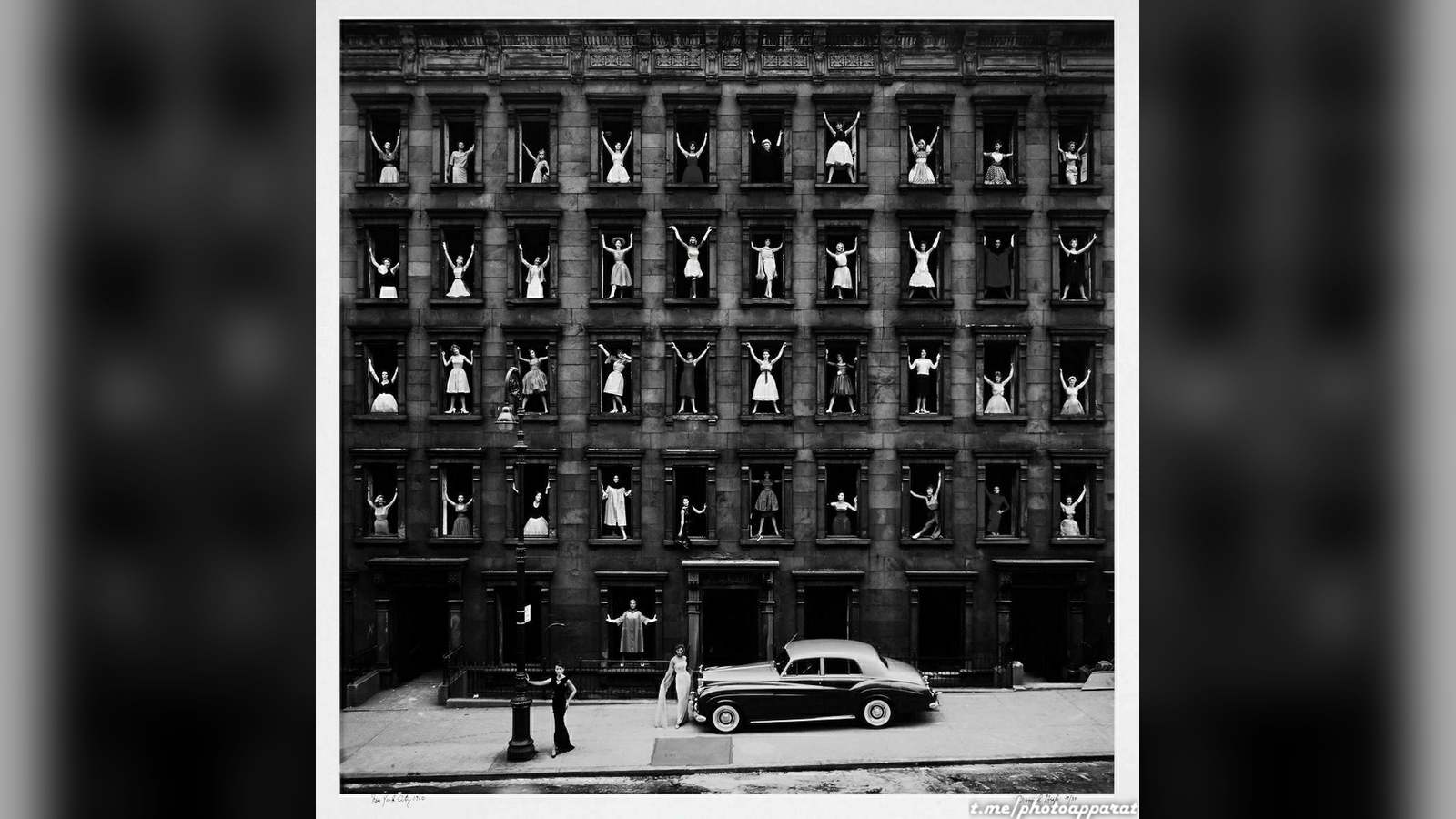
In this iconic 1960 photograph, forty women in vibrant, colorful outfits occupy the empty window frames of a classic Manhattan brownstone on East 58th Street. The building, stripped of its glass and sashes in preparation for its destruction, stands as a skeletal, temporary stage, while a vintage Rolls Royce parked on the street below anchors the composition. This image, titled Girls in the Windows, captures a fleeting moment of beauty, color, and poise against the grim backdrop of urban decay, immortalizing a structure that would be reduced to rubble just twenty-four hours after the shutter clicked. It is a work of art that bridges the gap between high-fashion editorial and raw, urban documentary.
What the photograph shows
The visual composition of the image is striking for its deliberate chaos and geometric precision. The facade of the brownstone serves as a grid, with each window acting as a frame for a distinct individual. The women are dressed in a spectrum of mid-century fashion—bold reds, yellows, blues, and patterns—that contrast sharply with the drab, weathered stone of the building. Below them, the street level is marked by the presence of a loaned Rolls Royce, adding a layer of high-fashion surrealism to what was essentially a construction site. The lighting, described as a fortunate “divine intervention” by the photographer’s son, provides a soft, even glow that avoids the harsh shadows typical of mid-day sun, lending the scene an almost dollhouse-like, ethereal quality. One observes the careful placement of subjects; some lean casually, others stand upright, creating a rhythm that guides the eye across five floors of the structure.
The moment behind the image
The photograph was the brainchild of American photojournalist Ormond Gigli. Looking out from his studio window, Gigli watched as demolition crews dismantled the neighboring brownstones. Seeing the empty, cavernous windows, he envisioned a living installation. With only two days until the building was leveled, Gigli acted with extreme urgency. He recruited models, friends, and even the wife of the demolition supervisor—who had requested her inclusion as a condition for removing the window frames—to fill the openings. The entire operation was a logistical tightrope walk; Gigli had to secure the building site, coordinate dozens of women, and ensure the safety of those posing on collapsing sills, all within the narrow window of the workers’ lunch break. He used a bullhorn from his second-story fire escape to direct the models, creating a scene that felt like a choreographed performance art piece.
Photographer and provenance
Ormond Gigli (1925–2019) was a seasoned professional, having served as a Navy photographer during WWII and later working for major publications like Life, Time, and Ladies’ Home Journal. For this shoot, he utilized a 4×5 Graflex camera for the color plates and a Hasselblad 500C for black and white. The image was not an assignment; it was a personal creative endeavor that Gigli later described as a “happening.” The provenance of the prints is unique; managed by his son, Ogden Gigli, the limited editions have been sold to collectors globally. The image’s popularity has surged in recent years as a symbol of 1960s chic, with some estimating the total sales value of the editions to be in the millions of dollars, challenging traditional notions of fine art scarcity.
Historical context and legacy
The image stands as a stark contrast between the decaying architecture of the past and the fresh, vibrant energy of the women posing within. It is often cited as one of the highest-grossing photographs in history, with hundreds of signed prints sold to collectors. Beyond its financial success, Girls in the Windows remains a testament to Gigli’s ability to turn a mundane construction site into a timeless piece of art. It captures a specific moment in New York history, a time of rapid urban change, and preserves it through a lens of whimsy and human connection. By inviting models to inhabit a dying building, Gigli gave it a final, glorious moment of life before the wrecking ball arrived, transforming a site of destruction into a gallery of human expression.
Why it still matters
Today, the photograph serves as a bridge to a vanished New York. The brownstones of the Upper East Side were rapidly being replaced by modern skyscrapers, and Gigli’s image acts as a visual eulogy for that architectural era. Its enduring appeal lies in its combination of high-fashion aesthetics and the gritty, real-world context of a building being torn down. It challenges the viewer to look past the surface of urban development and see the human stories—and the sheer audacity of artistic creation—hidden within the cracks. As the remaining prints become increasingly rare, the image continues to fascinate, proving that great photography is as much about the process and the story as it is about the final frame.