


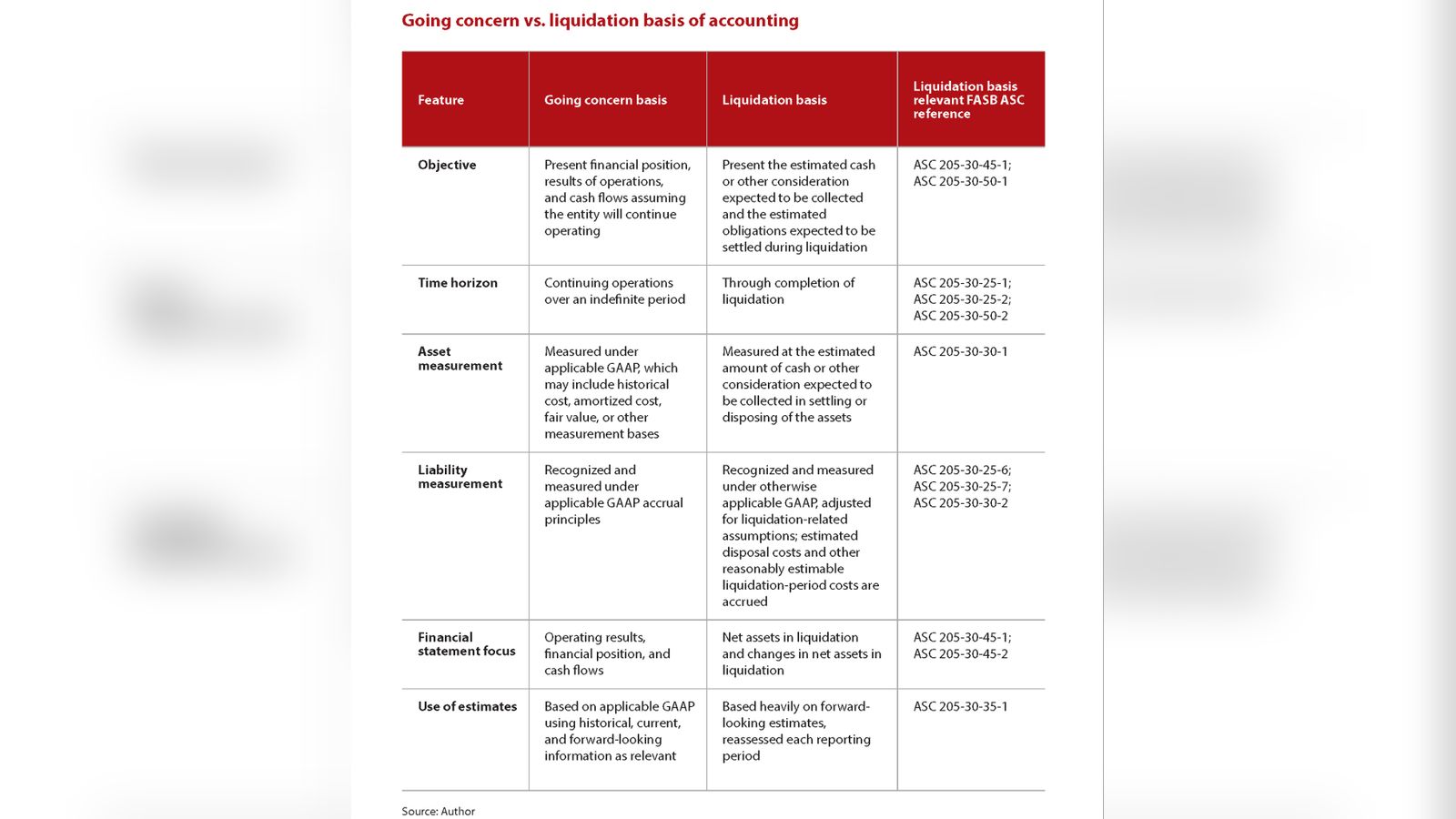
Although the firm remained solvent and liquid, insolvency actions involving foreign parents and affiliates created unsustainable operational risks. Once strategic alternatives failed, the board’s formal approval marked the exact trigger point for mandatory adoption of FASB ASC 205-30, Presentation of Financial Statements — Liquidation Basis of Accounting. Monthly reporting immediately pivoted from measuring operating performance to estimating realizable asset values and remaining liabilities.
Recognizing Imminence Under FASB ASC 205-30
Under FASB ASC 205-30-25-1, an entity must apply liquidation accounting when liquidation is imminent, unless the plan was specified in governing documents at inception. This is not an accounting policy election; meeting the criteria makes the transition mandatory. Guidance defines liquidation as imminent when an authorized plan is approved and the likelihood of execution blockage or a return from liquidation is remote.
Distinguishing liquidation from bankruptcy is vital. While certain bankruptcies result in liquidation, others allow reorganization and continued operations. In this financial services case, liquidation occurred outside formal bankruptcy through voluntary dissolution coordinated with foreign insolvency administrators after sales efforts stalled.
Recasting the Balance Sheet and Estimating Closure Costs
Under FASB ASC 205-30-30-1, assets are measured at estimated cash or consideration expected to be collected upon disposal. Fair value does not automatically apply to all assets. Marketable government securities were sold quickly to reflect expected sale proceeds, while intercompany receivables from affiliates in insolvency were measured using legal counsel and administrator recovery estimates.
Prepaid expenses were written off unless contractually refundable, and fixed assets like furniture and leasehold improvements were assigned zero liquidation value because disposal costs exceeded expected proceeds. Estimated disposal costs were accrued separately under FASB ASC 205-30-25-6.
FASB ASC 205-30-25-7 also requires accruing expected costs and income through the end of liquidation. Management built a comprehensive cost model covering severance, facilities obligations, vendor services, and post-liquidation tax compliance, working alongside U.S. legal counsel to address fiduciary duties and judgmental legal reserves.
Auditing Forward-Looking Estimates and Disclosures
External audit focus shifted from historical performance to the reliability of forward-looking estimates. Auditors scrutinized management’s assumptions, legal correspondence, and affiliate recovery documentation. Because small changes in assumptions materially affect net assets, robust disclosures under FASB ASC 205-30-50-2 became critical for explaining circumstances, measurement methods, and expected timelines to financial statement users.