


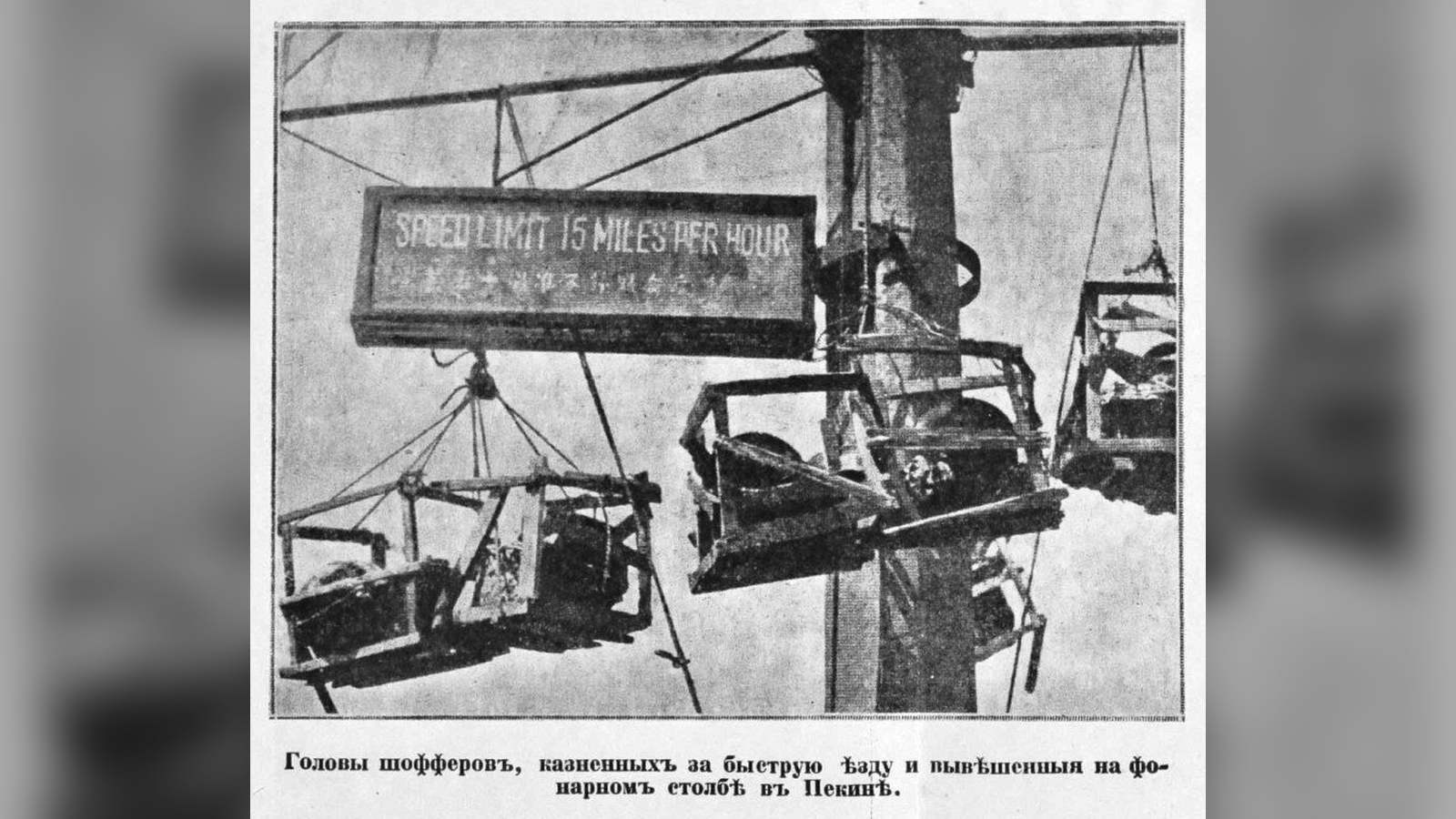
This stark historical photograph captures a man restrained in a heavy wooden cangue on a public street in China in 1928, serving a punitive sentence for speeding. Rather than facing a simple monetary fine, a brief administrative detention, or a standard court hearing, the offender is subjected to traditional public exposure, his head and hands firmly locked in the wooden frame while bystanders observe quietly in the background. The image freezes a fascinating transitional moment when early 20th-century urban modernization and motorized traffic collided directly with centuries-old penal traditions across East Asia.
What the photograph shows
In the center of the frame, an adult male stands outdoors, wearing traditional Chinese clothing of the period. His neck and wrists are firmly secured inside a large, weathered wooden cangue—a portable pillory historically used across China for public shaming and minor criminal sentencing. The background reveals an urban streetscape with indistinct buildings, dusty ground, and curious onlookers who pause to watch the spectacle. The lighting is bright daylight, casting sharp shadows that emphasize the rough texture of the wood and the physical vulnerability of the detained individual. Observers note the calm, almost resigned posture of the man, a psychological burden characteristic of public humiliation rituals designed to brand lawbreakers before their local communities. The visual composition places the offender squarely at the focal point, ensuring that every passing pedestrian and viewer of the subsequent photographic print confronts the immediate consequence of violating municipal ordinances.
The moment behind the image
During the late 1920s, China was undergoing profound social, political, and infrastructural shifts under the Nanjing decade of the Republic of China. As automobiles, trucks, and buses began to populate major cities and commercial hubs, municipal authorities scrambled to establish order on roads entirely unaccustomed to high-speed motorized vehicles. Speed limits were introduced to curb rising traffic accidents and pedestrian injuries. However, law enforcement often blended modern traffic regulations with traditional administrative punishments, utilizing public humiliation as an immediate and visible deterrent for reckless drivers. The seconds before the shutter click likely involved police officers guiding curious onlookers into place while the motorist was brought out for his scheduled duration of public exposure. The atmosphere surrounding the scene would have combined the curiosity of an impromptu urban gathering with the stern authority of local policing, capturing a fleeting intersection of routine law enforcement and theatrical deterrence.
Photographer and provenance
Photographs of this nature were frequently captured by foreign journalists, travelers, press agency photographers, or commercial postcard publishers operating in treaty ports and major Chinese urban centers. Western and Japanese media outlets avidly collected and published scenes depicting exoticized or unusual legal customs from Asia. Because many of these photographs were distributed anonymously or through early syndication agencies, the exact identity of the original camera operator remains lost to history, though the visual record survived in archival collections, missionary albums, and early pictorial magazines. The print’s survival relies heavily on the collecting habits of foreign residents who compiled visual albums of their time in East Asia, preserving moments that local authorities documented for administrative records or that foreign observers marketed as curiosities of a rapidly transforming society.
Historical context
The 1928 setting places this image in a volatile era defined by Nationalist consolidation, regional militarism, and rapid urbanization. While Western legal codes and modern police forces were gradually being adopted in urban policing, traditional methods of maintaining social order persisted side by side with new laws. Public shaming through devices like the cangue was designed to deter lawbreaking through community disgrace, a concept that clashed with modern penal reform movements yet remained effective in slowing down chaotic early traffic. As municipal police departments struggled to enforce newly minted vehicular statutes against wealthy car owners or commercial drivers, mixing traditional corporal shame with modern infractions offered an expedient, highly visible form of local deterrence. This juxtaposition reflects a society bridging two distinct epochs, where ancient punitive instruments were drafted into the service of contemporary municipal order.
Why it still matters
Today, this photograph serves as a powerful visual archive of cultural and technological transition. It documents the exact friction point where traditional governance met the unstoppable acceleration of the machine age. By freezing a moment of roadside justice from nearly a century ago, the image invites modern viewers to reflect on how societies have historically regulated public safety, punishment, and the responsibilities of travelers on shared roads. It remains an essential artifact for historians studying the social history of Republican China and the complex interplay between indigenous legal cultures and imported Western technologies, reminding us that every technological leap carries profound legal and social growing pains.