


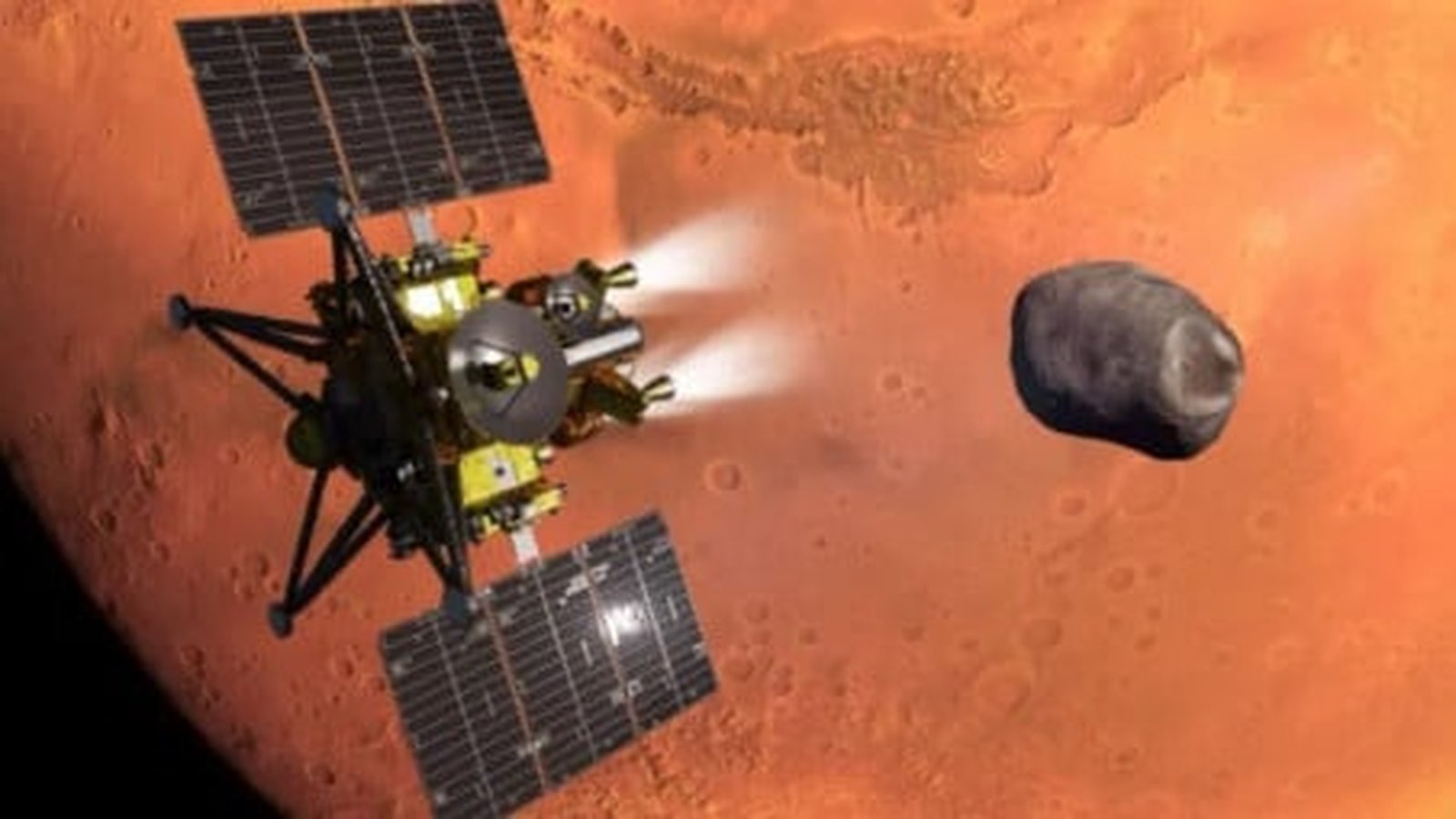
Japan is preparing to launch its Martian Moons Exploration mission toward Phobos. JAXA has scheduled liftoff from Tanegashima for October 20 at 04:41:03 Japan time—October 19 at 23:41:03 in Armenia. The mission aims to return samples from the Martian moon in 2031; launch and later milestones remain planned events.
Navigating Low Gravity and Orbital Complexities
Reaching and sampling Phobos presents immense engineering hurdles. Measuring roughly 20 kilometers across, the potato-shaped moon possesses extremely weak intrinsic gravity, yet it orbits in close proximity to Mars, a massive planetary body with immense gravitational pull. According to The Business Standard’s report of the mission plan, the mission design requires the spacecraft to first study Mars’ smaller moon, Deimos, before shifting focus to Phobos.
Once near Phobos, the spacecraft will deploy a small exploration rover—developed in partnership with French and German space agencies—to assess surface conditions and identify a stable landing zone. The main probe will subsequently touch down using a robotic arm and dual pneumatic and coring samplers to secure the material. Scientists emphasize that even a minute quantity of pristine dust is sufficient for advanced multi-lab analysis.
Unlocking Planetary Origins and Ancient Mars History
For decades, scientists have debated whether Phobos and Deimos formed roughly 4.5 billion years ago from debris ejected by a massive impact on early Mars, or if they represent captured asteroids from elsewhere in the solar system. Prof Sara Russell of the Natural History Museum, deputy for MMX sample analysis, notes that laboratory examination of the retrieved mineral composition will produce distinct results, helping distinguish the competing explanations.
Beyond the origin of the moons, researchers hope the samples will contain microscopic fragments of Mars itself. Because Phobos orbits so closely to the planet, historical meteorite impacts on the Martian surface may have blasted small grains into space, embedding them directly into Phobos’ regolith. This unexpected mechanism could provide unweathered Martian material free from Earth-based atmospheric contamination.
Scientific Stakes and Global Context
Dr Chrysa Avdellidou of Leicester University highlighted that individual grains can undergo multiple specialized studies, making every single gram scientifically invaluable. With arrival at the Martian system planned for August 2027, the global scientific community is watching closely to see if international collaboration can successfully overcome the technical boundaries of interplanetary sample return.