


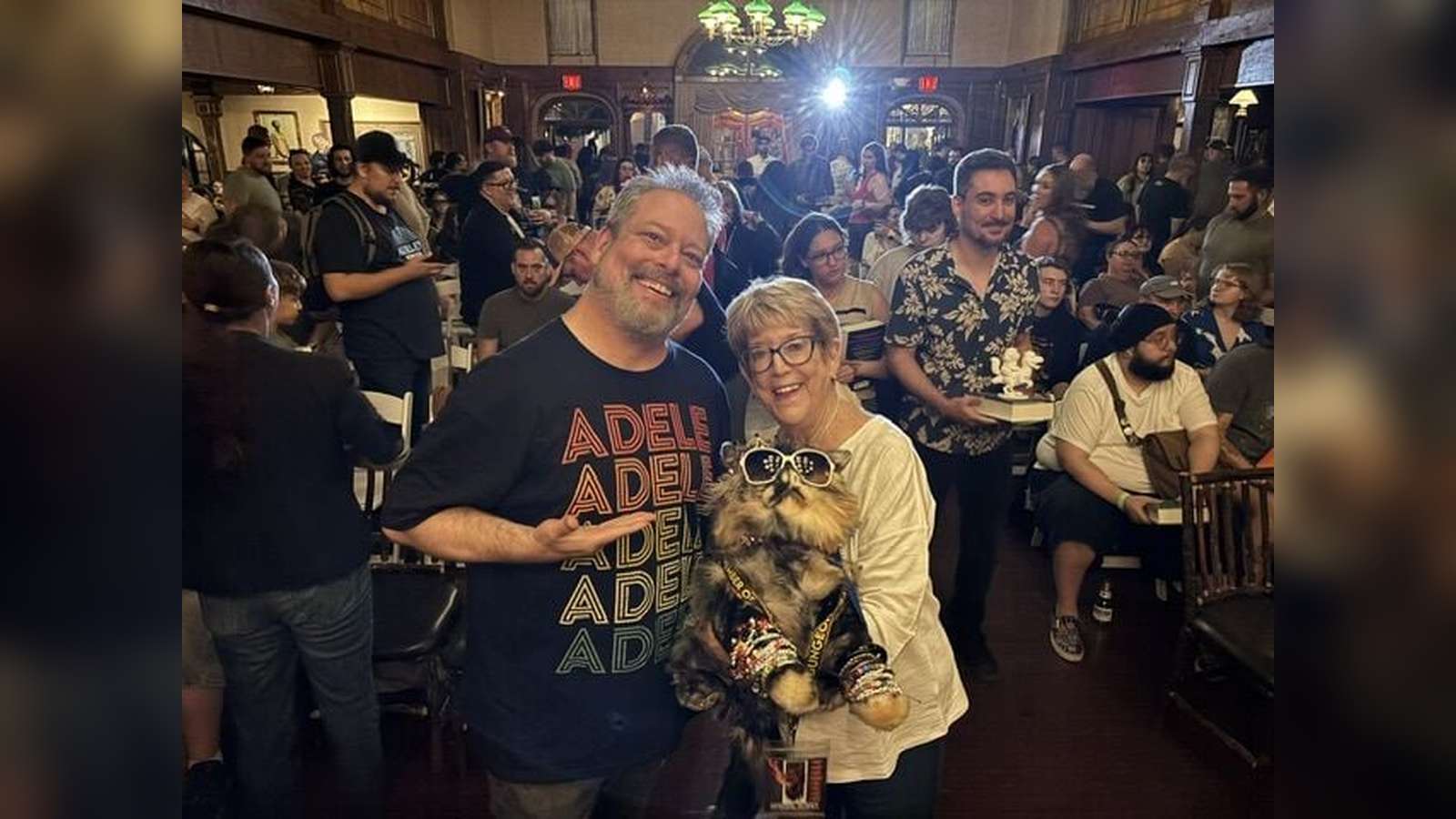
TUCSON — Fantasy author Matt Dinniman has achieved a milestone rare in modern publishing: crossing 10 million copies sold across a self-created universe that began as an unheralded web serial. His marquee series, Dungeon Crawler Carl, has evolved from an independently produced digital release into an international publishing juggernaut. As confirmed by local media reporting in Tucson, Arizona, Dinniman’s creation has now expanded far beyond the printed page into audiobooks, tabletop role-playing games, merchandise, and an active television adaptation in development.
Dinniman’s trajectory highlights a fundamental shift in how commercial fiction reaches global audiences. The series presents a darkly comedic narrative in which Earth is converted into a cosmic gladiatorial dungeon, forcing protagonist Carl and his ex-girlfriend’s award-winning talking cat, Princess Donut, to navigate deadly televised challenges. What began as a pandemic-era project after Dinniman lost his day-job income has transformed into one of the most commercially lucrative independent publishing success stories of the decade, capped by a mainstream partnership with publishing giant Penguin Random House.
The Decades-Long Apprenticeship
While the sudden explosion of Dungeon Crawler Carl can give the impression of an overnight phenomenon, Dinniman’s career rests on decades of quiet persistence. Raised in Tucson, where his family settled due to his father’s military career, Dinniman graduated from Sabino High School and began pursuing writing as a teenager. Though he attended the University of Arizona, he credits the writing program at Pima Community College as his primary creative crucible. For years, he balanced writing with various day jobs—including a stint at the Tucson Citizen—while publishing through small presses and literary magazines without breaking into mainstream commercial viability.
A turning point occurred around 2015, when Dinniman discovered LitRPG, an emerging fantasy subgenre that integrates video-game mechanics, leveling systems, and quest structures directly into literary prose. Crucially, Dinniman observed that authors within the genre were bypassing traditional literary agents and publishing houses by releasing work directly to readers. In 2017, he independently published Dominion of Blades. The debut earned more on its first day than his entire previous writing career combined, proving the viability of direct-to-consumer digital publishing and prompting him to master book packaging, digital marketing, and reader community management.
Pandemic Creation and Audio-Driven Expansion
The catalytic event for Dinniman’s career occurred during the COVID-19 pandemic. Faced with severe financial uncertainty after losing his day job, he began posting chapters of a new serial online. Dungeon Crawler Carl was launched independently via Amazon with minimal advertising capital, relying almost entirely on organic reader recommendations and online forum discussions to build traction. With each subsequent digital release, readership figures multiplied compounding sales momentum.
The growth trajectory sharply accelerated in 2021 following the launch of high-production audiobooks. The series’ fast-paced dialogue, comedic timing, and absurd action premises translated seamlessly into the audio format, capturing listeners who rarely purchased traditional fantasy titles. The rapid surge in popularity created an unexpected market dynamic: early self-published physical print runs, which originally saw modest sales, became scarce collector’s items, with early editions now trading for thousands of dollars on secondary markets.
Reshaping Reader Demographics and Industry Dynamics
Dinniman’s commercial success challenges long-held assumptions within the publishing establishment regarding reading habits. The series has demonstrated particular strength in converting non-readers and lapsed readers—specifically young men, a demographic traditional publishing houses frequently struggle to engage. By blending rapid gaming mechanics with grounded character dynamics and emotional stakes, the books have served as an entry point back into written fiction for thousands of consumers.
Addressing broader industry debates over the impact of digital popular fiction, romance, and online book communities on literary culture, Dinniman argues that accessible, highly engaging genre fiction acts as a gateway rather than a detriment. Online fandoms, character debates, and social media discussions around popular series create active reading communities that ultimately expand the overall market for books across genres.
Corporate Expansion and Institutional Impact
The scale of Dinniman’s self-built audience eventually compelled traditional publishing to step in on his terms. Penguin Random House secured a major distribution partnership to bring physical editions of Dungeon Crawler Carl into brick-and-mortar bookstores worldwide. Concurrently, the IP has expanded into a commercial franchise encompassing action figures, a pinball machine, a successful tabletop RPG, and crossover events with major sports franchises, such as the Colorado Avalanche’s official “Carl Night.” A Hollywood television series adaptation remains in active development.
Despite the commercial scaling, Dinniman faces new creative pressures, balancing the intense expectations of a million-strong fan base while managing the emotional weight of daily reader correspondence. Now planning a permanent return to Tucson to reconnect with family ahead of the birth of his first grandchild, Dinniman’s career stands as a textbook case study in modern publishing: leverage direct digital channels to build an unassailable audience, retain creative control, and let traditional institutions adapt to the movement.