


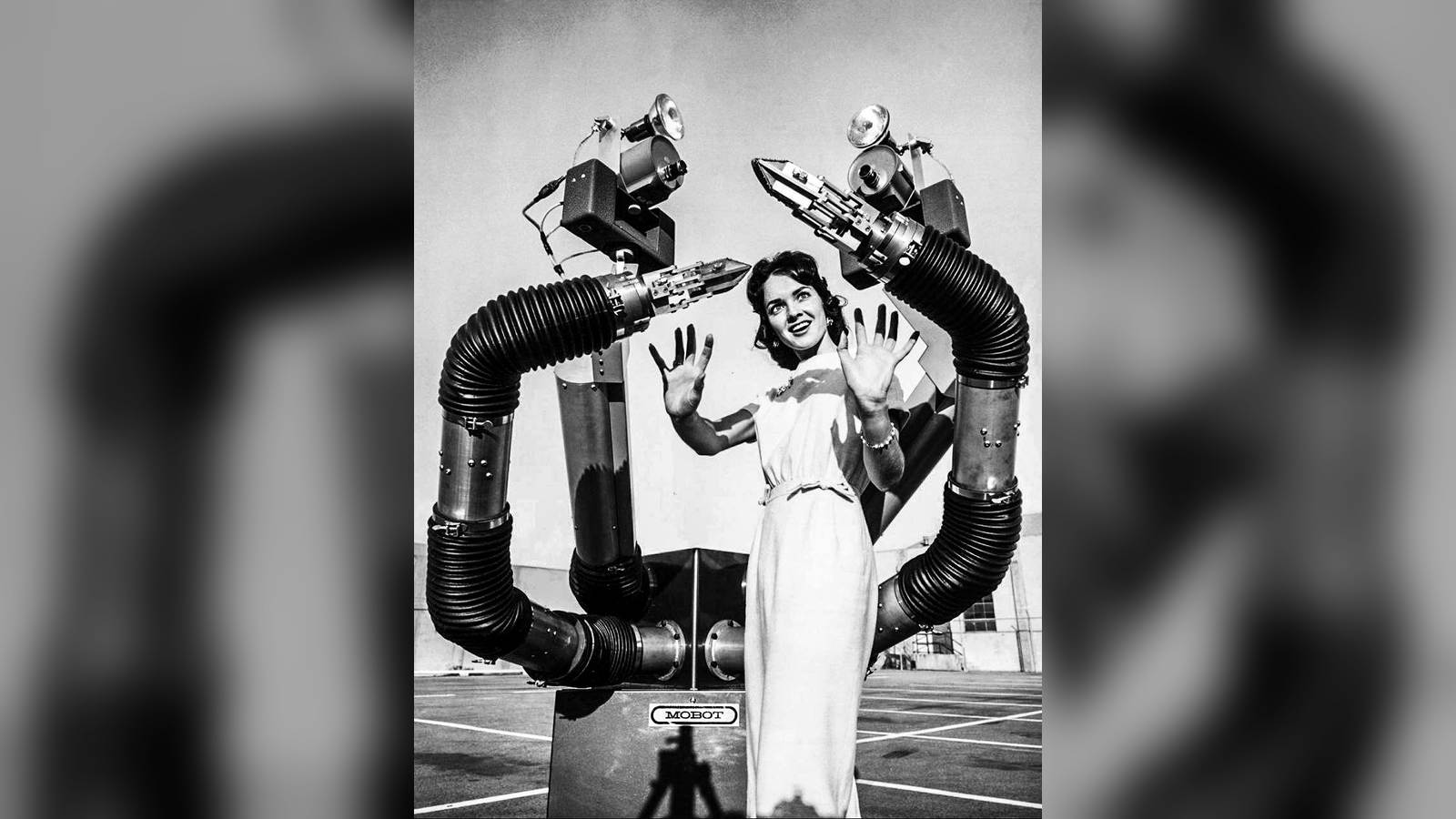
This photograph captures a moment of stark, mid-century technological ambition: the Mobot, a hulking, track-mounted machine, looms in a sterile, industrial-lit space. Its design is unmistakable for its time, reflecting a period when engineers believed that the future of automation lay in scale, durability, and raw mechanical power. With its long, multi-jointed arms ending in pincer-like grippers and a cluster of camera-sensors mounted atop its chassis like the eyes of a giant insect, the machine appears almost sentient, yet profoundly alien. The image, likely taken in 1964, freezes the Mobot in a moment of stillness, inviting the viewer to contemplate a time when the mere existence of a remote-controlled robot was a marvel of the modern age.
What the photograph shows
In the frame, we see the Mobot as a heavy-duty sentinel. The machine is mounted on robust metal tracks, suggesting its intended use in uneven or hazardous terrain. Its most prominent features are the two long, hydraulic-actuated arms, which are articulated in a way that mimics human reach but with a strength and cold precision that no human could possess. The ‘head’ section, equipped with optical sensors, gives the machine an anthropomorphic quality, which likely contributed to its nickname. The lighting in the photograph is typical of mid-60s industrial photography—sharp, high-contrast, designed to emphasize the metallic texture and complex geometry of the robot’s frame. The surrounding space is sparse, focusing all attention on the mechanical complexity of the device itself.
The moment behind the image
The Mobot—a portmanteau of ‘Mobile Robot’—was developed by the Hughes Aircraft Company, a titan of the aerospace and defense industry during the Cold War. The machine was not intended for factory floors or consumer use; it was built for the nuclear era. As research into atomic energy expanded, so did the need for machines that could perform maintenance, cleanup, and material handling in environments that were lethal to human workers. This photograph was likely taken during a promotional event or a press demonstration intended to showcase Hughes’s engineering prowess to government contractors and the public. The ‘Magnificent Monster’ moniker, bestowed by journalists of the time, reflects the dual nature of the public’s perception: a mixture of genuine awe at the machine’s capabilities and a lingering, science-fiction-fueled trepidation regarding autonomous technology.
Photographer and provenance
The specific photographer of this image remains uncredited, a common trait for corporate promotional photography of the 1960s. Such images were usually the output of in-house media departments at Hughes Aircraft, intended for distribution to trade magazines, newspapers, and scientific journals. These photos were carefully curated to project an image of American technological dominance. While the identity of the person behind the shutter is lost, the provenance of the image is firmly rooted in the corporate archive of Hughes, reflecting a time when the company was at the forefront of tele-robotics and aerospace innovation. The photograph has since been preserved in various retro-futurist archives, serving as a visual touchstone for the era’s optimism.
Historical context
The 1960s were a pivotal decade for robotics. Before the advent of microprocessors and sophisticated AI, robotics was defined by heavy hydraulics, complex cable management, and human operators who were often tethered to remote control consoles. The Mobot was a pioneer in the field of tele-robotics, bridging the gap between simple, manually operated cranes and the autonomous, software-driven systems we recognize today. It was an era when engineers believed that the future of labor would be dominated by massive, specialized machines capable of performing any task, provided they were sufficiently reinforced. The Mobot represents the ‘mechanical’ roots of the industry, a time when progress was measured in pounds of steel and the length of a hydraulic arm.
Why it still matters
Looking at the Mobot today, we see the direct ancestor of modern industrial automation. While contemporary robotics has shifted toward miniaturization, soft robotics, and machine learning, the Mobot reminds us of the persistent human desire to remove ourselves from dangerous or repetitive tasks. Whether it is a 1964 nuclear-cleanup bot or a modern AI-powered testing platform, the core objective remains unchanged: to automate the un-automatable and safeguard human life. This photograph is not just a relic of the past; it is a testament to the foundational logic of the robotics industry, which continues to evolve as we strive to create machines that can seamlessly navigate the complexities of our world.