


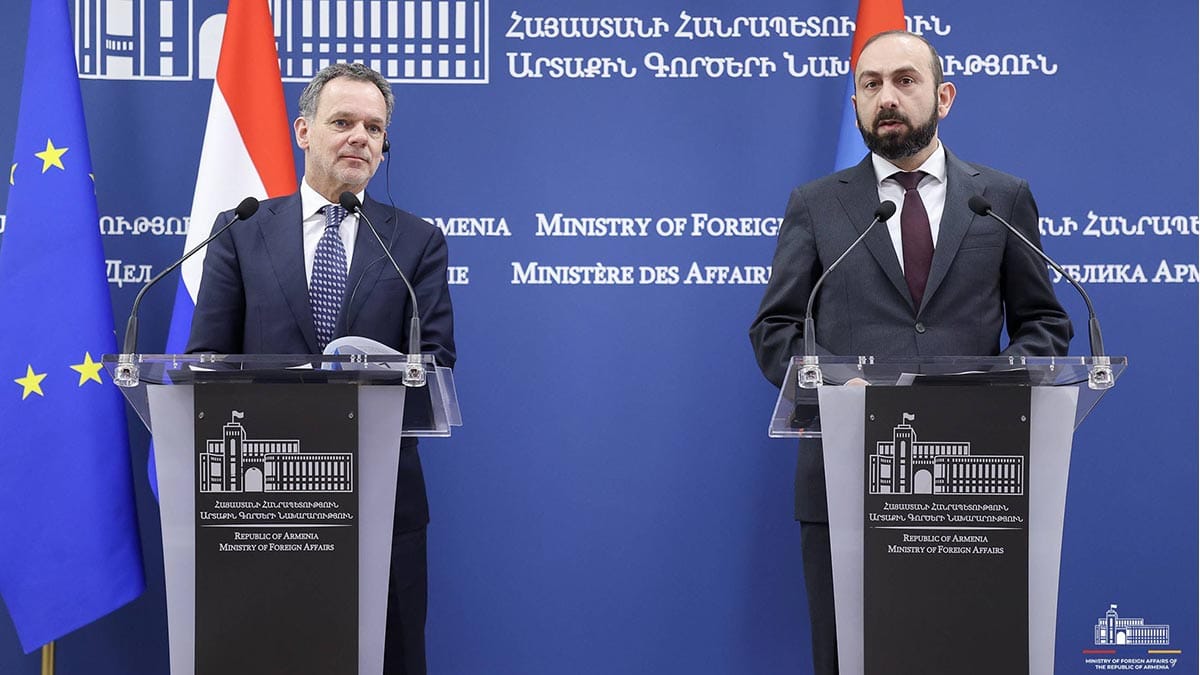
Quick Read:
- Dutch FM Kaspar Veldkamp visited Yerevan, signing Strategic Partnership Declaration with Armenian FM Ararat Mirzoyan.
- Dutch FM expressed concern over instability around Armenia, offered support to reduce dependence on Russia.
- Veldkamp highlighted steps towards Armenia-Azerbaijan peace, offered to facilitate Yerevan-Ankara dialogue.
- Minister warned about potential impact of Russian disinformation to strain Armenia-Azerbaijan relations.
- Declaration covers broad cooperation: political dialogue, economic & security sectors, people-to-people contacts, culture.
Yerevan became the venue for a significant event on March 12, as Armenian and Dutch Foreign Ministers, Ararat Mirzoyan and Kaspar Veldkamp, met and signed a Joint Declaration on Strategic Partnership between the Republic of Armenia and the Netherlands. This step marks the beginning of a new phase in bilateral relations, emphasizing a commitment to long-term cooperation based on mutual respect and shared values. Key discussion points during the meeting encompassed not only the bilateral agenda but also regional security issues, particularly the establishment of peace and stability in the South Caucasus, and ways to counter hybrid threats.
Instability Around Armenia and Reducing Dependence on Russia
Dutch Foreign Minister Kaspar Veldkamp, during a press conference, voiced concern regarding the instability surrounding Armenia, identifying it as one of the primary challenges to regional security. He emphasized the Netherlands’ vested interest, as an active EU member, in the peaceful and prosperous development of the European neighborhood and offered the Netherlands’ readiness to assist Armenia in reducing its dependence on the Russian Federation, which he described as a key element of regional instability. This statement can be seen as the EU’s willingness to activate its role in the South Caucasus and support efforts aimed at strengthening regional security.
Dialogue Between Yerevan and Baku, Yerevan and Ankara
Kaspar Veldkamp positively assessed the steps taken by Armenia and Azerbaijan towards establishing peace, while highlighting the importance of continued dialogue. The Dutch Foreign Minister also expressed readiness to facilitate dialogue between Yerevan and Ankara, which, as mentioned, was also discussed during his meeting with Turkish representatives. Veldkamp expressed hope that the parties would demonstrate political will to make progress in normalizing relations. In this context, the EU can potentially act as a mediator and contribute to fostering regional dialogue, aiming to achieve lasting peace.
Hybrid Threats and Russian “Fakes”
Addressing contemporary challenges, the Dutch Foreign Minister drew particular attention to hybrid threats, specifically mentioning the potential impact of Russian disinformation on Armenia. According to Veldkamp, Russian “fakes” could be aimed not only at worsening Armenia’s relations with Ukraine and other countries but also at fueling tensions in Armenia-Azerbaijan relations. This underscores the necessity of strengthening cybersecurity and information resilience to maintain the stability of democratic societies. The focus on hybrid threats highlights a growing concern within the EU regarding external interference and the importance of safeguarding democratic processes and information integrity.
Strategic Partnership Declaration: A New Foundation for Cooperation
The Joint Declaration on Strategic Partnership between the Republic of Armenia and the Netherlands, signed in Yerevan, outlines the main directions of bilateral cooperation. The document covers a wide range of areas of collaboration, including political dialogue, regional and international cooperation, economic ties and infrastructure development, security cooperation in cybersecurity and countering hybrid threats, as well as people-to-people contacts and culture. The signing of the declaration testifies to the political intention of the governments of Armenia and the Netherlands to deepen bilateral relations and work together to address regional and global challenges, setting a new foundation for enhanced partnership and cooperation.