


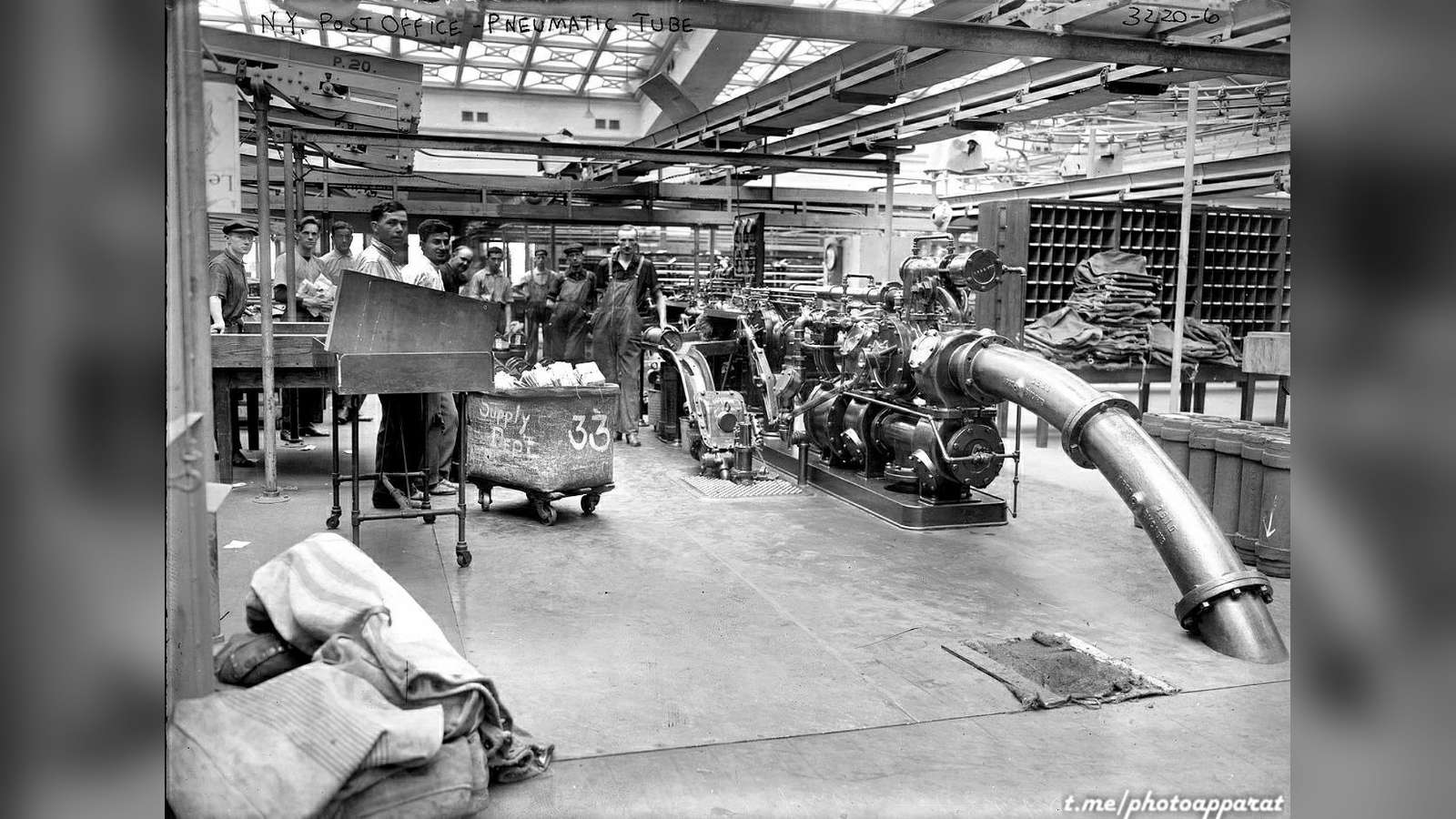
This 1914 photograph captures a rare, intimate look at the bustling nerve center of New York City’s pneumatic mail system. In the frame, we see a complex, industrial workspace where human labor meets mechanical precision. On the right side of the image, the iconic 9-kilogram steel cylindrical containers—the workhorses of this subterranean network—are stacked in anticipation of their next journey. The operators, dressed in the utilitarian clothing of the early 20th century, stand amidst the heavy iron machinery, their postures reflecting the disciplined, repetitive nature of a system that functioned like a mechanical heartbeat beneath the city’s surface. The image is not merely a record of a workplace, but a testament to an era when the physical movement of information was a high-stakes, high-pressure industrial endeavor.
What the photograph shows
The visual composition of the image is dominated by the contrast between the rigid, circular forms of the steel mail carriers and the chaotic, mechanical clutter of the terminal. The tubes themselves, which disappear into the walls and floors, are the silent protagonists. These cast-iron arteries were buried between 4 and 18 feet below the street level, sometimes running above the subway tunnels, other times beneath them. The image captures the sheer physicality of the service; it was not a digital or ethereal process, but a heavy, noisy, and high-pressure operation that required constant human intervention to maintain the vacuum and pressure needed for transit. We can observe the specific tools of the trade: the levers used to switch the routing of the canisters, the pressure gauges monitoring the flow of compressed air, and the sheer volume of mail containers stacked like artillery shells, ready to be fired across the city.
The moment behind the image
Taken in 1914, the photograph depicts the system at its mid-life maturity. By this time, the Tubular Dispatch Company had integrated its lines into a sophisticated network that connected the main postal building to various substations across Manhattan and Brooklyn. The moment captured here is one of relative normalcy—the quiet before the next batch of letters was loaded into the tubes. It was a time when the city was obsessed with speed; as Senator Chauncey Depew famously stated, the pneumatic tube was a “howling success” because it offered a multiplication of power for the busy urbanite. The workers in the frame were part of a specialized workforce that had to navigate not just the mail, but the technical breakdowns, moisture issues, and mechanical clogs that plagued the network. They were the unsung heroes of the “Saturday afternoon Grunters,” teams who would literally listen to the pipes to locate leaks, a process as archaic as it was brilliant.
Photographer and provenance
While the specific photographer remains uncredited in the surviving archival record, the image belongs to the era of industrial documentation common in the early 1900s. Such photographs were often commissioned by the Post Office or private entities like the American Pneumatic Service Company to demonstrate efficiency to Congress and the public. The archival survival of this image is significant because it provides a visual anchor for a system that has largely been erased from the modern New York landscape. It is a testament to the era of “techno-optimism,” where infrastructure was seen as a way to conquer the friction of distance. The lack of a specific attribution is common for this type of industrial photography, which was intended as functional documentation rather than art, yet the quality of the composition suggests a professional hand capturing a moment of civic pride.
Historical context
The pneumatic mail system in New York was a massive, privately-owned venture that the federal government contracted to handle the city’s growing mail volume. It was not merely a local curiosity; it was a critical piece of national infrastructure. From 1897 to 1953, the tubes carried millions of letters. The system was frequently embroiled in political controversy, most notably under Postmaster General Albert Burleson, who viewed the tubes as an “incubus” on the public purse. The tension between private contracting and government efficiency, which is visible in the very existence of this terminal, remains a relevant theme in political history today. The system was a victim of its own success and the rapid rise of the automobile, which eventually made the expensive, maintenance-heavy tubes appear redundant to officials like Arthur Summerfield.
Why it still matters
The photograph serves as a bridge to a lost vision of the future. In the early 20th century, the pneumatic tube was the ultimate symbol of modern efficiency, a precursor to the digital connectivity we take for granted today. When the system was finally shut down in 1953, it was because the automobile had made it obsolete. Yet, looking at this image, one is struck by the ingenuity of the design. The tubes remain under the streets of New York, a dormant skeleton of an older, more mechanical age. This image forces us to look closer at the history of urban innovation, reminding us that every “modern” solution eventually becomes a historical artifact, waiting to be rediscovered by future generations. It serves as a reminder that the logistical problems of the 1910s—congestion, speed, and the cost of infrastructure—are perennial challenges that define the urban experience.