


NOAA Reports Strengthening Pacific Warming
The National Oceanic and Atmospheric Administration (NOAA) Climate Prediction Center has issued a new diagnostic report indicating an 81% probability that the current El Niño event will reach ‘very strong’ or ‘Super’ status between October and December 2026. Data released on July 9 confirms that the event is intensifying, with a 97% chance of persisting through early spring 2027.
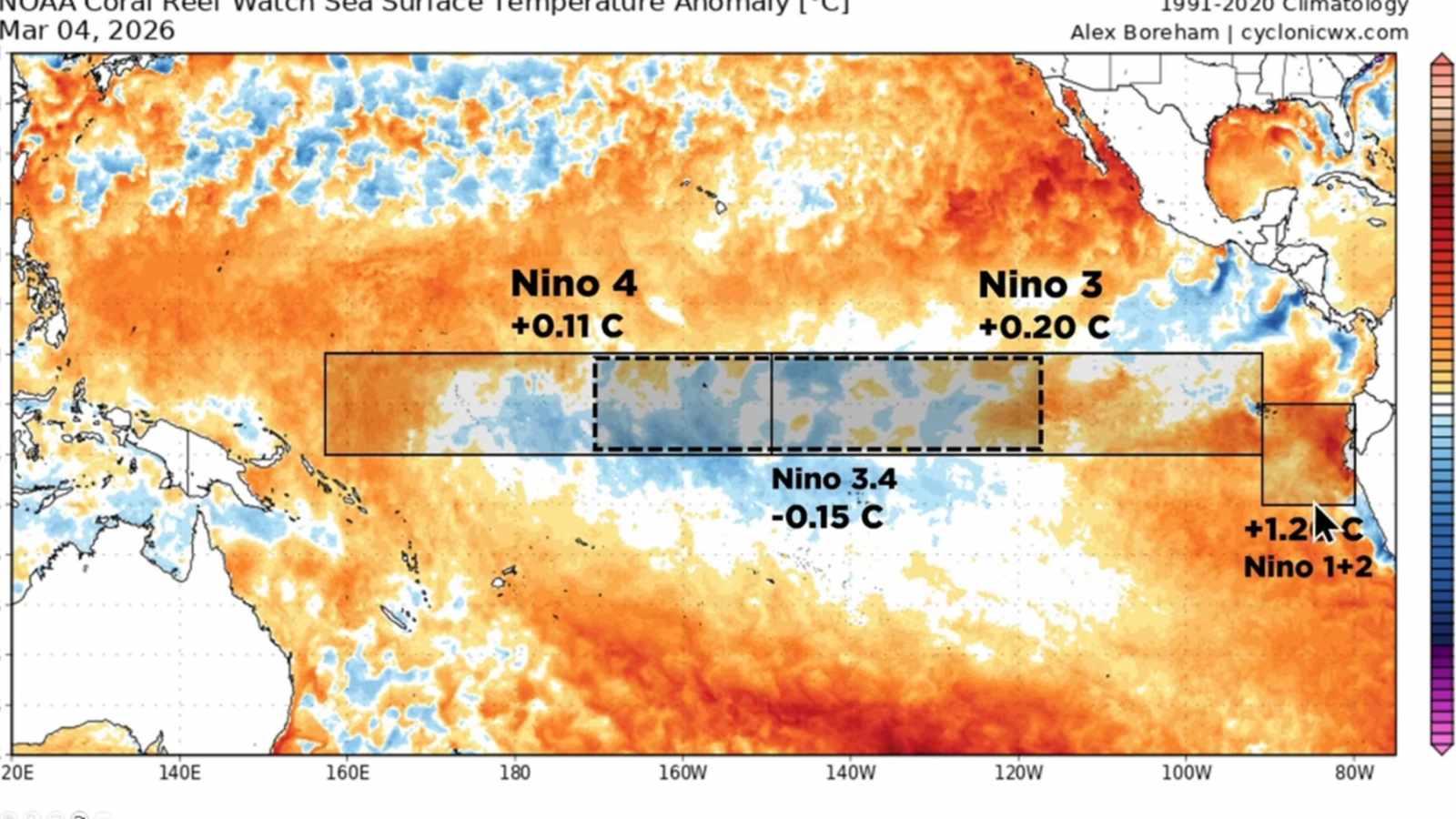
Sea surface temperatures in the equatorial Pacific have shown consistent warming, with the weekly Niño-3.4 index reaching +1.2°C. Further east, the Niño-1+2 region has recorded anomalies as high as +2.7°C. Scientists attribute this to a combination of a deepening thermocline and strong atmospheric coupling, evidenced by low-level westerly wind anomalies across the central Pacific.
Historical Stakes and Regional Impacts
Meteorologists note that while ‘very strong’ El Niño events—such as those in 1982-83 and 1997-98—often correlate with significant precipitation increases in regions like California, historical data is not a guarantee of specific outcomes. Of the seven major events recorded since 1950, impacts have varied significantly, influenced by other climate drivers like the Pacific Decadal Oscillation.
The current warming is not limited to the tropics; the North Pacific off the California coast recently recorded its warmest June in 177 years. This ambient heat, combined with El Niño, is expected to increase the frequency of monsoonal moisture surges and tropical cyclone activity, heightening risks for wildfires and flooding.
The Geoengineering Debate
As the potential for record-breaking weather extremes grows, researchers are exploring experimental mitigation strategies. A study led by the Scripps Institution of Oceanography is investigating ‘marine cloud brightening’—a form of solar geoengineering where particles are introduced to clouds to increase their reflectivity and cool the ocean surface.
However, the scientific community remains divided. While models suggest potential cooling benefits, experts like SIUE weather specialist Alan Black caution against the risks of large-scale, irreversible atmospheric interventions. The infrastructure required for such projects does not currently exist, and the ethical and ecological implications of manipulating global weather systems remain a subject of intense debate among climate scientists.