


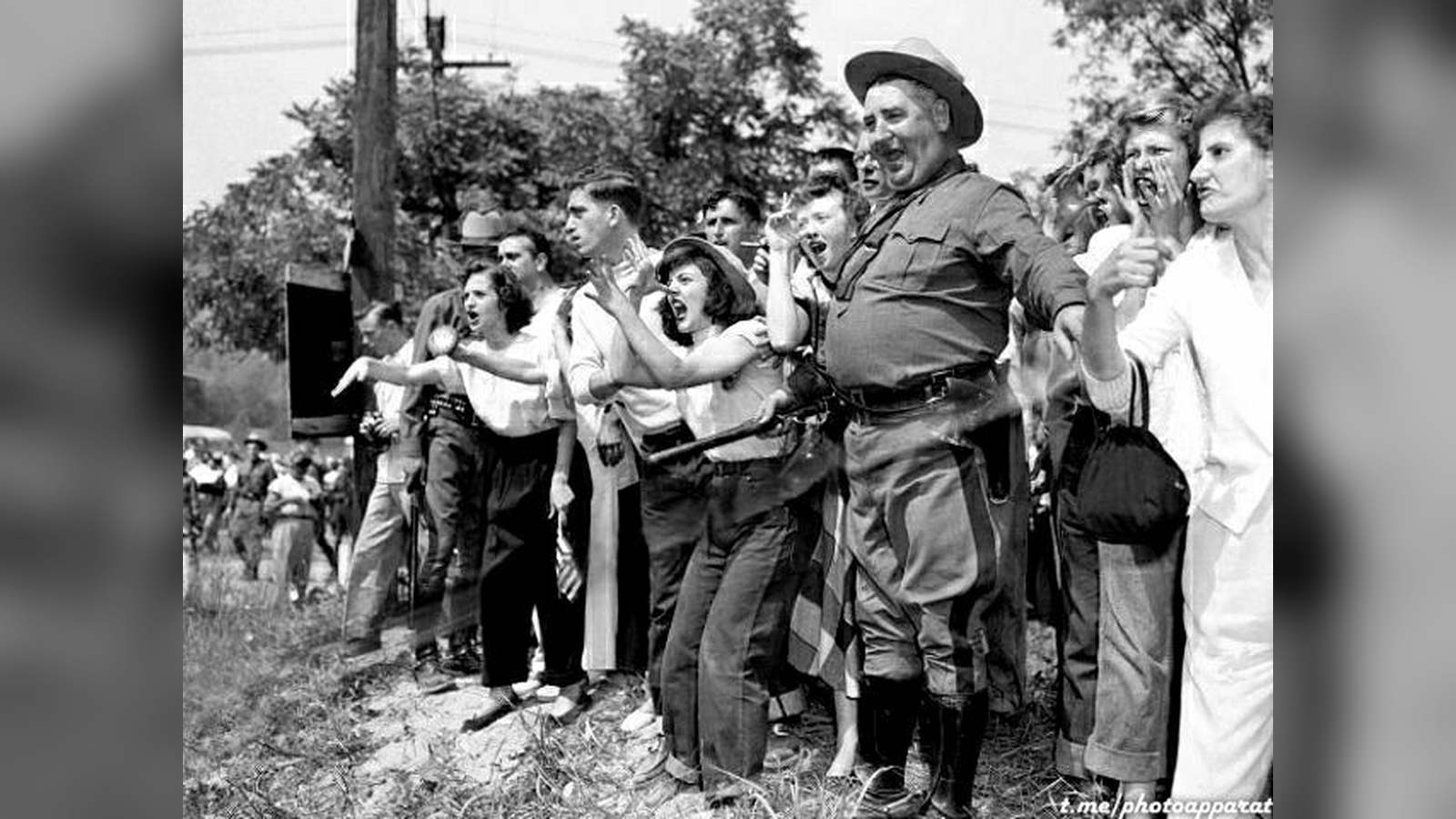
This stark, black-and-white photograph captures a moment of raw, unvarnished hostility: a crowd of white men, their expressions contorted with anger, standing on the outskirts of Peekskill, New York, in August 1949. They are not merely observers; they are an organized force of intimidation. This image freezes the instant when the simmering tensions of the early Cold War erupted into overt racial and political violence, serving as a chilling reminder of the opposition faced by Black civil rights leaders during the McCarthy era. The men in the frame, some wearing hats and casual shirts of the period, appear to be shouting, their bodies tensed for confrontation, illustrating the visceral nature of the hate that defined the Peekskill events.
What the photograph shows
Looking closely at the frame, we see a sea of faces that reflect a singular, focused rage. The composition is tight, emphasizing the density of the mob. You can discern the variety of ages among the men—some older, perhaps veterans of World War II, others younger—all united in a common purpose: to prevent a Black man from speaking and singing in their community. Their posture is aggressive; some are pointing, others are mid-shout, their mouths open in vitriol. The background is blurred, suggesting the chaos of the scene, but the foreground is sharp enough to reveal the individual features of those participating in the intimidation. This is not a spontaneous gathering; it is a tactical deployment of bodies meant to signal that certain spaces are off-limits to those who challenge the status quo.
The moment behind the image
The photograph documents the atmosphere of terror that surrounded the August 27, 1949, concert featuring the legendary Paul Robeson. Robeson, a globally renowned bass-baritone and outspoken advocate for civil rights and labor, was scheduled to perform at Lakeland Acres. The event was intended to benefit the Civil Rights Congress, but it never took place. As concertgoers arrived, they were met by hundreds of protesters—members of the American Legion and other veteran groups—who had gathered to physically block the entrance. The mob, armed with clubs, brass knuckles, and rocks, turned the site into a battlefield, forcing the cancellation of the performance. The photographer, whose identity is often lost in the archives of mid-century news agencies, captured the crowd at the precise moment of their mobilization, effectively documenting the shift from a local protest to an act of domestic terrorism.
Photographer and provenance
While specific attribution for this individual frame is often debated due to the chaotic nature of the riots, it is widely circulated as part of the visual record of the 1949 Peekskill events. These images were typically captured by wire service photographers—such as those from the Associated Press or local newspapers—who were on assignment to cover what had been billed as a controversial performance. The working conditions were dangerous; reporters and photographers were frequently targeted by the mob alongside the concertgoers. The survival of these images in modern archives is a testament to the importance of the press in documenting the reality of the riots, which local officials initially attempted to minimize or blame on the victims themselves. The lack of a single, definitive “named” photographer for every frame of the riots speaks to the sheer volume of media presence required to document such a significant, albeit suppressed, historical event.
Historical context
The violence in Peekskill was fueled by a toxic mixture of anti-communism and virulent racism. Robeson, who had been targeted by the House Un-American Activities Committee for his left-wing politics, became a lightning rod for those who conflated civil rights activism with subversion. When a second concert was organized for September 4, 1949, 25,000 supporters arrived to defend the right to assemble. Despite a massive union-led security effort and a heavy police presence, the mob attacked attendees as they left the meadow, resulting in over 145 injuries and widespread destruction of property. Witnesses described the aftermath as a scene of broken glass and blood, with families forced to flee under a barrage of stones and bottles. The event was a watershed moment that exposed the fragility of civil liberties in the face of organized, state-sanctioned bigotry.
Why it still matters
For decades, the Peekskill Riots were relegated to the shadows of American history. The legal system largely failed the victims; lawsuits filed by those injured were dismissed, and no members of the mob were ever held accountable for the violence. Today, the image serves as a grim artifact of a time when the mere presence of a Black voice for equality was viewed by many as a threat to be silenced by force. It challenges us to look closely at the faces in the crowd and consider the enduring legacy of the struggles for justice that Robeson fought for in the face of such overwhelming hatred. The story of Peekskill is not just a relic of 1949; it is a fundamental chapter in the long, ongoing struggle for civil rights in America, reminding us that the preservation of democracy requires constant vigilance against the forces of exclusion.