


What the photograph shows
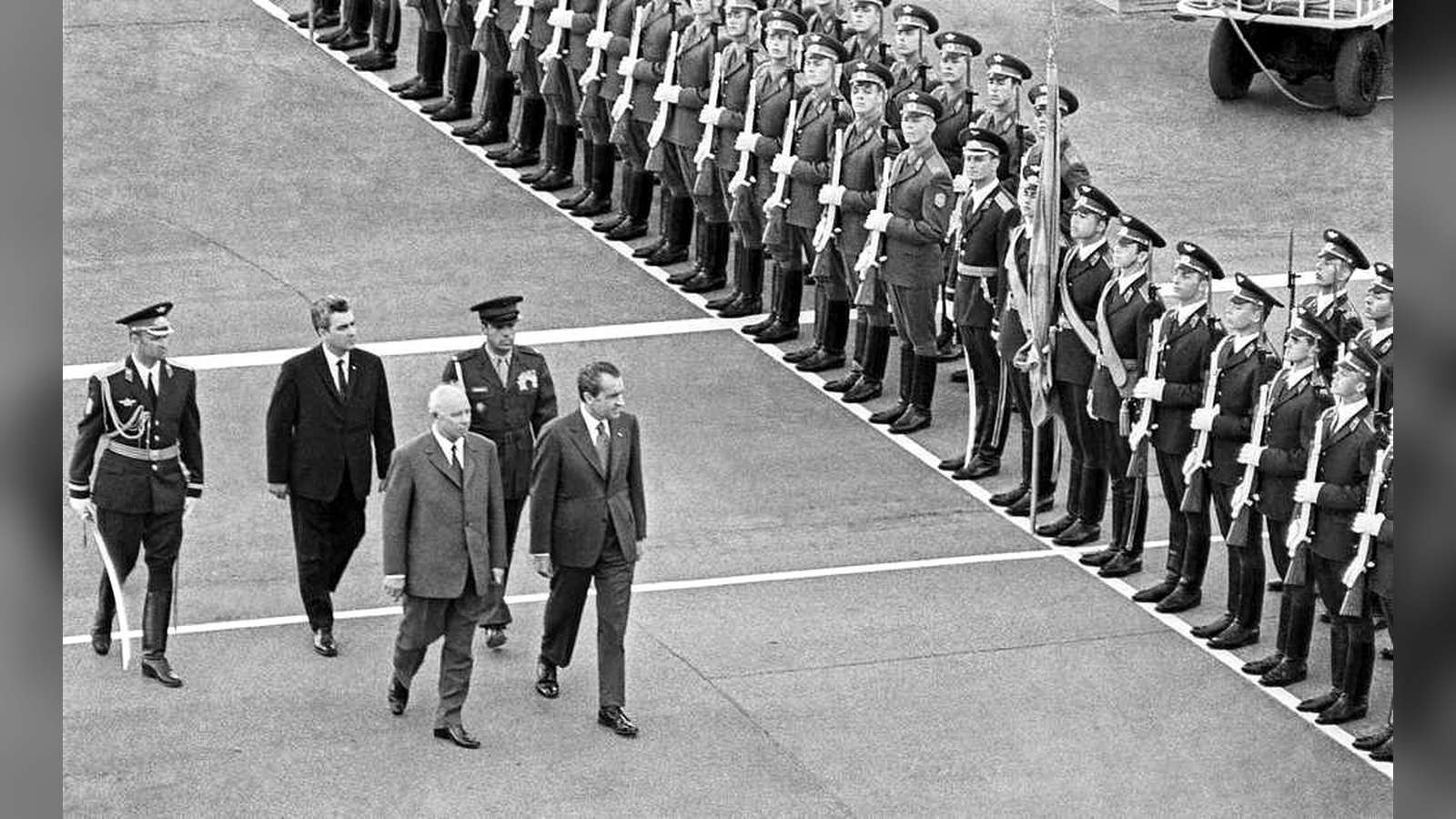
This photograph captures a singular moment of high-stakes diplomacy in May 1972, featuring U.S. President Richard Nixon and Soviet General Secretary Leonid Brezhnev within the formal confines of the Kremlin. The composition is classic for state photography of the era: the two leaders are positioned in a way that suggests both intimacy and the immense weight of the superpowers they represent. Their expressions are carefully composed, reflecting the gravity of a meeting that had been deemed impossible only years prior. One can observe the distinct contrast in their attire and posture—Nixon, often described as the quintessential American politician, and Brezhnev, the Soviet leader whose authority was at its peak during this period. The background, though slightly blurred to keep the focus on the subjects, hints at the opulent, heavy architecture of the Soviet seat of power, a setting intended to impress and intimidate.
The moment behind the image
The visit was the culmination of months of secret, back-channel negotiations. For decades, the Iron Curtain had remained largely impenetrable to the highest levels of American executive authority. When Nixon stepped onto the tarmac in Moscow, he was not just visiting a foreign capital; he was entering the heart of the ‘enemy’ camp. The atmosphere was one of cautious, almost fragile optimism. While the Vietnam War continued to rage, creating a deep ideological rift, both leaders recognized that the nuclear arms race had reached a point of existential danger. This photograph freezes the tension of that realization. It captures the moment when two adversaries decided that the survival of their respective nations required talking rather than merely threatening. The immediate aftermath of this shutter click involved the signing of the Anti-Ballistic Missile (ABM) Treaty and the Strategic Arms Limitation Talks (SALT I) agreement, tangible outcomes that proved the summit was far more than a mere photo opportunity.
Photographer and provenance
The provenance of official state photography from the 1972 summit is a complex tapestry. These images were produced by a collaborative effort between the Kremlin’s dedicated photographic services and the U.S. White House press pool. In the Soviet context, photographers were often employees of TASS or the Kremlin press office, working under strict guidelines to present the General Secretary as a statesman of world stature. Conversely, the White House photographers were tasked with capturing Nixon as a global peacemaker. Because these images were intended for immediate global distribution as propaganda or diplomatic tools, they often lack individual attribution, existing instead as collective artifacts of the state. This specific frame has survived in various archives, including the National Security Archive and the U.S. National Archives, serving as a primary visual source for historians studying the era of detente.
Historical context
To understand this image, one must look at the internal state of the Soviet Union. As noted in the diaries of Anatoly Chernyaev, a senior official in the International Department of the Central Committee, the Brezhnev of 1972 was far removed from the frail, stagnant figure later depicted in Western media. He was a skillful negotiator, actively consulting with intellectuals and experts like Georgy Arbatov to craft a foreign policy that was remarkably non-ideological. Chernyaev’s diary entries from May 1972 describe a palpable sense of change among the Soviet elite. He writes of the summit as a ‘crossing of the Rubicon,’ a moment that shattered the rigid ideological barriers of the past. For those working in the Kremlin, this visit was a window into a future where the Soviet Union might engage with the West on equal, pragmatic terms—a hope that would eventually be deferred by the long years of stagnation that followed.
Why it still matters
This image remains a powerful testament to the necessity of face-to-face diplomacy. It serves as a visual reminder that even during the most intense periods of geopolitical conflict, communication channels can be opened if the political will exists. The photograph does not just show two men; it shows the intersection of two worldviews attempting to find a middle ground. Its enduring significance lies in the reminder that history is not a static sequence of events, but a series of moments where leaders make choices that either escalate or de-escalate the risks of global catastrophe. The 1972 Moscow Summit remains the gold standard for how adversaries can manage their differences through structured, high-level engagement.