


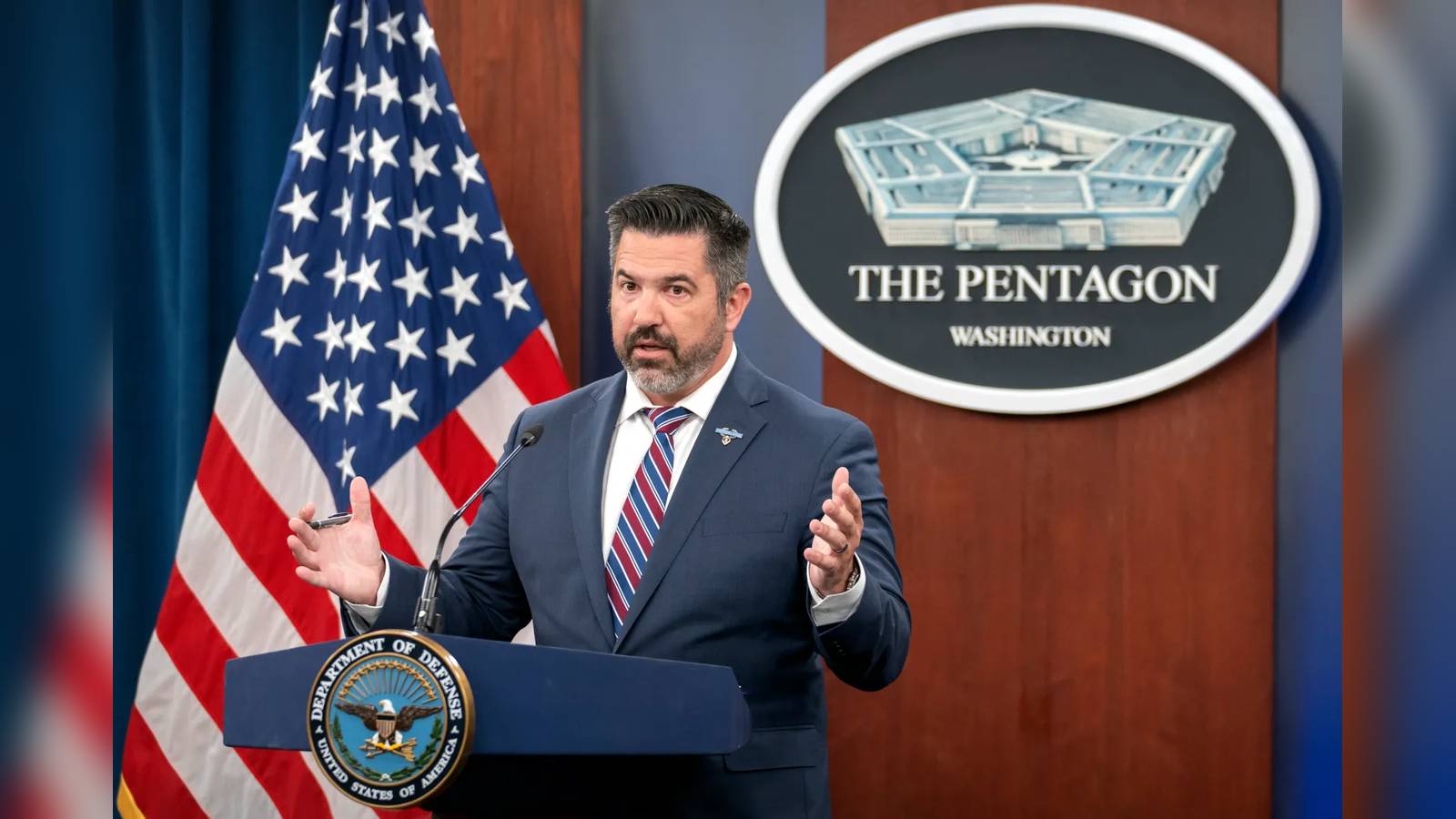
WASHINGTON — Chief Pentagon spokesman Sean Parnell has fiercely condemned the disclosure of a classified military assessment that detailed mounting internal alarms over U.S. combat readiness, escalating an intense political fight over the sustainability of the ongoing war in Iran.
Parnell’s statements, issued on Sunday, responded to reporting by The Washington Post that revealed top military commanders had warned Defense Secretary Pete Hegseth that prolonged Middle East operations are severely straining the armed forces. The leaked internal document—the August 14 Secretary of Defense Orders Book (SDOB)—showed that senior leaders across the Army, Navy, Air Force, and key global combatant commands cautioned that diverting warfighters, warships, and air defense assets to the Persian Gulf is undermining the military’s capacity to protect the U.S. homeland and deter potential conflicts in other regions.
This report draws on information published by newsweek.com.
Top Commanders Warning of Readiness Crisis
According to internal documents detailed by The Washington Post, leadership across multiple regional commands—including European Command (EUCOM), Indo-Pacific Command (INDOPACOM), and Southern Command (SOUTHCOM)—issued formal “non-concurrences” during force-allocation deliberations. Commanders warned that sustained deployments to the Iranian theater have forced the Pentagon to strip vital air defense systems, surveillance aircraft, and naval escorts from their respective areas of responsibility.
The most acute operational warning came from the Navy’s top admiral, Daryl Caudle. Caudle reportedly informed Secretary Hegseth that the service “cannot sustain its current level of support” without an established end date for active hostilites. Navy data cited in the assessment indicated that barely one-fourth of the U.S. Navy’s guided-missile destroyer fleet is currently fully ready for immediate deployment—a drastic decline from pre-conflict baseline readiness. Severe maintenance backlogs at domestic shipyards have further compounded the issue, creating a scenario where damaged or overused vessels cannot be quickly overhauled.
While Army and Air Force leadership concurred with extending certain regional deployments, they emphasized significant long-term risks. Elements of the 82nd Airborne Division have seen their combat mobilizations extended up to a full year, while Patriot missile batteries—already heavily deployed globally and transferred to Ukraine—are being kept in the Middle East indefinitely to shield U.S. installations and partner forces from Iranian ballistic and drone barrages.
Pentagon Blasts Disclosure While Media Defends Reporting
Rebuffing the leak, Parnell took to social media and released an official statement to Newsweek, calling the publication of classified operational assessments a “crime” and a “betrayal of the force.” Parnell asserted that the report contained inaccuracies and maintained that Secretary Hegseth remains in constant communication with military leadership to guarantee operational readiness.
“Publishing highly classified assessments from the Secretary’s orders book is a crime,” Parnell stated on X. “Of course, we demand candid military advice. Non-concurs are standard. The Secretary sees them constantly. That’s how you run a real military. We are in great shape around the world.”
Parnell further emphasized that strategic decisions are guided by presidential priorities and advice from Joint Chiefs Chairman and combatant commanders, noting that the Department of Defense does not publicly dissect internal deliberate risk assessments. However, Washington Post reporter Dan Lamothe quickly defended the news outlet’s coverage, noting that independent journalism covering government conduct during wartime is essential, particularly when officials withhold critical operational details from the public.
Legal experts generally maintain that publishing classified information by media outlets is protected under the First Amendment unless the publication directly reveals specific, real-time tactical operational details that put troops in immediate physical danger.
Depletion of Precision Munitions and Interceptors
The operational friction comes alongside growing bipartisan scrutiny over the rapid consumption of advanced American munitions. The U.S., Israel, and allied regional forces expended nearly 11,300 munitions within the first 16 days of hostilities following the war’s outbreak in late February. Six months into the conflict, reports indicate that inventories of critical long-range strike weapons and high-end air defense interceptors have fallen to precarious levels.
Estimates provided by the Center for Strategic and International Studies (CSIS) underscore the scale of inventory depletion. Prior to the war, the U.S. possessed approximately 452 Terminal High Altitude Area Defense (THAAD) interceptors; by late July, that figure had dropped to as few as 234. Similarly, stockpiles of Patriot air defense interceptors plummeted from roughly 2,330 before the war to approximately 759 by late July. Furthermore, reports indicate that the U.S. Army has nearly exhausted its available inventories of Army Tactical Missile Systems (ATACMS) and Precision Strike Missiles (PrSM).
The rapid burn rate reportedly influenced internal White House deliberations in late July, when President Donald Trump called off a planned two-week intensified bombing campaign against Iranian targets due to concerns over missile reserves. President Trump has since taken to Truth Social to warn that individuals leaking information regarding defense stockpiles are being hunted down and will face long-term prison sentences.
Fiscal Toll and Upcoming Congressional Debate
The conflict’s financial burden is mounting alongside its physical strain. In testimony before the Senate, Defense Secretary Hegseth revealed that direct U.S. expenditures for the war in Iran had reached $37.5 billion through the end of the fiscal year on September 30. Defense analysts expect these costs to expand dramatically as operations continue.
Lawmakers in Washington are currently evaluating an $88 billion emergency supplemental funding request alongside a broader Pentagon budget proposal that exceeds $200 billion earmarked specifically for Middle East operations. As Congress reconvenes, lawmakers are expected to push for formal hearings on military readiness, force posture, and defense industrial capacity, seeking clear answers on how the administration plans to maintain global deterrence while sustaining a high-intensity war.