


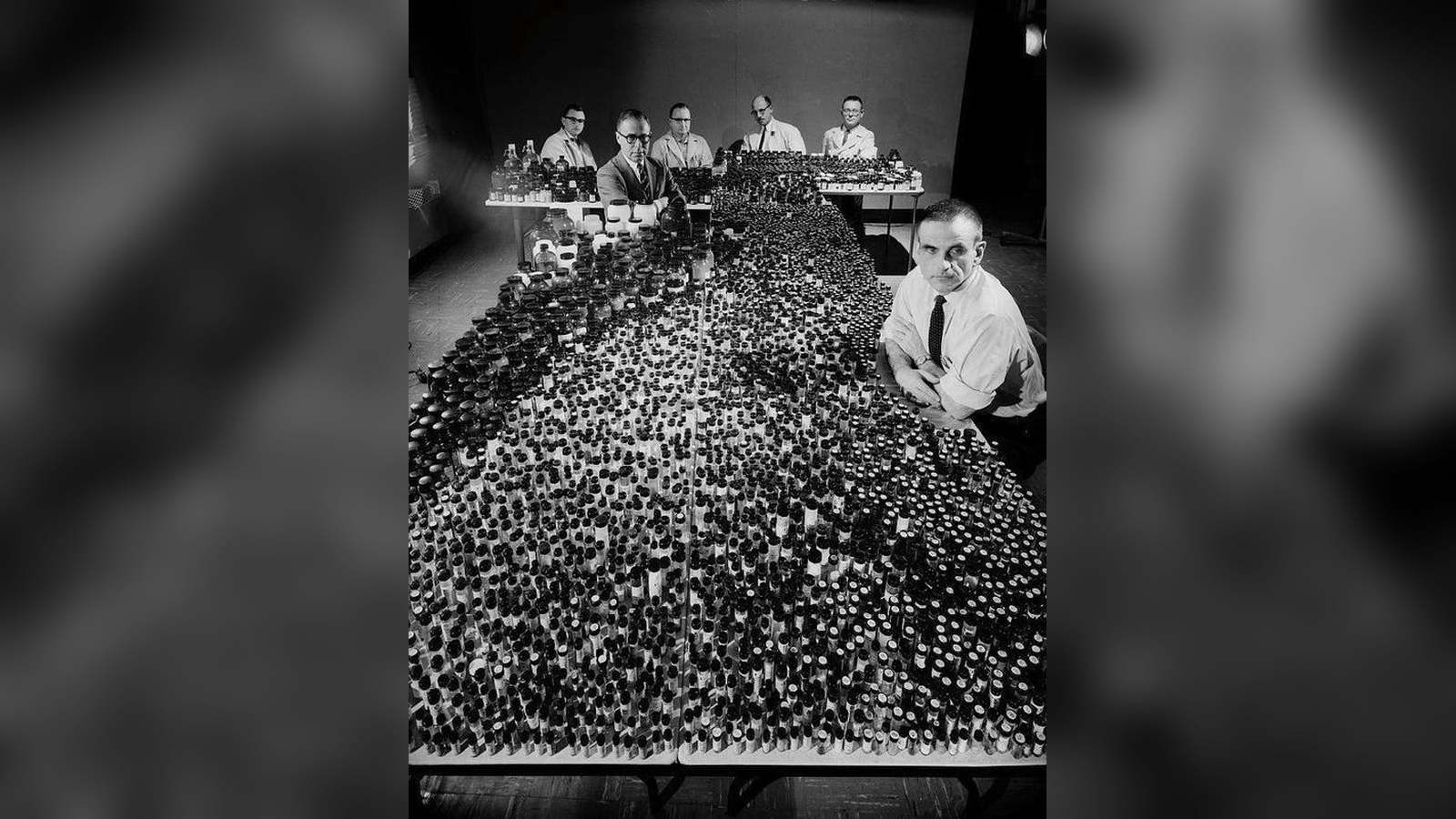
A towering wall of glass bottles frames a triumphant scientific milestone in a striking photograph that frequently captivates digital audiences worldwide. In this iconic 1963 image, Polaroid engineer and Director of Research Howard G. Rogers stands proudly before an astonishing array of approximately 5,000 chemical containers. These glass vessels represent a fraction of the grueling experimental path required to solve one of the twentieth century’s most complex photographic enigmas: how to create a stable, instant color photograph. This visual record not only documents a pivotal industrial laboratory but also invites us to examine the immense human patience and chemical ingenuity hidden behind the magic of early instant photography.
What the photograph shows
The frame is dominated by rows upon rows of glass chemical bottles stretching across shelving units, emphasizing the sheer scale of trial and error undertaken by the Polaroid research team. Standing centrally among the glassware, Howard G. Rogers projects a calm, understated confidence, embodying the intellectual rigor of industrial research chemistry. The composition deliberately contrasts the ordered precision of the laboratory with the dizzying multitude of individual compounds tested. Every bottle in the background serves as a silent testament to a failed hypothesis, an adjusted formula, or a microscopic molecular adjustment on the road to breakthrough success. The lighting highlights the meticulous categorization of the containers, showing how empirical science demanded a massive structural framework of archival tracking.
The moment behind the image
Taken in 1963—the watershed year Polaroid finally unveiled its revolutionary color film to the public—the photograph captures the exhaustion and elation of a long-fought victory. Developing instant color was infinitely more complex than Edwin Land’s original black-and-white or sepia processes. Rogers proposed an ingenious mechanism: tethering dye and developer molecules together into novel compounds known as dye developers, ensuring that each color followed a precise, timed path from negative to positive layers. The final hurdle was image permanence, solved by neutralizing alkaline developers with acid polymer layers that produced harmless water molecules inside the film unit. The photograph immortalizes the exact era when these grueling theoretical hurdles finally transformed into a commercially viable reality.
Photographer and provenance
The visual documentary weight of the scene is largely credited to Fritz Goro, an influential photojournalist renowned for his pioneering work capturing complex scientific and technological subjects for Life magazine. Goro possessed a rare talent for rendering invisible chemical processes and abstract laboratory innovations into compelling, intelligible visual narratives. Commissioned to document the inner workings of Polaroid’s cutting-edge research facilities, Goro framed Rogers and his chemical archive to visually quantify the immense labor behind modern consumer technology. The photograph’s survival and subsequent circulation in modern archives and digital platforms cement its status as a masterpiece of corporate and scientific photojournalism.
Historical context
When Edwin Land founded the Polaroid Corporation following a famous 1943 prompt from his young daughter asking why she couldn’t see her photograph immediately, instant photography changed visual culture forever. However, consumer demand swiftly pushed the company to conquer color. Operating under rigorous industrial conditions, Rogers and his team spent over a decade conducting thousands of individual experiments with diverse reagents. Their work bridged the gap between basic chemical research and mass-market consumer electronics, altering forever how families, artists, and journalists captured daily life. This era of corporate research symbolized the apex of mid-century industrial development, where vast resources were dedicated to solving singular technological impossibilities.
Why it still matters
Decades after digital sensors largely superseded chemical film, the image of Rogers and his 5,000 bottles endures as a universal symbol of perseverance, scientific inquiry, and the unseen labor behind technological progress. It reminds contemporary viewers that monumental inventions are rarely born from sudden flashes of isolated genius alone, but rather from relentless persistence through thousands of iterative failures. The photograph speaks to the timeless value of disciplined empirical work in an age of instant digital gratification.