


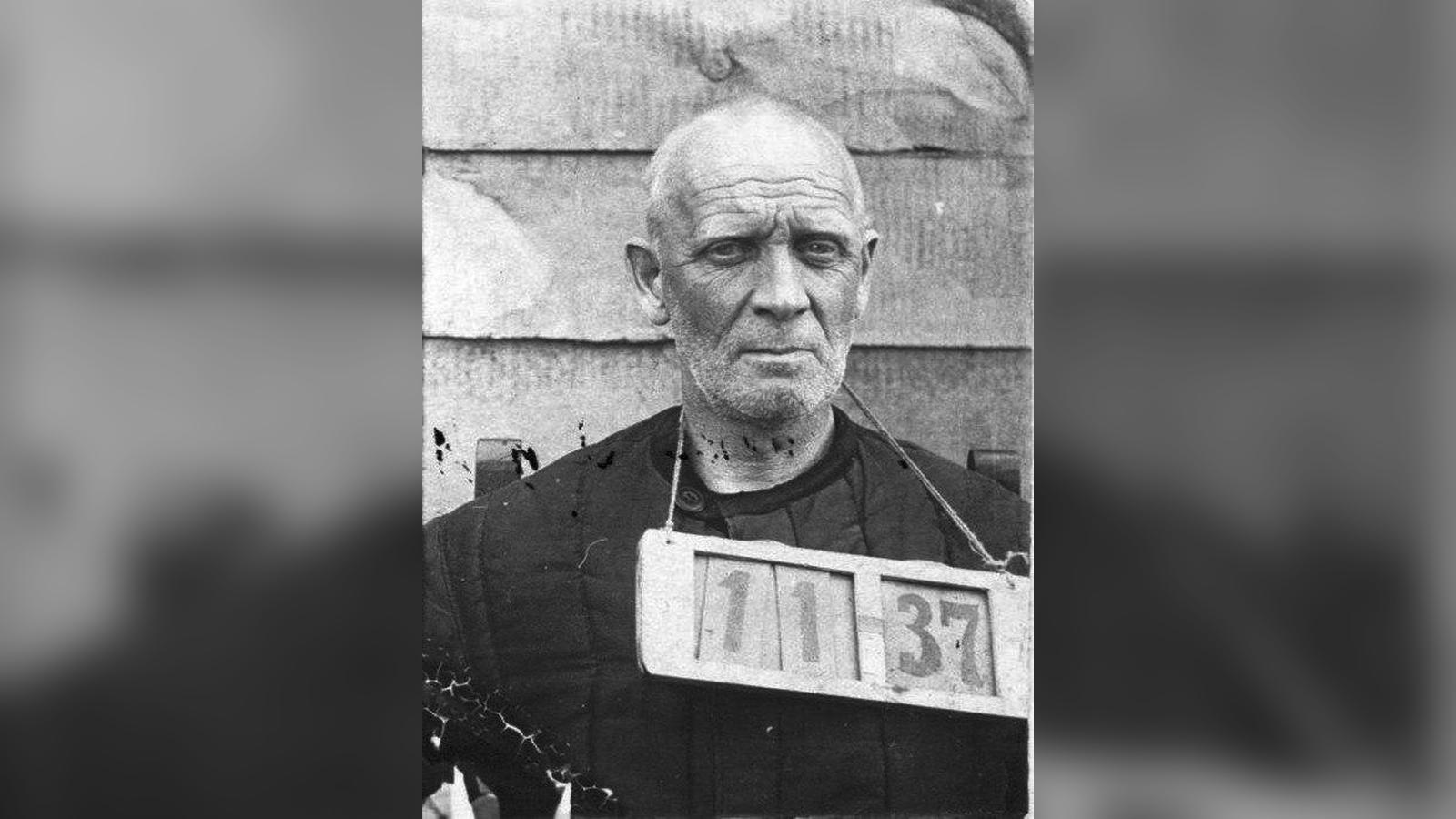
This stark archival head-and-shoulders portrait captures an older man with a bald head, short grey hair on the sides, and a neat grey beard and mustache, gazing directly forward with a composed, neutral expression. Centered firmly in the frame, he wears a dark, quilted jacket or robe, his hands concealed from view. Around his neck, suspended by a simple string, hangs a wooden or cardboard identification sign featuring the visible markings “11-37.” The background consists of a plain wall marked with horizontal paneling or brickwork, illuminated by direct frontal lighting characteristic of official penal photography that casts sharp, unsparing contrast across his features. This photograph raises a profound historical question: how did a scion of an ancient aristocratic dynasty spend his final months in the machinery of Soviet repression, and how did this solitary prison mugshot survive to become an enduring symbol of the Great Terror?
What the photograph shows
The visual composition relies entirely on the stark intimacy of institutional documentation. The subject fills the frame, his gaze fixed steadily on the unseen camera lens operated by an NKVD officer or prison photographer. The identification plaque resting against his dark quilted jacket anchors the image in administrative procedure, serving as a cold bureaucratic marker designed to index a human life for destruction. The simple string holding the placard and the utilitarian backdrop devoid of personal belongings underscore the total stripping of status, identity, and autonomy. The lighting accentuates the lines of age and quiet endurance on his face, preserving a moment of supreme vulnerability paired with steadfast human dignity.
The moment behind the image
While the precise date and indoor location of the shutter click cannot be determined from the frame alone, the visual clues align with the grim intake procedures of Soviet penal institutions in 1937. Prince Mikhail Mikhailovich Dolgorukov stood before the camera following his arrest on June 10, 1937, in the village of Podgornoye, Chaiansky District, in the West Siberian Krai. Accused of belonging to the clandestine Russian All-Military Union (ROVS), he was subjected to the standard administrative routines of confinement, interrogation, and cataloging that preceded execution by firing squad during the height of Joseph Stalin’s purges.
Photographer and provenance
The photograph was produced anonymously within the apparatus of the NKVD security organs, intended strictly for internal investigative files and investigative dossiers rather than public viewing. Photographers within these agencies operated under strict state mandates to document prisoners immediately before sentencing or execution. For decades, these harrowing images remained locked away in classified state and security archives. The survival and eventual circulation of Dolgorukov’s portrait decades later transformed an instrument of state terror into a testament of remembrance, recovered as families and historians sought to piece together the lost faces of the Soviet purges.
Historical context
Born in Saint Petersburg in 1891, Mikhail Dolgorukov graduated from the prestigious Imperial School of Jurisprudence and initially served in the Tsarist army. Following the 1917 revolution and the collapse of the Russian Empire, the former prince navigated a precarious existence under the new regime, working various low-status jobs as a clerk, night watchman, cloakroom attendant, and bookkeeper to survive. His aristocratic background made him a persistent target of suspicion. In 1926, he was convicted under Article 58-10 of the RSFSR Criminal Code and sentenced to three years of exile in the Buryat-Mongolian ASSR. Following a subsequent ten-year sentence in 1929, he worked as a medical assistant (sanlyuk) at the Toinsk district commandant’s office in Siberia. Ultimately, his title and lineage proved fatal; on September 22, 1937, an NKVD troika condemned him to death, and he was executed on December 11, 1937.
Why it still matters
This photograph endures because it encapsulates the human cost of systematic political violence, preserving the likeness of a man targeted simply for who he was. On January 4, 1957, amid the Khrushchev Thaw, the Military Tribunal formally rehabilitated Mikhail Dolgorukov posthumously, ruling that no corpus delicti existed in his alleged actions. The image bridges the gap between cold historical statistics and individual tragedy, ensuring that the face of Prince Mikhail Dolgorukov remains visible across generations as a haunting reminder of the lives consumed by totalitarian terror.