


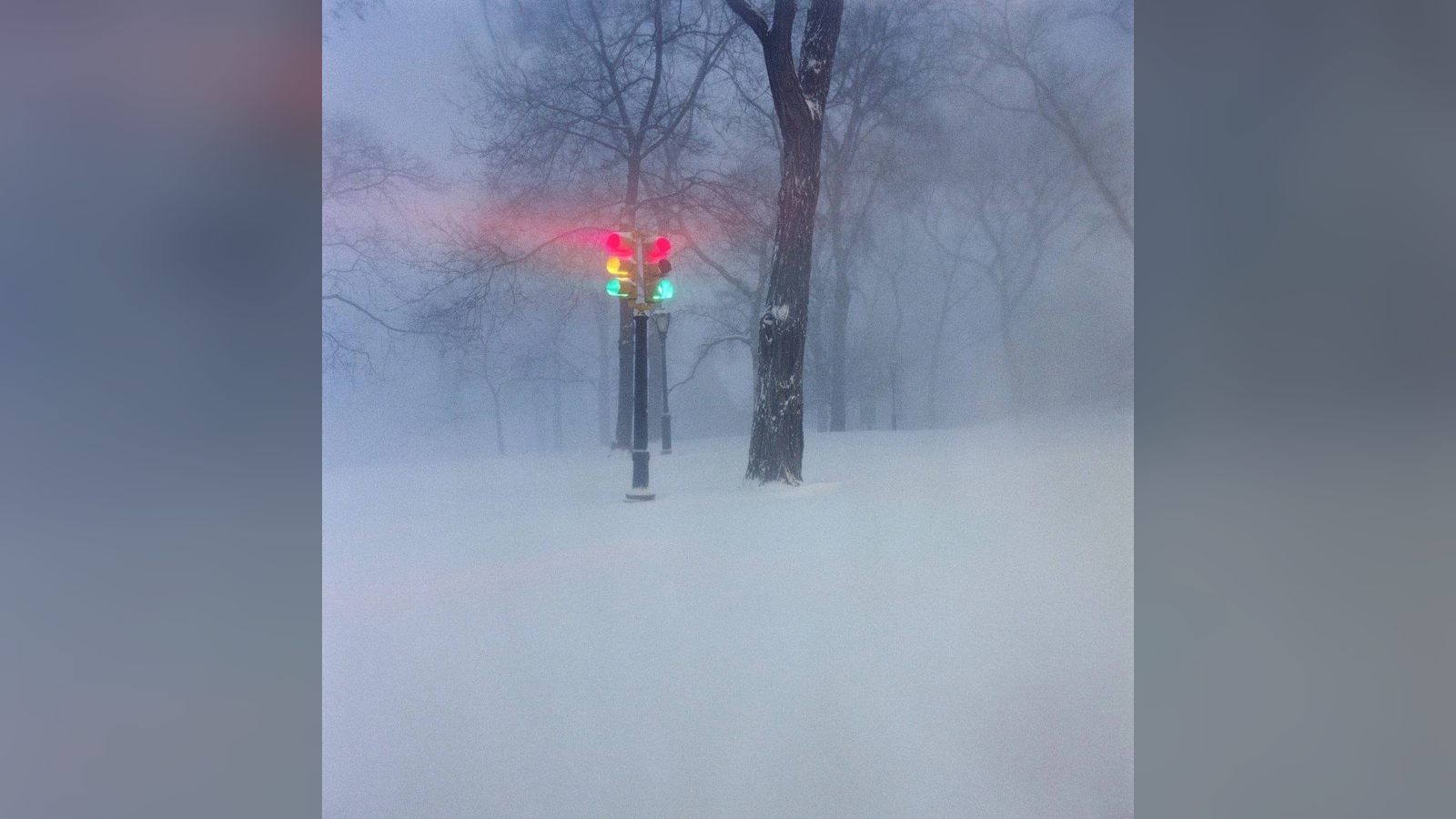
In this evocative frame, a solitary traffic signal stands as the lone, artificial sentry against a landscape seemingly erased by winter weather. The photograph depicts a scene dominated by a dense, milky-white fog that obscures the boundaries of the environment, leaving only the sharp, vertical silhouettes of leafless, snow-laden trees and the stark, functional geometry of the metal signal pole. The light from the traffic signal bleeds into the surrounding air, creating a soft, ethereal halo that contrasts sharply with the cold, blue-grey tones of the frozen surroundings. There is no indication of human activity, traffic, or urban noise; the scene is one of profound, suspended silence, suggesting a moment where the city has paused its frantic pace.
What the photograph shows
Looking closely at the composition, the eye is drawn immediately to the vibrant glow of the traffic signal. It is an industrial object, yet here it feels like a beacon in an alien landscape. The ground is a uniform blanket of white, suggesting deep, undisturbed snow, which muffles any potential sound. The trees in the background are skeletal and dark, their branches heavy with ice, serving to frame the signal and reinforce the isolation of the scene. The film-like quality of the image suggests a deliberate choice of medium; the grain and the specific color balance—a signature of Staller’s work—emphasize the chill in the air and the damp, heavy texture of the fog. The perspective is neutral, placed at eye level, which invites the viewer into the scene as if they were standing on that deserted corner or park path themselves.
The moment behind the image
This image belongs to a series Jan Staller produced throughout the 1980s and 1990s, focusing on the overlooked and often desolate peripheries of the New York metropolitan area. Unlike the rapid-fire, chaotic street photography that defined much of the city’s visual history in that decade, Staller sought out moments of stillness. At this exact instant, the photographer likely positioned his camera to emphasize the contrast between the rigid structure of the signal and the fluid, unpredictable nature of a blizzard or heavy fog. The framing creates a sense of ambiguity—without the familiar clutter of yellow cabs, pedestrians, or street signs, the traffic light feels less like a piece of municipal equipment and more like a mysterious, glowing artifact in a lost world. The photographer likely spent long hours waiting for exactly this kind of low-visibility weather, as his work relied heavily on the atmospheric conditions to soften the harshness of the urban environment.
Photographer and provenance
Jan Staller, born in 1952, gained widespread recognition for his large-format color photography that transformed ordinary, often industrial landscapes into dreamlike, painterly compositions. His work from the 1980s and 1990s frequently explored the fringe environments of the city—roadside embankments, construction sites, and snow-covered parkways. These images were often meticulously composed to strip away the narrative distraction of human subjects, allowing the viewer to engage with the texture and light of the built environment. Provenance for these works is often verified by the artist’s signature and date, frequently found on the lower margins of the prints. While specific location data for this frame remains obscure, typical of Staller’s work, the visual cues point toward the outer boroughs or parkland regions of New York where such isolated traffic signals were more common during the era.
Historical context
The 1980s in New York City were characterized by stark socioeconomic divides and a gritty urban reality, yet Staller’s work intentionally steered away from the era’s headline-grabbing turmoil. Instead, he tapped into a quiet, introspective tradition of landscape photography. By using long exposures and waiting for the right atmospheric conditions, Staller rendered the city not as a center of commerce or crime, but as a vast, malleable stage shaped by the elements. His aesthetic reflects a departure from the high-contrast black-and-white tradition of the mid-century, embracing the psychological depth that saturated color could offer when filtered through fog and snow. During this time, photographers began to re-examine the “non-places” of the modern city, finding beauty in the intersections of nature and infrastructure.
Why it still matters
Staller’s photographs of winter in New York endure because they capture the city in a state of suspended animation. In a metropolis that is defined by perpetual motion and density, this image acts as a vital counterpoint—a reminder of the moments when the city stops, holds its breath, and becomes a canvas of pure atmosphere. By elevating a mundane traffic light to the subject of a compelling photograph, Staller forces us to re-evaluate the infrastructure that surrounds us daily. It remains a poignant reminder that even in the heart of an urban jungle, nature—in the form of snow, fog, and light—can reclaim the landscape, however briefly.