


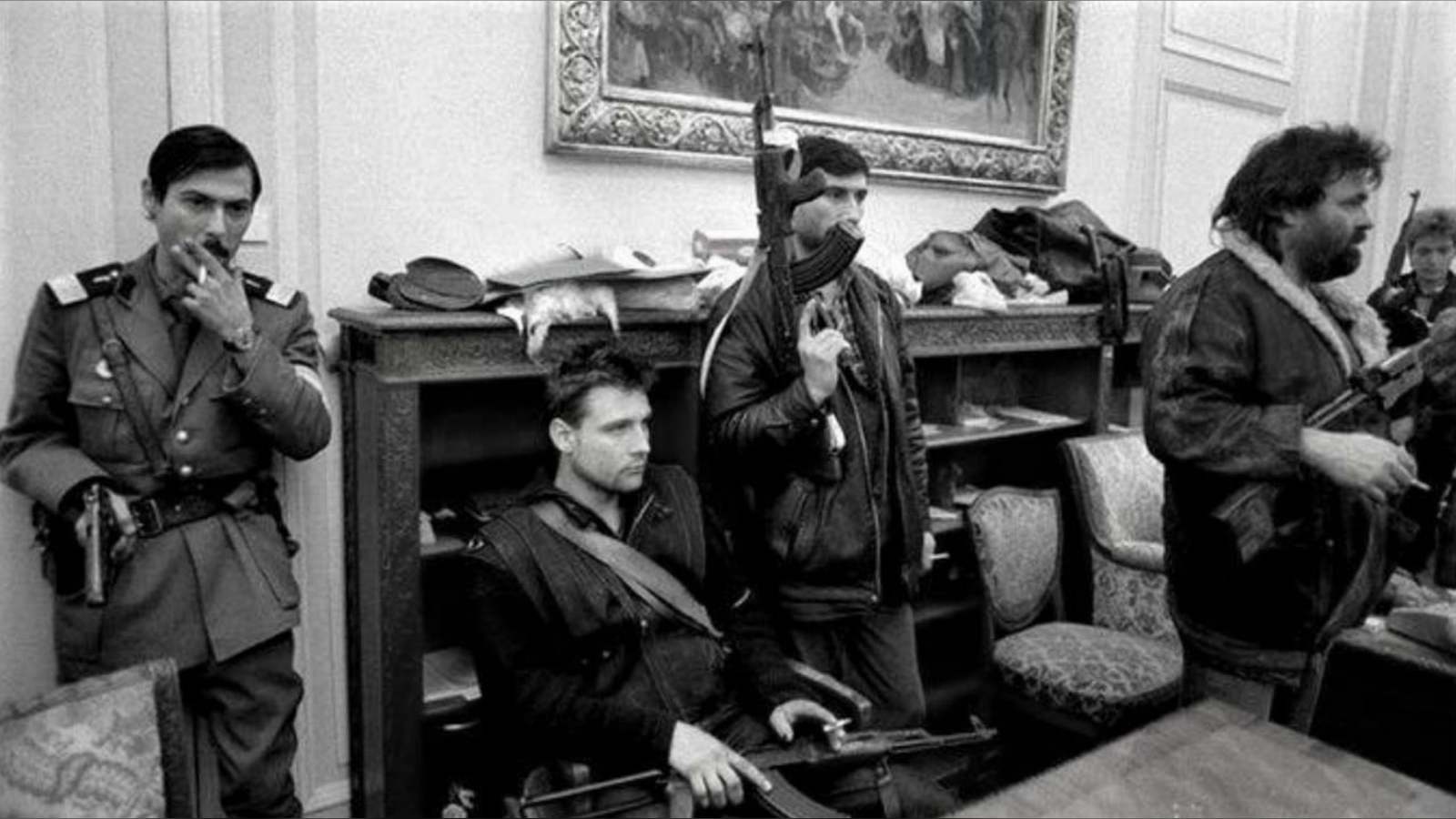
This photograph captures the surreal instant when the inner sanctuary of one of Cold War Europe’s most feared dictators was breached by the very people he had repressed for nearly a quarter of a century. In the frame, ordinary Romanians—wearing heavy winter coats, knitted caps, and streetwear—crowd into the polished private office of Nicolae Ceaușescu inside the Central Committee headquarters in Bucharest. Some lean over the heavy mahogany desk where absolute decrees were once signed, while others wave to international news cameras and assemble in victory poses. How did a room once guarded by the lethal Securitate secret police transform into an open stage for popular revolution in a matter of hours?
What the photograph shows
The composition brings into sharp focus the collision between totalitarian grandeur and grassroots liberation. At the center sits Ceaușescu’s expansive desk, flanked by high-backed leather armchairs and formal conference tables that epitomized state power in communist Romania. Surrounding and sitting upon these symbols of authority are young workers, students, and city residents. Their facial expressions range from disbelieving joy to defiant triumph. Many wear thick overcoats and scarves, reflecting the cold winter afternoon of December 22, 1989. In the background, ornate wooden paneling and gold-trimmed drapes frame a scene devoid of official decorum, as citizens inspect papers, touch the dictator’s personal telephones, and flash the ‘V’ for victory sign to photographers.
The moment behind the image
The immediate chain of events leading to this photograph unfolded with breathless speed on the morning of December 22, 1989. Just twenty-four hours earlier, Ceaușescu had staged a televised mass rally in Bucharest’s Palace Square to project order after days of bloody unrest in the western city of Timișoara. Instead, the crowd turned on him, chanting slogans for freedom and drowned out his speeches on live television. By the morning of December 22, hundreds of thousands of demonstrators surrounded the Central Committee building. As the crowd smashed through the front doors, Ceaușescu and his wife Elena escaped to the roof and fled in a White Aerospatiale SA 365 Dauphin helicopter at 12:06 PM. Minutes after the aircraft cleared the roof, protesters flooded the corridors and breached Ceaușescu’s personal suite, turning his office into a symbol of the regime’s sudden eviction.
Photographer and provenance
As the Central Committee doors gave way, both Romanian photojournalists and foreign correspondents working for agencies such as Reuters, Associated Press, and Agence France-Presse rushed into the building alongside the crowd. In the chaotic hours following the flight of the Ceaușescus, press credentials merged with revolutionary enthusiasm. Photographers documented every room of the top-secret facility, capturing citizens exploring state offices, broadcasting from state television studios, and displaying national flags with the communist emblem cut out from the center—a hole that became the defining graphic symbol of the Romanian Revolution. The resulting imagery was rapidly transmitted across global wire services, providing the world with visual proof that Ceaușescu’s totalitarian hold had finally snapped.
Historical context: From Timișoara to Bucharest
The revolution had ignited one week earlier, on December 16, 1989, in the city of Timișoara, where citizens gathered to prevent the forced eviction of a dissident Reformed Church pastor, László Tőkés. When security forces opened fire on the demonstrators, protests escalated rapidly despite state curfews, armored vehicle deployments, and indiscriminate gunfire that killed hundreds across the country. Romania stood as the last hardline Stalinist outpost in Eastern Europe; while neighboring communist regimes in Poland, East Germany, and Hungary collapsed through peaceful negotiations during 1989, Ceaușescu chose maximum force. His attempt to suppress the uprising culminated in widespread military defecting to the side of the public on December 22, leaving the dictator isolated and hunted.
Why it still matters
This image remains one of the most vivid visual markers of the end of the Cold War in Europe. Unlike formal diplomatic ceremonies or political handshakes, this photograph records the visceral human reality of political transformation—the literal occupation of totalitarian space by ordinary citizens. Three days after this photograph was taken, on December 25, 1989, Nicolae and Elena Ceaușescu were captured near Târgoviște, tried in a rapid military tribunal, and executed by a firing squad. The image of citizens claiming his desk stands as a permanent reminder of how quickly seemingly unbreakable authoritarian systems can crumble when public fear gives way to collective courage.