


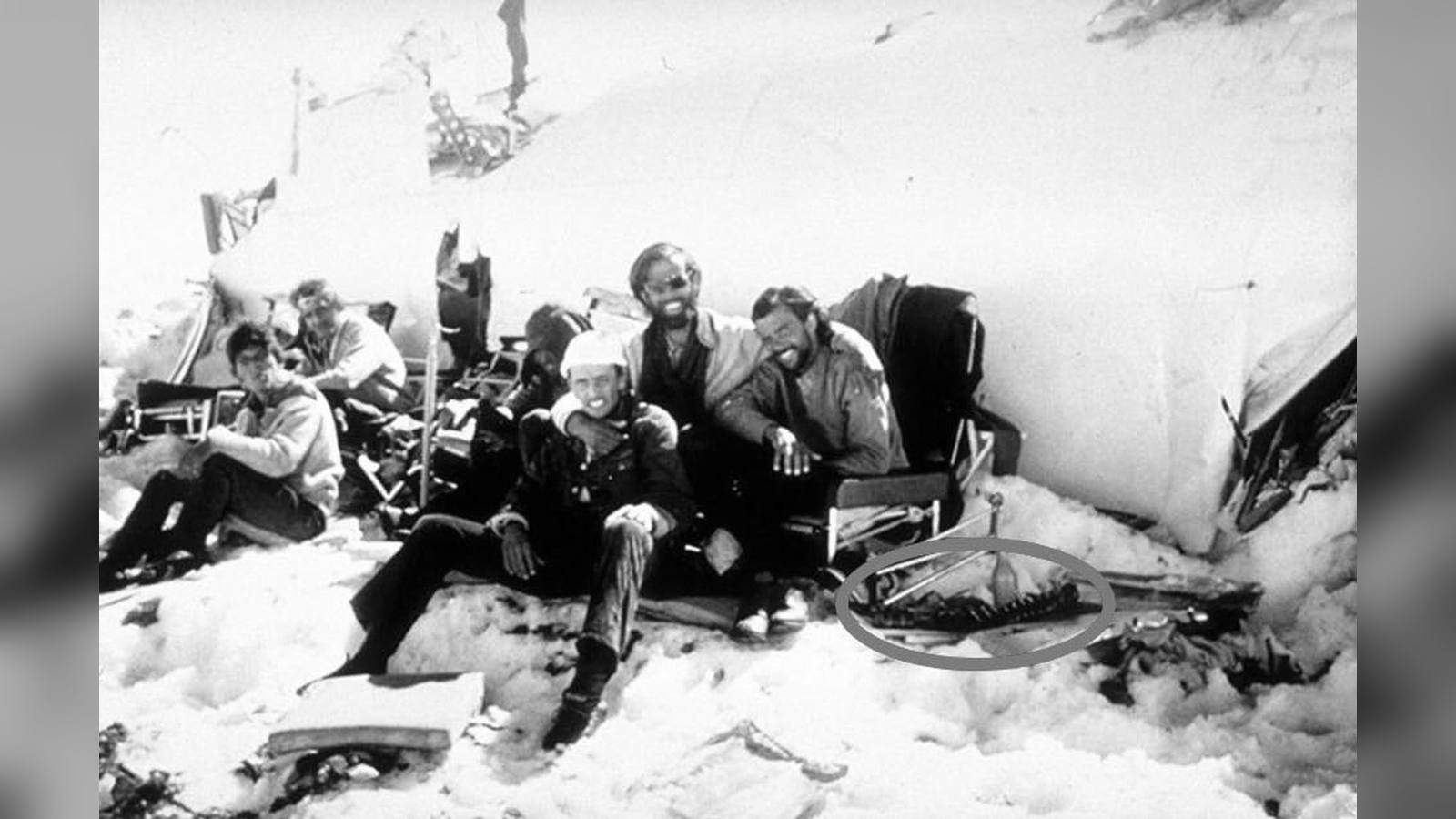
At first glance, the photograph appears to capture a moment of rugged outdoor camaraderie. A group of young men in heavy winter coats, layers of sweaters, and improvised sunglasses huddle together against a blinding white mountain backdrop. They pose near the metallic remains of a cabin, squinting into the high-altitude sun like university students on an adventurous ski trip. Yet when the viewer’s eye strays from the center of the frame down to the bottom right corner, the illusion shatters entirely. Resting on the crusted snow, exposed to the bare elements, lies a human spine and ribcage stripped of flesh. That single, horrific detail transforms an otherwise ordinary snapshot into one of the most stark visual records of extreme human survival ever recorded.
What the photograph shows
The image is framed at eye level amidst the vast, desolate landscape of the Andes range. In the middle ground, several young men stand and sit in front of the shattered fuselage of a twin-turboprop aircraft. They wear mismatched clothing—multiple jackets pulled over shirts, heavy woolen trousers tucked into boots, and hand-fashioned eye protection made from plastic salvaged from the plane’s cockpit windows to prevent snow blindness. Some look directly at the camera with weathered, wind-burned faces. The surrounding terrain is a blinding expanse of snow and ice locked between towering rock walls. The composition feels almost unstudied, recorded on a small handheld camera under ambient sunlight. But in the lower right foreground, bathed in the same crisp mountain light, sit the discarded skeletal remains of a fellow passenger. The contrast between the surviving men’s calm postures and the visible proof of human consumption creates an overwhelming psychological tension for anyone looking at the frame.
The moment behind the image
The photograph was taken in late 1972 on the Glacier of the Tears (Valle de las Lágrimas), a remote valley on the Argentina-Chile border at an elevation of roughly 3,570 meters. On October 13, 1972, Uruguayan Air Force Flight 571—a Fairchild FH-227D chartered to carry the Old Christians Club rugby team from Montevideo to Santiago, Chile—struck a mountain peak during severe weather and broke apart. Of the 45 passengers and crew on board, 12 died in the initial crash or shortly thereafter. Over the following weeks, freezing temperatures reaching minus 30 degrees Celsius, severe injuries, and a devastating avalanche on October 29 that buried the fuselage killed 13 more, including team members, relatives, and friends.
Stranded in an environment completely void of animal or plant life, the survivors quickly exhausted the handful of chocolate bars, snacks, and wine bottles found in luggage. As starvation set in and a transistor radio informed them that the official search had been abandoned after eleven days, the group faced a terrifying choice. Following intense collective discussions rooted in their shared Catholic faith and desire to live, they made a pact: if anyone died, the remaining survivors had permission to use their bodies for nourishment. The photograph documents a moment during those grueling 72 days when anthropophagy had become an integrated, daily ritual of survival inside their mountain camp.
Photographer and provenance
The photograph was taken using a personal pocket camera belonging to one of the survivors. Several team members, including Eduardo Strauch, Roy Harley, and Nando Parrado, had brought cameras on the flight to document their rugby tour to Chile. Throughout their two-and-a-half-month ordeal, they used remaining rolls of film to photograph their daily routines, the construction of snow barriers, the repair of gear, and group portraits aimed at maintaining morale.
Because temperatures in the valley were perpetually well below freezing, the film inside the cameras remained remarkably preserved. When Nando Parrado and Roberto Canessa completed a desperate ten-day trek across the mountain range in mid-December to reach civilization, they alerted Chilean authorities to the existence of the remaining 14 survivors. During the air rescue by Chilean Air Force helicopters on December 22 and 23, 1972, the survivors brought their personal belongings, including the loaded cameras, off the glacier. Upon return to Montevideo and Santiago, the film rolls were developed. Images from the crash site were subsequently acquired by international news agencies, sparking worldwide discussion when the explicit details of their survival became public.
Historical context
When the 16 young men returned alive after 72 days in the high Andes, the global media initially hailed their ordeal as a miraculous story of human endurance. However, within days of their rescue, Chilean and international newspapers published photographs showing severed human limbs near the plane, triggering intense sensationalism and public controversy. Rumors of murder and indiscriminate cannibalism began to circulate in South American press outlets.
To address the growing media frenzy, the survivors held a historic press conference on December 28, 1972, at Stella Maris College in Montevideo. Spokesman Pancho Delgado eloquently explained that when their food ran out, they drew inspiration from Holy Communion, viewing the bodies of their deceased friends as a final gift of life given so that others might survive. Their candor and dignity transformed public reaction from morbid shock to deep admiration. The Catholic Church subsequently confirmed that the survivors had committed no sin under the extraordinary circumstances of life-and-death necessity.
Why it still matters
This photograph remains an unvarnished document of human adaptability under conditions of absolute existential extremity. Unlike staged historical portraits or professional photojournalism, it represents a private moment captured by the victims themselves for their own memory, completely unedited for public consumption. The incidental inclusion of the human spine in the lower corner underlines the brutal reality of their environment: survival was not a sanitized triumph, but a daily, visceral struggle that required breaking the ultimate human taboo. Decades later, the image stands as a testament to the instinct to live, the power of solidarity, and the unbelievable physical toll of the Miracle of the Andes.