


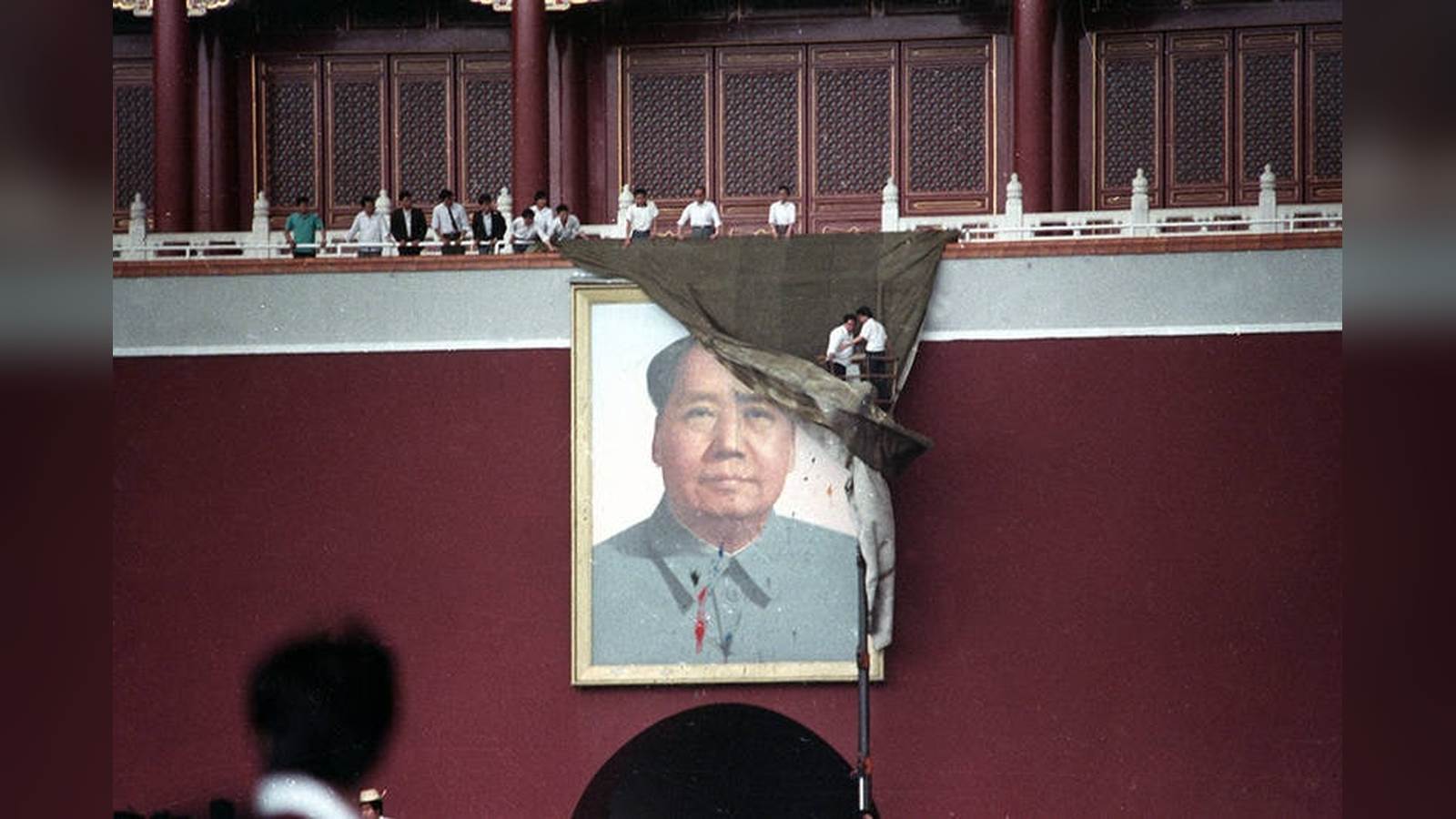
At the northern boundary of Tiananmen Square on the afternoon of May 23, 1989, a giant sheet of fabric is hoisted over the iconic six-by-four-point-six-meter portrait of Mao Zedong mounted on the Gate of Celestial Peace. Workers and security personnel maneuver hastily against the red ramparts of the Forbidden City, attempting to veil dark, indelible streaks of paint that splash across the Chairman’s face and collar. This remarkable photograph captures a rare moment of visual vulnerability for the Chinese state’s most sacred political icon during the height of the Beijing pro-democracy movement. What prompted three provincial visitors from Hunan to risk lifetime imprisonment by hurling paint-filled eggshells at Mao’s image, and how did this singular act of political iconoclasm expose the profound ideological tensions dividing the 1989 protests?
What the photograph shows
In the photograph, the grand architectural facade of Tiananmen—the Gate of Celestial Peace—serves as the dramatic backdrop for an unprecedented breach of state symbolism. Hung centrally above the primary arched gateway, the massive oil portrait of Mao Zedong is partially obscured by improvised drapes and scaffolding netting. Despite the effort to conceal the damage, dark splatters of gray and black oil paint remain visible beneath the cloth, dripping down from the chin and lapels of the monumental portrait. Below the ramparts, near the Gold Water Bridge, small clusters of onlookers, student monitors, and uniformed officials gather in visible confusion and anxiety. The image contrasts the permanent, towering grandeur of dynastic and communist power with the messy, immediate evidence of civilian defiance.
The moment behind the image
The defacement occurred mid-afternoon on May 23, 1989, executed by three young men from Hunan province: Yu Zhijian, a 25-year-old former rural primary school teacher; Yu Dongyue, a 22-year-old arts reporter for the Liuyang Daily; and Lu Decheng, a 25-year-old bus driver. Frustrated by what they perceived as the student movement’s overly cautious negotiations with the Chinese Communist Party, the trio sought a radical act to challenge the core of autocracy. Arriving in Beijing after collecting public donations in Changsha, they bought twenty raw eggs at the Wangfujing Department Store, carefully drained their contents, filled the shells with dark gray paint mixed with oil, and sealed them with wax. Standing near the Gold Water Bridge, they unfurled a banner reading, ‘An end to five thousand years of despotism / Cult of personality is no more,’ alongside a sign declaring ‘Hail Liberty!’ Yu Zhijian blocked passersby while Yu Dongyue and Lu Decheng launched the paint eggs at the giant canvas. Three of the eggs struck the portrait directly, spreading dark stains across Mao’s face.
Photographer and provenance
This image was recorded by international photojournalists and Western news agencies stationed in Beijing to cover the historic hunger strikes and mass demonstrations of May 1989. Photographs of the shrouded, paint-splattered portrait were transmitted worldwide within hours via satellite wire services like the Associated Press and Reuters. State-controlled media, including China Central Television (CCTV), also broadcast footage of the defaced portrait, airing indignant commentaries that denounced the three men as ‘counterrevolutionary hooligans.’ While Chinese authorities quickly cleared the square of journalists in the weeks that followed, these photographs survived in global media archives as incontrovertible visual evidence of the protest’s most radical symbolic gesture.
Historical context
The reaction within Tiananmen Square was immediate and fiercely divided. Student guards belonging to the Beijing Students’ Autonomous Federation, fearing that defacing Mao would give the government a pretext for military intervention, detained Yu Zhijian, Yu Dongyue, and Lu Decheng at the base of the Monument to the People’s Heroes. After an intense interrogation, student leaders handed the three dissidents over to the Beijing Public Security Bureau. Following the violent military crackdown on June 4, 1989, the regime prosecuted the trio with extreme severity. Yu Zhijian was sentenced to life imprisonment (serving eleven and a half years), Yu Dongyue received twenty years (serving nearly seventeen years and suffering severe permanent psychological damage from prison torture), and Lu Decheng was sentenced to sixteen years (serving over eight years). The damaged portrait was taken down within hours of the incident and replaced with a spare original held in reserve by municipal authorities.
Why it still matters
This photograph remains an indispensable historical artifact because it captures the precise moment when the sacred visual authority of China’s autocratic system was publicly ruptured. While many student leaders sought reform within the framework of the party-state, the ‘Three Hunan Hooligans’ insisted that true freedom required dismantling the foundational myth of Maoist totalitarianism. Today, the Mao portrait above Tiananmen Gate is replaced annually in a pristine ritual of state continuity. Yet this image endures as a powerful testament to the fragile nature of political propaganda and the courage of individuals who used paint and eggshells to puncture an illusion of untouchable power.