


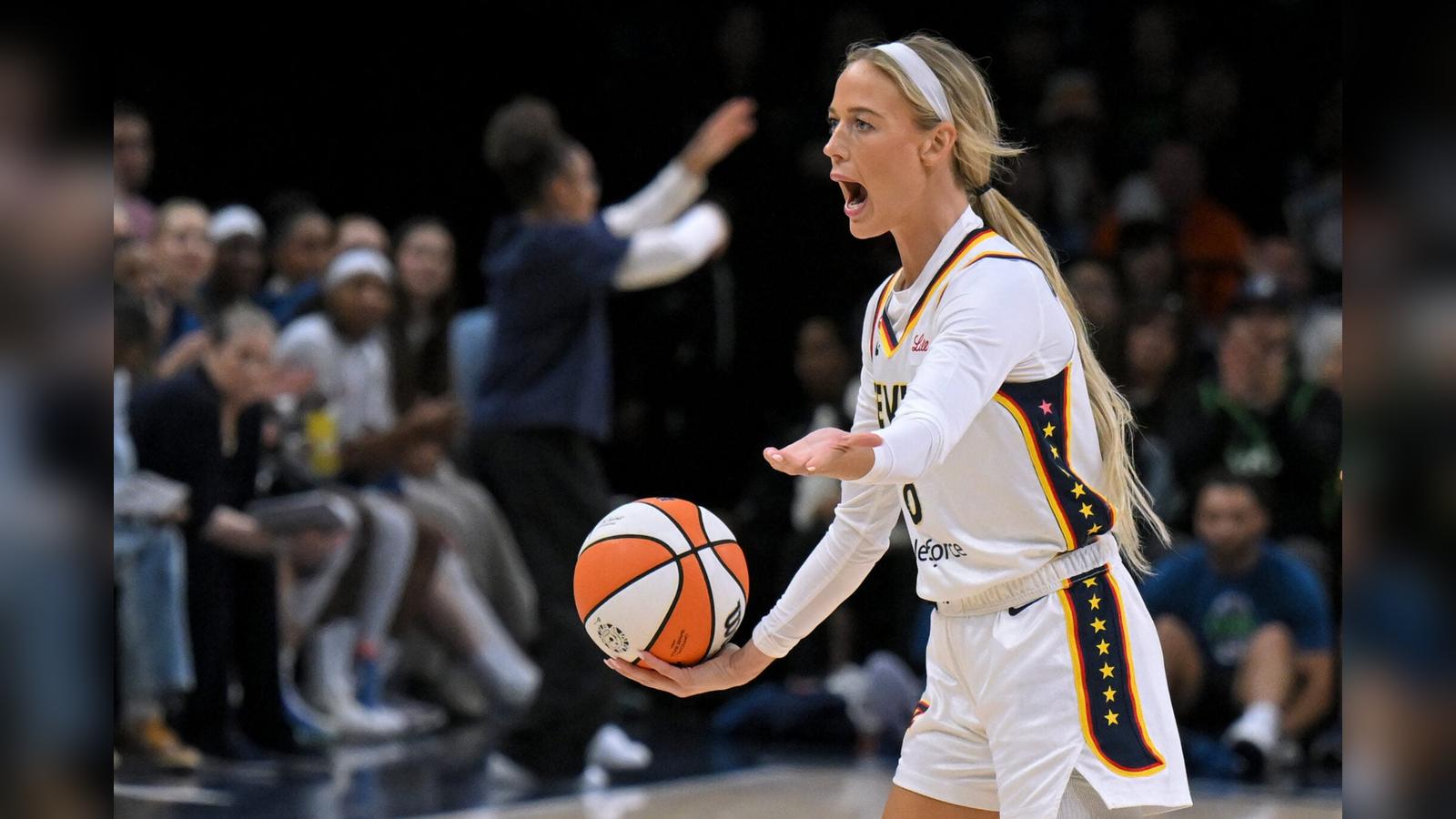
Cunningham challenges men to a 3-point contest
Indiana Fever guard Sophie Cunningham has publicly issued an open challenge to recreational league players to compete against her in a three-point shooting contest. The challenge, announced during the November 20, 2026, episode of her “No Hesitation” podcast, serves as a direct response to persistent online skepticism regarding the technical proficiency of WNBA athletes. Cunningham, known for her high shooting efficiency, explicitly called out “average Joes” from local YMCA and recreational leagues who frequently criticize professional women’s basketball players on social media platforms. By framing the dispute around a specific, measurable skill like three-point shooting, she moves the conversation away from vague conjecture and into the realm of athletic accountability.
The context of professional skepticism
As reported by HITC, Cunningham’s frustration stems from a recurring narrative that amateur male players could successfully compete against or outshoot professional female athletes. During the podcast, she contrasted her professional standing with the “couch-cushion confidence” of online critics, stating, “I want to find some average Joes—like in the YMCA league and the rec league—who think that they can outshoot me, and have a three-point competition.” She further emphasized her intent to settle the debate through direct competition, asserting that she would consistently outperform challengers who undermine the skill level of the league. Her co-host, Drew Hanlen, who also serves as her professional trainer, has been a vocal supporter of her technical capabilities during this ongoing public discourse.
Stakes and professional performance
The challenge highlights a broader friction between professional female athletes and digital critics who often ignore the rigor of professional training. By inviting a head-to-head contest, Cunningham aims to ground the abstract arguments surrounding talent disparities in tangible, observable performance. This move is not merely a personal retort but a strategic attempt to leverage her own shooting percentages—which have historically rivaled those of top-tier NBA shooters—as a benchmark for the requested competition. According to data from the 2026 season, Cunningham maintained a high level of efficiency, shooting 41.9 percent from beyond the arc. This follows a 2025 campaign where she achieved a career-high 43.2 percent, placing her consistently among the top shooters in the WNBA. Her performance metrics serve as the foundation for her confidence in the proposed challenge.
The discourse surrounding this challenge was further contextualized by Newsweek, which noted that the topic arose during a discussion about professional player efficiency and the public perception of WNBA athletes. Critics of the league often rely on gender-based stereotypes to dismiss the legitimacy of professional statistics, a trend that Cunningham is actively attempting to disrupt. By inviting her detractors to the court, she forces a confrontation that mirrors the reality of professional basketball: that elite talent is not easily replicated by recreational enthusiasts. The outcome of such a competition, should it occur, would provide a clear visual indicator of the differences in skill and preparation between professional athletes and their vocal critics.
Navigating public visibility and professional snubs
The cultural impact of such challenges is significant within the context of women’s sports growth. As the WNBA continues to see record-breaking interest, the gap between the professional product and the perception of casual fans remains a point of contention. Cunningham’s willingness to engage directly with her critics serves as a public demonstration of the disparity between professional training and recreational play. This development also follows previous instances where Cunningham has navigated public scrutiny. For instance, in July 2026, as reported by The Big Lead, Cunningham expressed public disappointment regarding her exclusion from the WNBA All-Star three-point contest, despite ranking among the league’s most accurate shooters. Her ability to maintain high shooting percentages while navigating these professional slights and increased public attention—including reports of security concerns—underscores the complexity of the environment in which she operates.
Cunningham’s challenge remains open, with no specific date or venue currently established for these potential matchups. However, the invitation signals a shift toward more direct confrontation of online hostility. By leveraging her proven statistics, she is not merely reacting to criticism but is actively defining the terms of the debate. As she prepares for the upcoming off-season, the potential for such a competition remains a point of interest for fans and critics alike, offering a potential venue to settle long-standing debates regarding the technical gap between professional and recreational play. Whether or not these “average Joes” accept the challenge, the act itself serves as a firm statement regarding the legitimacy and high level of skill inherent in professional women’s basketball.