


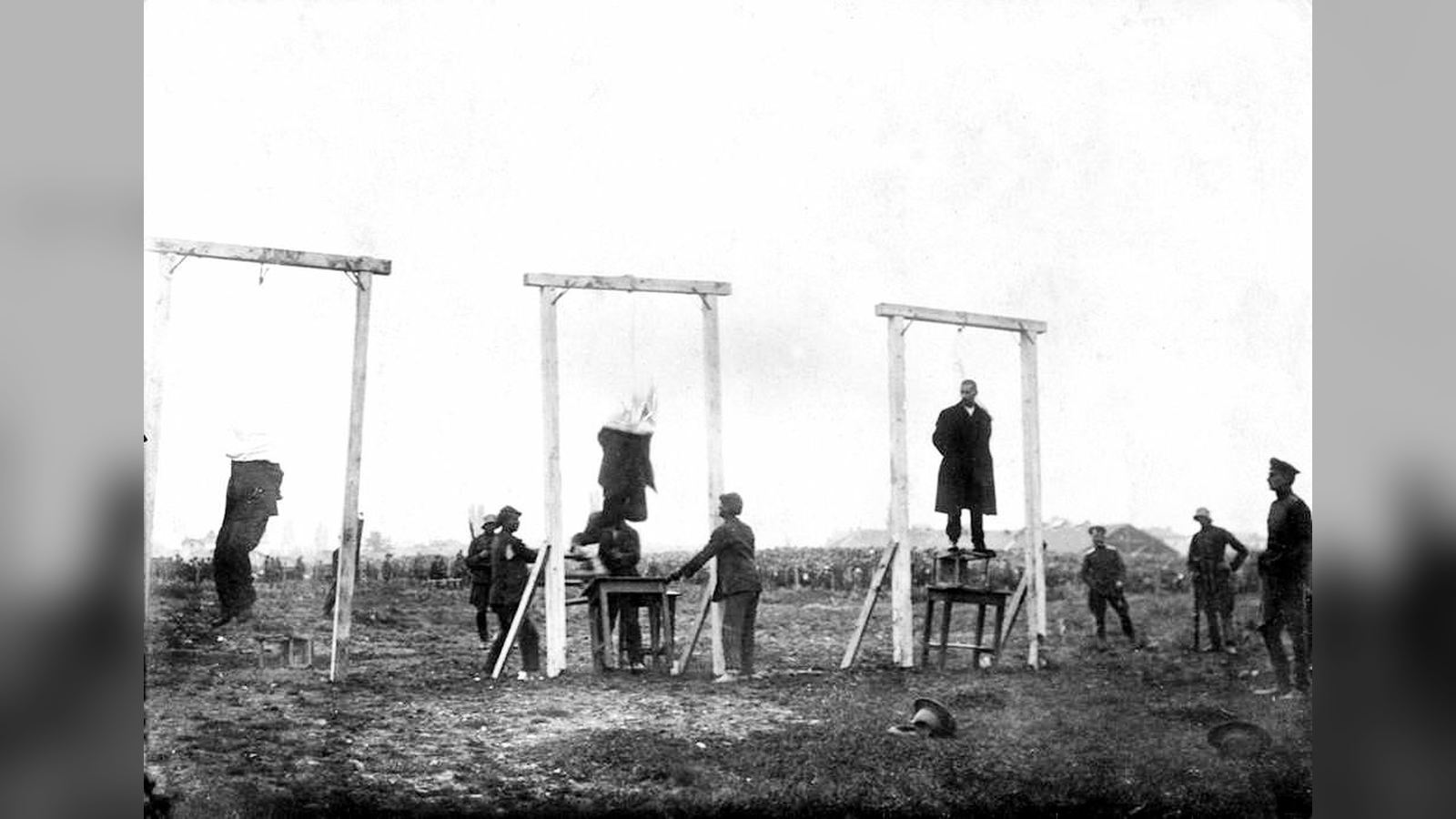
This historic photograph captures a chilling chapter of state retribution in interwar Europe, preserving the grim reality that followed the single deadliest terrorist attack in Bulgarian history. Set against the backdrop of sweeping martial law and intense political violence, the image freezes a moment of reckoning after the catastrophic bombing of the St. Nedelya Church in Sofia. By examining the figures, the stark lighting, and the tense atmosphere preserved in the frame, this article explores the immediate aftermath of the tragedy, the murky provenance of the archival record, and the violent vortex that engulfed Bulgaria in the spring of 1925.
What the photograph shows
In the frame, the stark visual evidence lays bare the ruthless machinery of state counter-terror. Though the exact identities of every individual caught by the camera remain blurred by the passage of time and the limitations of period photo-journalism, the composition typically presents condemned conspirators or suspected militants facing public execution or awaiting their sentence under heavy guard. The subjects wear the heavy, rumpled clothing of the 1920s, their postures conveying exhaustion, defiance, or resignation against a backdrop of military personnel. The stark daylight casts sharp shadows, emphasizing the grim gravity of the public spectacle designed to deter further communist uprisings. Direct visual observation reveals no grand theatricality, only the bleak, utilitarian brutality of rapid military justice administered in the streets of Sofia.
The moment behind the image
The historical catalyst for this photograph occurred on April 16, 1925—Holy Thursday—when a cell of the Military Organisation of the Bulgarian Communist Party detonated 25 kilograms of explosives hidden in the roof of the St. Nedelya Church in Sofia. The blast was engineered to assassinate high-ranking military and police officials attending the funeral of General Konstantin Georgiev, who had been murdered days earlier. The roof collapsed onto the crowded cathedral, killing 213 people—predominantly members of the nation’s political and military elite—and injuring over 500 worshipers. In the chaotic days that followed, the Bulgarian government declared martial law, unleashing a wave of white terror, mass arrests, and summary executions of suspected communists, leftist sympathizers, and direct conspirators like those captured in period photographs.
Photographer and provenance
Like many visual artifacts from the turbulent Balkan conflicts of the 1920s, the precise authorship of this specific photograph remains obscure, often attributed anonymously to press photographers or police archivists operating under strict state censorship. During the mid-1920s, visual documentation of political executions served a dual purpose: as intelligence records for the regime of Tsardom of Bulgaria and as propaganda warnings distributed to newspapers to project state control. Over the decades, these glass-plate negatives and vintage prints found their way into state archives, eventually being digitized and preserved in historical repositories and public domain collections, where they continue to serve as haunting reminders of an era when political photography functioned as an instrument of both news and deterrence.
Historical context
The bombing and its violent aftermath cannot be separated from the deep societal fractures of post-World War I Bulgaria. Following the failure of the communist-led September Uprising in 1923 and the subsequent banning of the Bulgarian Communist Party (BCP), underground factions grew increasingly desperate under intense police persecution. Directed by militant leaders and encouraged by radical elements—despite the initial disapproval of Comintern leaders like Georgi Dimitrov and Vasil Kolarov—the bombing was conceived as a desperate bid to decapitate the country’s military-police hierarchy. Instead, it triggered an overwhelming backlash. The state’s ferocious retaliation decimated the BCP’s underground networks, leading to thousands of arrests, torture, and extrajudicial executions, driving the Bulgarian left into deep, fractured exile for years.
Why it still matters
Decades later, this photograph endures not merely as a historical illustration of a tragic epoch, but as a cautionary document on the self-perpetuating cycle of extremism and state violence. The St. Nedelya Church bombing remained Europe’s deadliest terrorist attack for six decades, setting a grim benchmark for mass-casualty political violence. By confronting the unfiltered visual record of the executions that followed, modern observers are reminded of the human cost of radical fanaticism and the fragile threshold where the rule of law collapses into state-sponsored vengeance.