


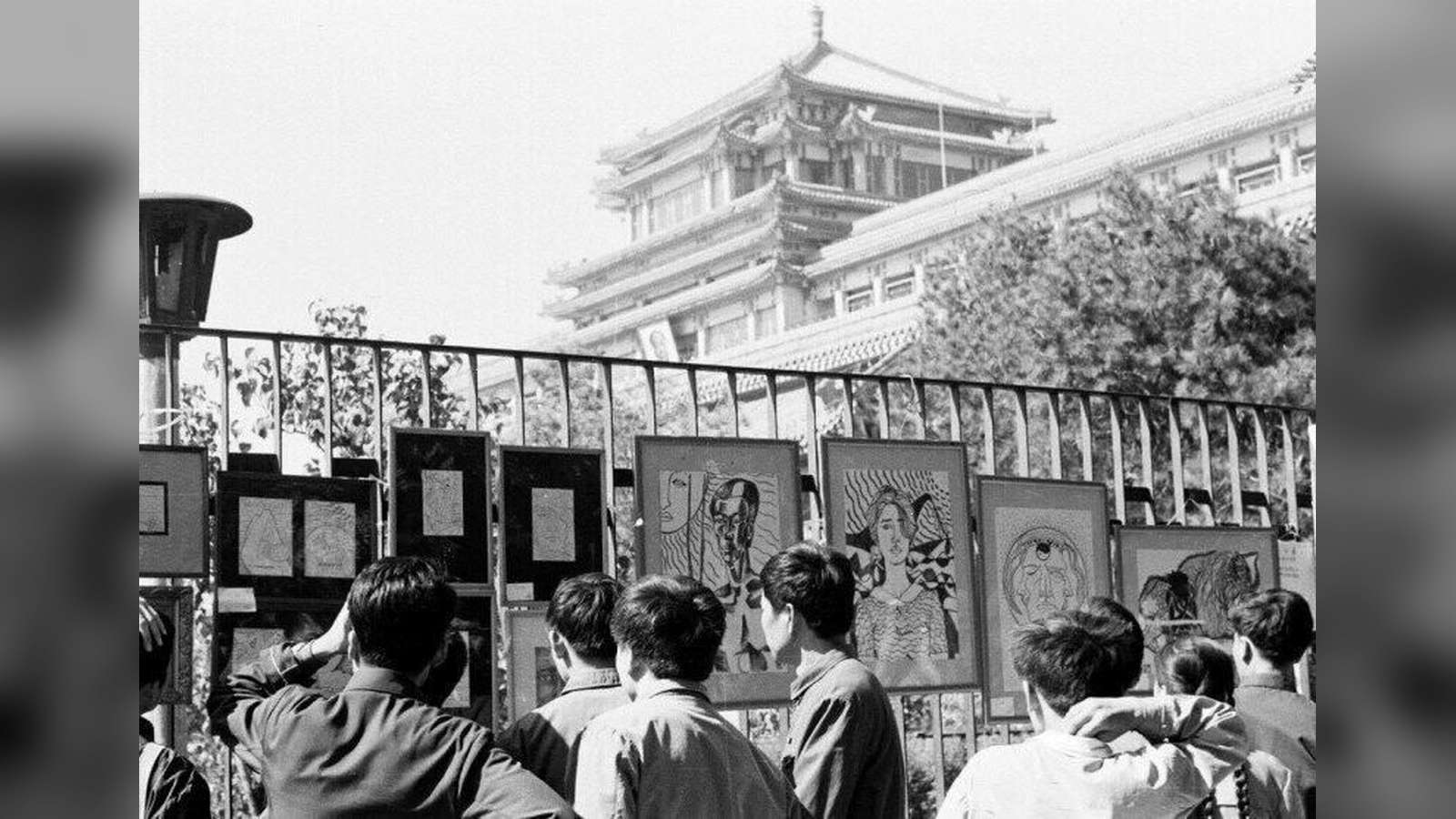
In this black-and-white photograph, the exterior railings of the National Art Museum of China in Beijing do not keep people out; instead, they serve as an impromptu gallery wall for an artistic insurrection. Canvases rendered in distorted expressionist strokes, ink experiments, and raw wooden sculptures hang suspended from the spiked iron fence and nearby park trees, while a dense crowd of onlookers—dressed almost uniformly in dark Mao suits and flat worker caps—leans in with quiet intensity. The instant captured on film marks the exact fissure where decades of rigid ideological control over visual culture shattered, raising an urgent question for the viewer: how did an unauthorized street display by twenty-three self-taught youths manage to permanently redefine the cultural landscape of modern China?
What the photograph shows
The frame preserves a scene of stark contrast between official austerity and raw creative non-conformity. In the foreground, dozens of Beijing residents gather on a dusty sidewalk, their bicycles propped nearby, shoulder to shoulder as they inspect works unlike anything publicly exhibited in the People’s Republic since its founding in 1949. Instead of radiant peasant-heroes, heroic Red Army soldiers, or glowing portraits of Chairman Mao Zedong, the works on display feature angular portraits echoing Pablo Picasso, post-impressionist landscapes, somber ink washes, and haunting wooden faces carved with chisels and axes.
The physical composition tells the story of institutional exclusion turned inside out. The massive, neoclassical-socialist roof of the National Art Museum of China looms in the background, barred and inaccessible. Unable to secure gallery space inside, the artists utilized wires, cords, and nails to lash their creations to the perimeter fence and tree trunks of the small adjacent park. Viewers in the photograph crane their necks, pointing fingers, murmuring, and examining hand-lettered paper title tags fluttering in the early autumn breeze. There is no velvet rope or security cordon; the distance between experimental art and the ordinary pedestrian is collapsed entirely.
The moment behind the image
This defining moment occurred on the morning of September 27, 1979. The informal collective known as the Stars Art Group (Xingxing), spearheaded by Huang Rui, Ma Desheng, Wang Keping, and Qu Leilei, arrived at daybreak to mount more than 100 pieces along the eastern perimeter wall of the national museum. The group, which also numbered among its circle a 22-year-old Ai Weiwei, Li Shuang, and Bo Yun, had applied for permission to exhibit inside the halls but were rebuffed by the official artists’ association.
Rather than retreating into private apartments, the group took their work into the open street. For forty-eight hours, the makeshift open-air exhibition generated an electric public reaction, drawing thousands of curious citizens, intellectuals, foreign journalists, and diplomats. By September 29, however, officers from the Dongcheng Public Security Bureau arrived, declaring the gathering illegal, cordoning off the fence, and confiscating the remaining artworks. The sudden shutdown did not silence the artists; instead, they aligned with contributors to the underground literary journal Today (Jintian) and activists from the Democracy Wall movement, staging a historic protest march on October 1—the 30th anniversary of the People’s Republic—chanting slogans demanding constitutional rights and artistic liberty.
Photographer and provenance
The visual memory of the Stars exhibition survived largely thanks to a small circle of photojournalists and artist-activists working under considerable legal risk. Notably, photojournalist Liu Heung Shing, then documenting Beijing’s cautious early reforms for international news wires, captured indelible images of the crowds and the confrontational installation. Alongside Liu, local participants and documentary chroniclers such as Chi Xiaoning and Li Xiaobin preserved photographic negatives that documented both the fence exhibition and the subsequent protest march.
In the tense political climate of autumn 1979, pointing a camera at unauthorized public assemblies and police activity carried severe hazards of confiscation and interrogation. Many negatives were hidden away in private drawers for years. As the Stars achieved landmark historical status—celebrated decades later in retrospectives at Beijing’s OCAT Research Center, Art Basel Hong Kong, and international institutions—these surviving photographs shifted from endangered subversive documentation into primary artifacts of modern art history.
Historical context
To understand the shock registered on the faces in the photograph, one must recall the decade that preceded it. The Cultural Revolution (1966–1976) had decimated the country’s intellectual life, reducing visual expression to narrow propaganda guided by the Gang of Four. Only works following strict Socialist Realism—depicting party orthodoxy with hyper-romanticized optimism—were permitted in public.
Following Mao’s death in 1976 and the launch of Deng Xiaoping’s “Reform and Opening Up” policies in late 1978, a cautious ideological thaw began. Ideas of free expression coalesced briefly around the Xidan Democracy Wall, where citizens pasted handwritten political essays and poems. The Stars exhibition was the visual counterpart to this movement. Their works did not merely introduce Western modernist styles like Cubism or Expressionism to China; they introduced personal grief, alienation, skepticism, and human vulnerability—emotions completely excised from public life for thirty years. Wang Keping’s contorted wooden head with an open, gasping mouth, titled Silence, gave physical form to a generation denied speech.
Why it still matters
Though authorities cracked down on unofficial movements shortly after, the Stars broke an aesthetic monopoly that could never truly be restored. Within a year of the sidewalk exhibition, the authorities granted the group an official exhibition inside the very museum whose gates they had picketed. While political tightening during the 1983 Campaign Against Spiritual Pollution drove many members into exile, the 1979 exhibition served as the direct catalyst for the explosive “85 New Wave Movement” and the internationally recognized Chinese avant-garde.
The image of paintings lashed to an iron railing remains a poignant visual testament to creative resilience. It proves that contemporary art in China was not an imported luxury or an academic exercise, but a grassroots civic struggle waged in broad daylight on the capital’s streets, claiming the right to see, feel, and create without state mediation.