


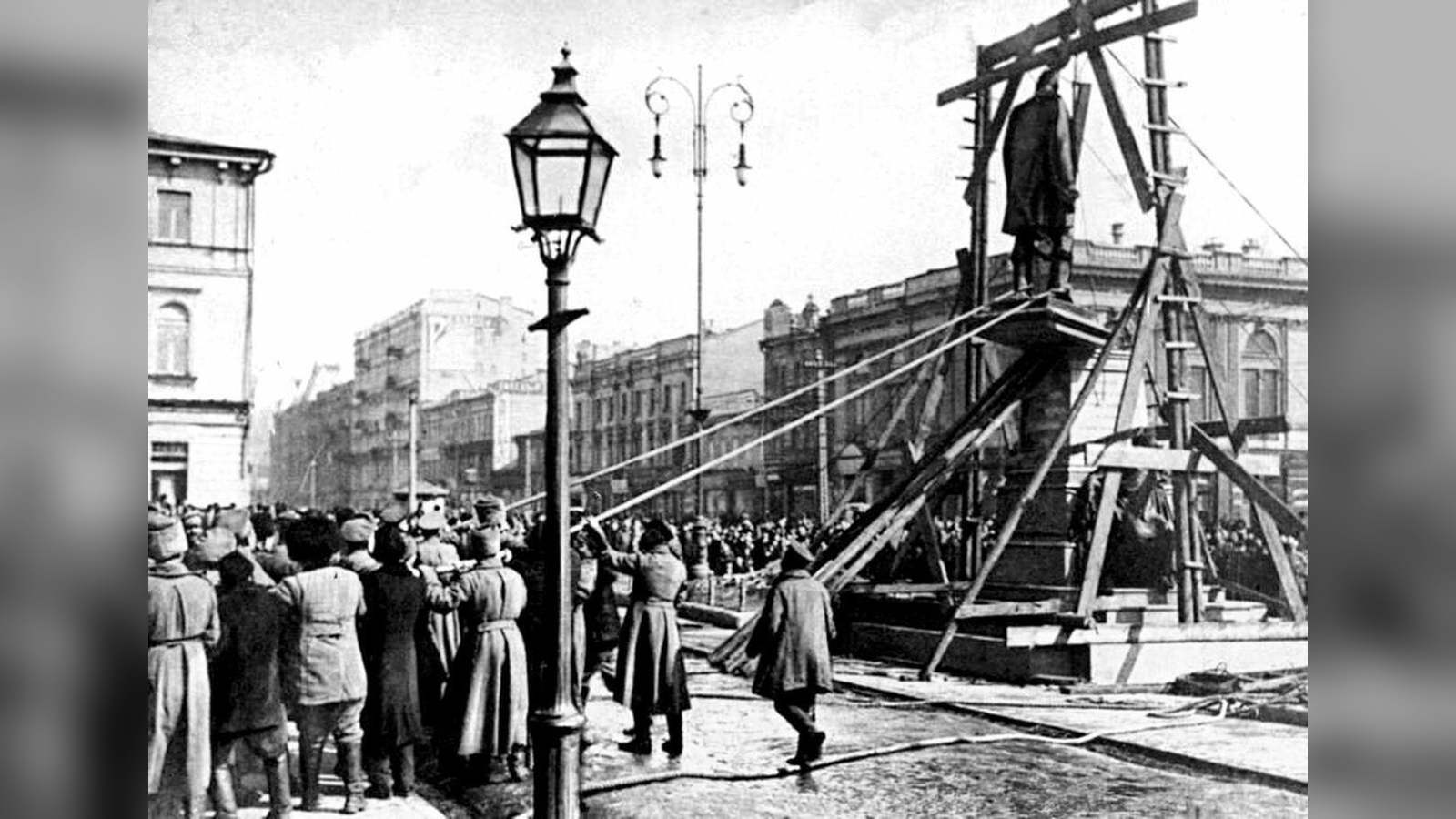
This photograph captures a visceral moment of historical rupture: a group of revolutionaries in Kiev, surrounded by a curious and emboldened crowd, is in the process of dismantling the bronze statue of Pyotr Stolypin. The image acts as a visual anchor for the collapse of the Russian Empire, turning the center of Kiev’s administrative life into a stage for iconoclasm. The frame is dominated by the tension between the rigid, authoritarian bronze figure and the chaotic, kinetic energy of the men pulling on ropes, effectively ending the monument’s four-year lifespan. It is a document of the exact second when the past was physically torn from its pedestal to make way for an uncertain, revolutionary future.
What the photograph shows
The photograph presents a scene of calculated destruction. The statue of Pyotr Stolypin, once a symbol of state stability, is suspended in mid-air, caught in the precarious process of being lowered from its granite pedestal. The composition is striking for its deliberate mimicry of an execution: the revolutionaries constructed a makeshift frame that resembles a gallows. Ropes are taut, straining under the weight of the bronze, while the crowd below watches with a mixture of triumph, exhaustion, and anticipation. The backdrop is the Kiev City Duma, a building that represented the very authority the revolutionaries were now actively dismantling. Every detail—from the men climbing the pedestal to the onlookers in their heavy 1917-era overcoats—speaks to the sudden transition of power from the imperial bureaucracy to the street.
The moment behind the image
The monument was removed on March 30, 1917, just weeks after the February Revolution swept through the Russian Empire. The atmosphere in Kiev was volatile, with the city serving as a crucible for competing political visions. Before the physical demolition, local revolutionary committees organized a ‘people’s court’ at the foot of the statue. They symbolically indicted Stolypin for his harsh domestic policies, including the mass use of field courts-martial during the 1905–1907 unrest. The choice of a gallows-like structure for the removal was not accidental; it was a direct reference to the ‘Stolypin necktie’—a derogatory term for the nooses used during his crackdown on revolutionaries. The act was a ritualized public shaming of a man who had been assassinated in that same city six years earlier. The crowd was not just removing a statue; they were performing a political exorcism.
Photographer and provenance
The specific photographer behind this image remains unknown, a common occurrence for such politically charged street-level photography during the chaotic days of 1917. Such images were often captured by amateur photographers, journalists, or revolutionary documentarians who sought to record the ‘new reality.’ The provenance of the image is tied to the broader archive of the 1917 revolution in Ukraine, which was later preserved in state archives. The scarcity of attribution reflects the fact that in the spring of 1917, the act of documenting the destruction of imperial symbols was more important than the individual identity of the person holding the camera. These negatives were often handed over to local newspapers or revolutionary committees, circulating as pamphlets or broadsheets to galvanize support for the new Provisional Government or local soviets.
Historical context
Pyotr Stolypin was a towering, polarizing figure. Appointed Prime Minister in 1906, he sought to modernize the Russian agrarian economy while simultaneously suppressing the revolutionary movement with an iron fist. His assassination in a Kiev theater in 1911 was a watershed moment that deepened the divide between the state and its subjects. The monument, designed by Italian sculptor Ettore Ximenes and unveiled in 1913, was meant to be a permanent tribute to his ‘Great Russia.’ By 1917, however, the political climate had shifted so drastically that the statue became a lightning rod for anger. Its removal was not merely a physical act but a symbolic cleansing of the public space, intended to signal that the old world was well and truly dead. The pedestal, stripped of its bronze, would soon host other, competing symbols of the changing political landscape, including temporary statues of Karl Marx.
Why it still matters
This image is a haunting reminder of the fragility of political symbols. It captures the exact moment when history shifted, turning a monument of a powerful statesman into scrap metal. The photograph survives as a testament to the speed with which public sentiment can turn and how, in times of revolution, the physical environment of a city becomes a battlefield for the soul of the nation. The statue’s subsequent melting down at the Arsenal factory serves as a final, ironic footnote to a life that ended in violence and a legacy that was erased by the very forces he had tried so desperately to suppress. The image forces us to consider how we memorialize power and how quickly those memorials can become targets of the very people they were intended to impress.