


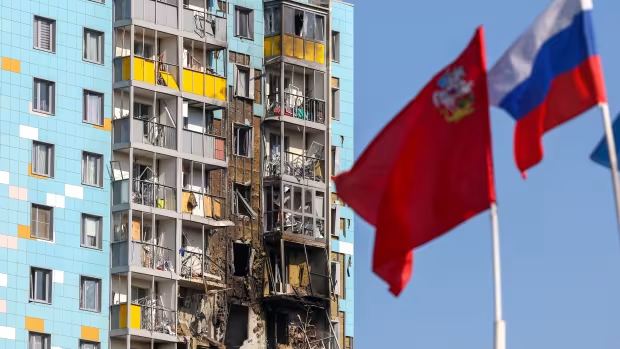
In a dramatic escalation of hostilities, Moscow faced a large-scale drone assault early Sunday morning, with Ukrainian forces deploying 32 unmanned aerial vehicles (UAVs) against targets within the city limits. Moscow Mayor Sergei Sobyanin confirmed that all drones were intercepted by the city’s air defenses, though two buildings sustained damage, and a woman remains in intensive care from related injuries. No fatalities were reported in the immediate aftermath.
The targeted areas included Moscow’s Ramenskoye district, where the impact from drone debris reportedly damaged residential and commercial buildings. Authorities temporarily closed Vnukovo and Domodedovo airports, two of the capital’s largest air travel hubs, as a precautionary measure during the attacks. Flights were diverted, and delays were widespread, but both airports resumed operations shortly after.
The Russian Ministry of Defense released a statement reporting that the drone assault extended beyond Moscow. According to state media, an additional 23 Ukrainian drones were intercepted over the Bryansk, Rostov, Belgorod, and Kursk regions. A ministry spokesperson indicated that Bryansk bore the brunt of these attacks, with 17 UAVs intercepted over its skies, heightening security concerns along Russia’s western border.
These latest drone attacks underscore the increasing technological sophistication and reach of Ukraine’s military capabilities. UAVs have been a cornerstone of Ukraine’s recent strategy, as drones allow strikes on high-value targets deep within Russian territory with minimal personnel risk. Analysts believe Ukraine’s focus on drone warfare marks a shift toward cost-effective strategies that keep Russia on the defensive, stretching its resources while countering its own aerial threats.
Moscow’s response to these drone incursions has been to intensify defensive measures, implementing reinforced air defense networks around key cities and infrastructure. Recent reports indicate that Russia has been fortifying Moscow’s perimeter with additional radar and anti-drone systems. Some Russian defense experts argue that Ukraine’s increased use of drones signals a pivot in the war, enabling Ukraine to achieve significant psychological impact while maintaining relatively low material costs.
The response from the Kremlin has been swift, with officials condemning the attacks as “aggressive acts of terrorism” that endanger civilian lives and provoke instability in the region. Ukrainian officials have yet to comment on the latest assault, but the escalation suggests a continuation of the high-stakes tactical exchanges that have characterized the conflict’s recent months.
For Moscow residents, Sunday’s attacks add to a growing list of wartime disruptions. While the impact on the capital’s infrastructure has been minimal, repeated incursions have heightened public concern. Analysts expect Moscow to bolster its defenses even further, though it remains to be seen how effective these measures will be if Ukraine continues to refine its drone technology.
As both sides persist with their respective strategies, the conflict’s trajectory suggests a prolonged period of aerial skirmishes and retaliatory actions. Experts warn that without diplomatic intervention, escalations in drone warfare may widen the conflict’s scope, drawing in broader international responses and further destabilizing the region.