


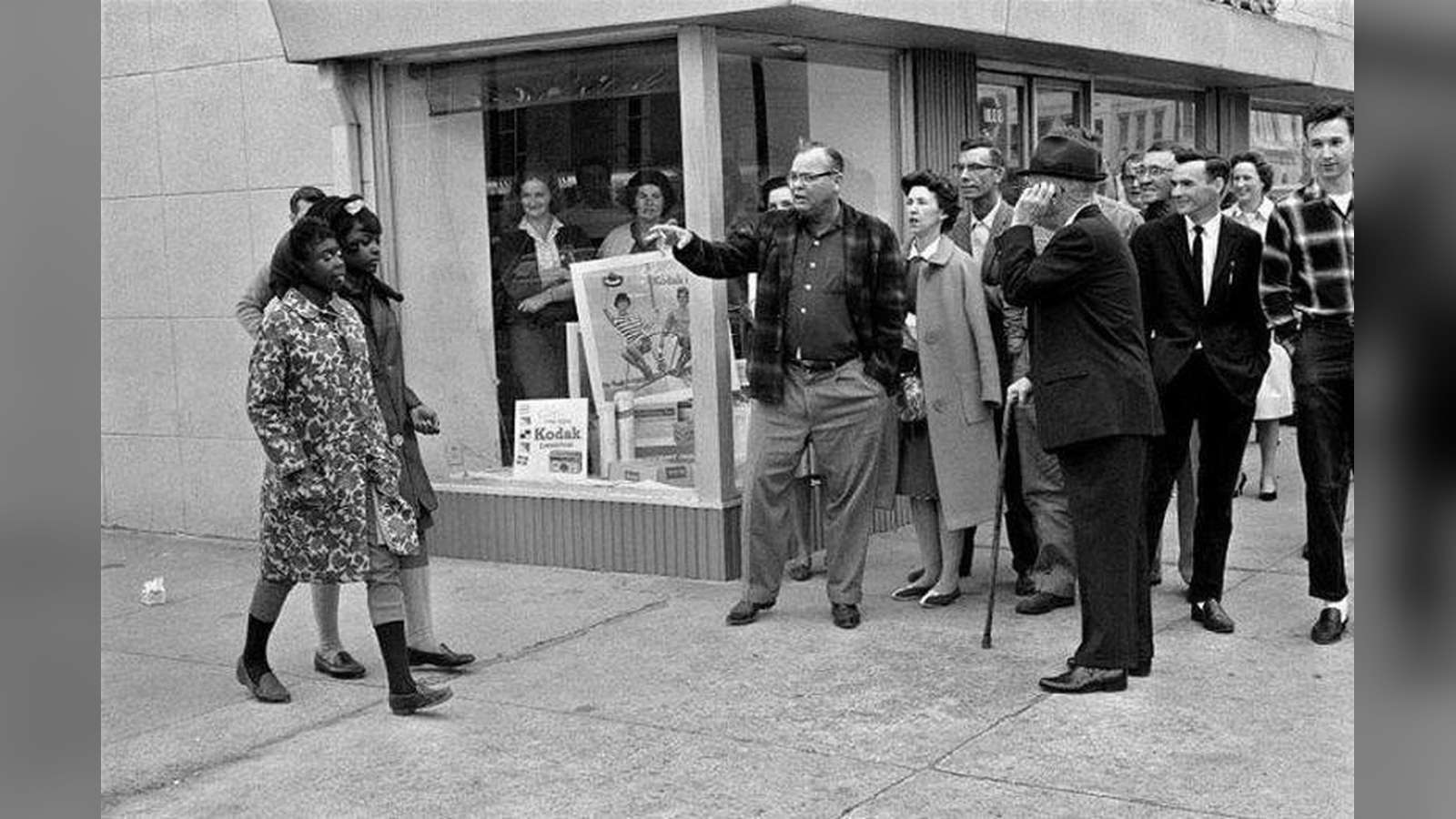
Two women walk with measured composure while behind them a line of white onlookers dissolves into smirks, pointed fingers, and open mockery. Captured at the height of the American civil rights movement in 1965, this photograph exposes the visceral everyday resistance faced by African Americans and their allies as they demanded basic constitutional rights across the United States. Beyond the immediate confrontation visible in the frame, the image poses a fundamental question: how did quiet, nonviolent discipline in the face of intense public contempt become one of the most effective political strategies of the twentieth century?
What the photograph shows
In the foreground, the two female activists present a portrait of quiet composure. Their posture is straight, their facial expressions controlled, and their attire neat and understated—a deliberate aesthetic choice characteristic of mid-1960s civil rights demonstrators who sought to project dignity and moral clarity. By contrast, the background is dominated by a crowd of white bystanders whose faces reveal a spectrum of hostility ranging from amused contempt to aggressive ridicule. Several individuals lean forward, their mouths open in laughter or taunts, while others watch with hardened indifference. The stark visual contrast between the calm restraint of the two women and the unrestrained behavior of the surrounding crowd forms the central narrative tension of the frame.
The moment behind the image
The photograph captures a fleeting yet typical scene from the 1965 civil rights demonstrations, where public streets served as frontline arenas for voting rights and racial desegregation. Before stepping into public spaces, activists organized by groups such as the Southern Christian Leadership Conference (SCLC), the Student Nonviolent Coordinating Committee (SNCC), and the Congress of Racial Equality (CORE) underwent rigorous training in nonviolent direct action. Demonstrators were trained to absorb verbal abuse, taunts, and physical intimidation without retaliating or breaking ranks. Immediately after the shutter clicked, the march or picket line likely continued along its designated route under the watchful eyes of police officers, counter-demonstrators, and press crews.
Photographer and provenance
While specific archival credits for this exact framing vary across press wire syndicates, the image reflects the standard working conditions of news photojournalists during the 1960s. Photographers working for wire services like the Associated Press (AP) and United Press International (UPI), as well as magazines like Life and Look, covered Southern civil rights protests under dangerous conditions. Photographers carried heavy 35mm cameras like Leicas or Nikons, often finding themselves targeted by angry mobs and hostile police officers who resented media coverage. Distributed nationwide through press networks, photographs like this brought the harsh reality of racial antagonism directly into American living rooms.
Historical context: 1965 and the struggle for equality
The year 1965 marked a decisive turning point in the struggle for civil rights in the United States. In March 1965, the violent police repression of peaceful marchers in Selma, Alabama—known as ‘Bloody Sunday’—galvanized national outrage and prompted federal intervention. Later that year, on August 6, President Lyndon B. Johnson signed the landmark Voting Rights Act of 1965 into law, outlawing discriminatory voting practices such as literacy tests that had disenfranchised Black voters for decades. Against this backdrop of legislative battle, everyday street demonstrations across the country highlighted the deep-seated societal resistance to racial desegregation.
Why it still matters
This image survived in press archives and historical collections because it distills the moral contrast of the civil rights movement into a single frame. It demonstrates how photojournalism did not merely document events, but actively shaped public conscience by exposing the stark asymmetry between peaceful protesters and hostile onlookers. Decades later, the photograph stands as a lasting testament to the essential role of women in the civil rights movement and an enduring study in the power of nonviolent resilience.