


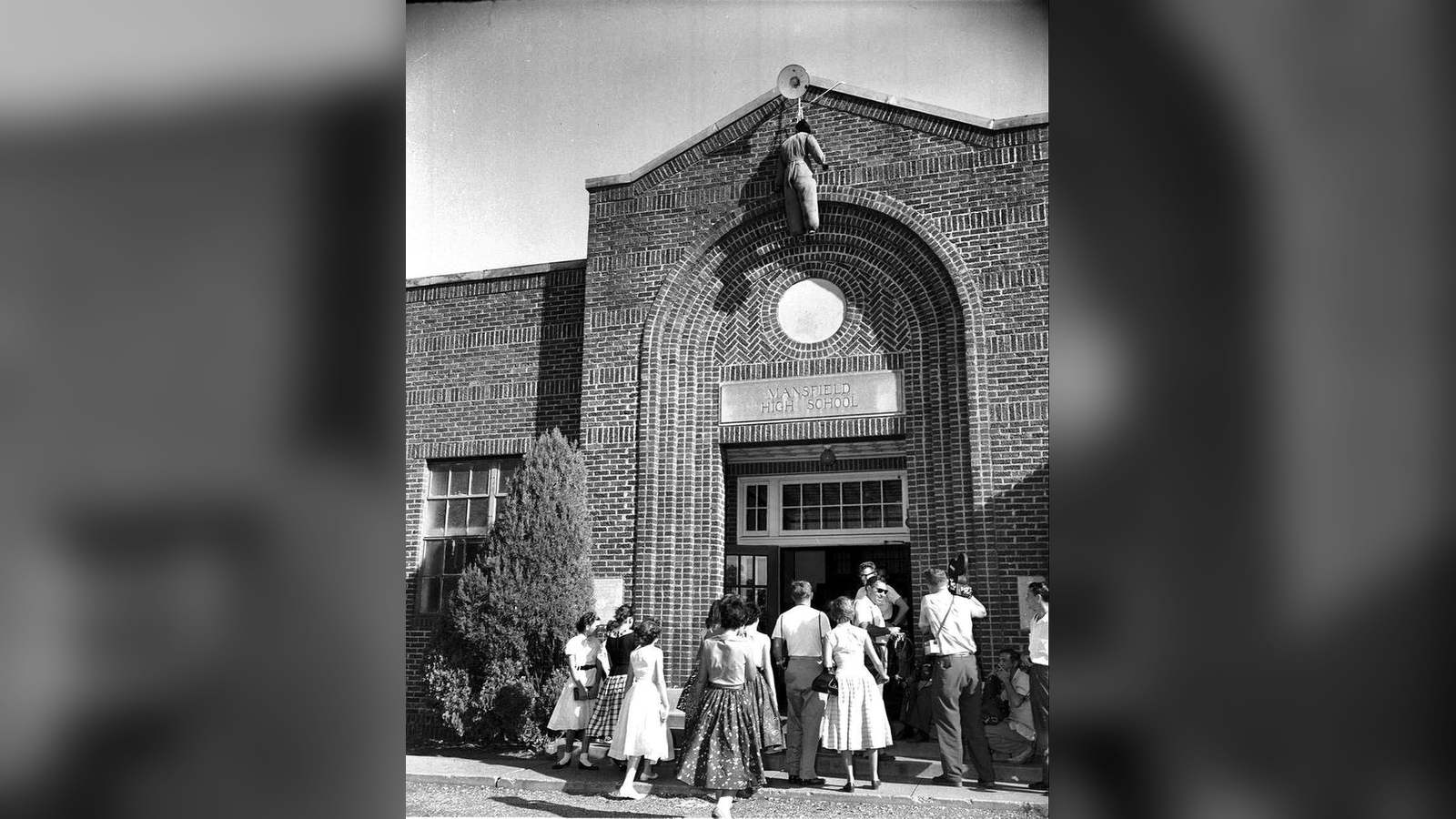
In late August 1956, press photographers arriving at Mansfield High School in Tarrant County, Texas, framed an image that exposed the violent hostility surrounding public school desegregation in the American South. Suspended by a rope above the school’s doorway hung a dark effigy, its neck taut against the brick facade. Below and around it, crowds of angry white residents gathered to block three African American teenagers from enrolling for the fall semester. This photograph did not merely record a local protest; it captured the stark human reality of racial intimidation and raised a pivotal national question: would federal civil rights mandates be enforced by the state, or abandoned to mob rule?
What the photograph shows
The image reveals a stark visual composition dominated by the architecture of the public school and the symbolic violence staged at its entrance. The effigy, constructed from stuffed clothing and fashioned to resemble a Black person, hangs centrally over the main doorway. The dark form stands out sharply against the sunlit brick wall and white painted window trim of Mansfield High School. Below the hanging figure, members of an all-white crowd cluster near the walkways and steps. Some onlookers gaze directly up at the dummy with smiles or posture of approval, while others monitor the perimeter to block any approaching African Americans or outside journalists. The photograph relies on available daylight, bringing out the coarse details of the effigy and the summer clothing of the crowd, documenting a public display of hatred staged openly in broad daylight.
The moment behind the image
The photograph was taken between August 30 and August 31, 1956, as the Mansfield Independent School District prepared for the start of the academic year. Days earlier, U.S. District Judge Joe Ewing Estes had issued a landmark ruling ordering the school district to desegregate. The lawsuit had been brought by the National Association for the Advancement of Colored People (NAACP) on behalf of three Black high school students: T.M. Moody, John F. Lawson, and Mark Moody. At the time, Mansfield’s public school system segregated its small Black student population into a substandard four-room elementary school, forcing high school students to commute by bus into nearby Fort Worth and then walk twenty blocks to the segregated I.M. Terrell High School.
When news of Judge Estes’s order spread, local defiance erupted. Mayor William Arnold “Bud” Halbert and Police Chief C.G. Harwell publicly declared they would not cooperate with desegregation. Encouraged by local leadership, a mob of nearly 400 white residents surrounded Mansfield High School. Protesters strung up effigies at the school entrance and across downtown streets, harassed visiting reporters, and threatened Tarrant County Sheriff Harlan Wright when he attempted to intervene. Downtown businesses closed in solidarity with the blockade, and armed vigilantes stopped incoming vehicles to search for integration supporters.
Photographer and provenance
The photograph was produced by wire service news photographers covering the unfolding crisis for national press agencies, including the Associated Press and regional newspapers such as the Fort Worth Star-Telegram. Photographers working in Mansfield faced severe physical hostility; members of the mob assaulted several reporters and smashed camera equipment to prevent coverage of their actions. Despite these threats, photojournalists managed to preserve negatives of the effigy and the surrounding crowds. These images quickly circulated across American newspapers and international media, providing undeniable visual evidence of the intimidation tactics used to uphold Jim Crow segregation. Today, copies and original prints of the photograph are preserved in archives such as the Texas State Library and Archives Commission and the Special Collections at the University of Texas at Arlington.
Historical context and state resistance
The crisis at Mansfield represented the first test of federal court-ordered desegregation in Texas following the Supreme Court’s landmark 1954 Brown v. Board of Education ruling. However, instead of upholding federal authority, Texas Governor R. Allan Shivers intervened to defeat integration. Citing the risk of public disorder, Shivers deployed the Texas Rangers to Mansfield on August 31. Rather than protecting the three Black students exercising their constitutional rights, the Rangers were instructed to maintain order by keeping the Black students out of the school and authorizing the school board to transfer them back to Fort Worth.
This action marked the nation’s first major failure to enforce a federal court order for school integration. Governor Shivers’ defiance provided a successful legal and political playbook for other Southern governors opposing civil rights. The unresolved crisis in Mansfield directly influenced the violent resistance at Little Rock Central High School in Arkansas in 1957 and the University of Mississippi in 1962. It also emboldened the Texas state legislature to pass a series of segregationist laws in 1957 that stalled public school integration across Texas for nearly a decade.
Why it still matters
The photograph of the Mansfield High School effigy remains one of the most powerful visual records of the massive resistance movement in the Civil Rights era. Mansfield High School did not ultimately integrate until 1965, when the threat of losing federal funding finally forced compliance—a decade after the initial legal battle began. The image stands as an enduring historical artifact, confronting viewers with the visceral reality of white supremacy and highlighting the profound gap that existed between federal judicial rulings and their enforcement on the ground in 1950s America.