


What the photograph shows
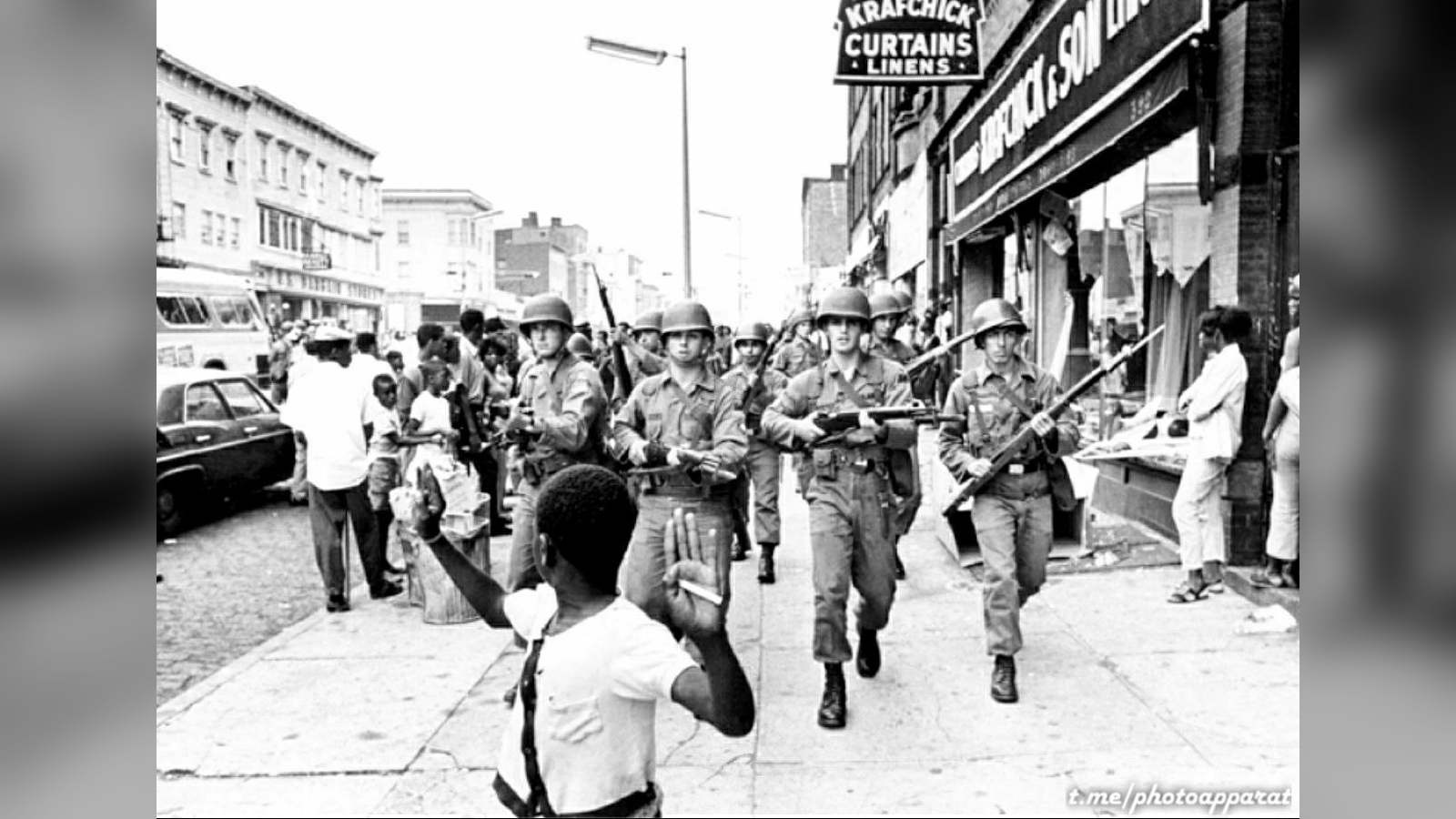
In this arresting visual document from July 1967, federal military forces and heavily equipped police officers occupy the sunbaked, ash-strewn avenues of Detroit, transforming a major American industrial center into an armed combat zone. Framed against the shattered storefronts and smoke-tinged skyline of 12th Street, the photograph captures soldiers in full military gear, bayonets and rifles at the ready, standing watch over broken glass, debris, and empty residential blocks. The frame freezes a singular, chilling instant in American history: the moment when domestic social crisis escalated beyond civilian law enforcement, compelling President Lyndon B. Johnson to authorize the deployment of thousands of U.S. Army paratroopers to patrol domestic city streets. By examining this image, we confront an essential question: how did long-brewing systemic inequality, police friction, and economic disenfranchisement explode into a five-day uprising that required federal military occupation to quell?
In the foreground and mid-ground of this photograph, the physical reality of militarized intervention is laid bare. Soldiers from the U.S. Army—equipped with steel helmets, heavy fatigues, and service rifles—stand positioned along the pavement of 12th Street, the commercial heart of Detroit’s predominantly Black Virginia Park neighborhood. The backdrop features commercial facades stripped of their glass windows, brick structures scorched by fire, and wooden boards hastily nailed across entryways to deter further looting. The composition emphasizes a stark contrast: the disciplined, heavy posture of federal troops and riot-geared police officers set against the chaotic, ruined urban landscape of a working-class neighborhood. Dust, light smoke, and scattered household detritus line the gutters, while the shadows suggest the oppressive heat of midsummer. Every detail in the frame—from the tense stance of the soldiers to the vacant, charred storefronts—conveys an atmosphere of strict containment, where an American city was temporarily ruled by curfews, armored personnel carriers, and armed patrols.
The moment behind the image
The flashpoint that led to this militarized scene occurred in the early hours of Sunday, July 23, 1967. At approximately 3:15 a.m., Detroit police officers launched a routine vice squad raid on an unlicensed after-hours drinking establishment, known locally as a ‘blind pig,’ located at the corner of 12th Street and Clairmont Avenue. The venue was hosting a welcome-home party for several local residents, including two African American servicemen who had recently returned from fighting in the Vietnam War. Expecting only a dozen patrons, police discovered over 80 people inside and decided to arrest everyone present. As officers lined up the patrons on the sidewalk to await police wagons, a crowd of neighbors and passersby gathered under the humid night air. Decades of resentment over police harassment and racial profiling boiled over; verbal protests quickly turned into thrown bottles and rocks. By morning, fires were burning along 12th Street, and looting spread rapidly across Linwood, Dexter, and Livernois avenues. When local police and state troopers failed to contain the expanding civil unrest, Michigan Governor George Romney requested federal assistance. On July 25, President Johnson invoked federal authority, dispatching 17,000 U.S. Army paratroopers—including combat-tested soldiers from the 82nd and 101st Airborne Divisions—and National Guard troops to join state and local police.
Photographer and provenance
This striking photograph survives as part of the permanent archival collections at the Walter P. Reuther Library, Archives of Labor and Urban Affairs at Wayne State University in Detroit. Photojournalists operating in Detroit during late July 1967 faced extraordinary physical danger and logistical obstacles, navigating sniper fire, tear gas, burning buildings, and unpredictable confrontations between military patrols and angry residents. While press outlets at the time often framed these images around themes of property destruction and mob violence, modern archival preservation allows historians to analyze the photographs with greater visual and contextual depth. Archives like the Reuther Library preserve these visual artifacts alongside administrative memos, police logs, and oral histories, ensuring that the visual record documents not only the physical enforcement of order but also the human reality of a community under military occupation.
Historical context
The Detroit uprising was not an isolated outburst, but rather the most explosive episode of what historians term the ‘Long Hot Summer’ of 1967. Across the United States, 164 civil disturbances erupted in the first nine months of that year alone, reflecting widespread anger among Black Americans living in northern industrial cities. While civil rights legislation in 1964 and 1965 dismantled formal Jim Crow segregation in the South, cities like Detroit suffered from deep-seated structural inequality. Following World War II, major automobile manufacturers began relocating production plants from inner-city Detroit to outer suburbs, sparking a massive exodus of white residents known as ‘white flight.’ Black Detroiters were systematically excluded from suburban housing through discriminatory real estate practices, trapping thousands in overcrowded neighborhoods like Virginia Park, where 60,000 low-income residents were squeezed into 460 acres. Compounding these economic pressures was the Detroit Police Department, which was 95 percent white and frequently utilized aggressive tactics, such as stop-and-frisk stops by specialized Tactical Mobile Units. Following five days of violence that left 43 people dead, over 1,100 injured, and more than 7,000 arrested, President Johnson formed the Kerner Commission to investigate the root causes of urban unrest. Released in February 1968, the commission’s landmark report concluded that the United States was ‘moving toward two societies, one Black, one white—separate and unequal.’
Why it still matters
More than half a century later, this photograph remains a crucial touchstone for understanding urban politics, civil rights, and state power in modern America. Institutions such as the Detroit Historical Museum, through its permanent exhibition ‘Detroit 67: Perspectives,’ and the Charles H. Wright Museum of African American History use this imagery to challenge traditional media narratives that historically labeled the event merely as a ‘riot.’ By reframing the moment as a ‘rebellion’ or ‘uprising,’ historians emphasize that the violence was an organized and desperate reaction against systemic injustice, housing discrimination, and police misconduct. Looking closely at this photograph forces contemporary viewers to re-examine the boundaries of law enforcement, the ethics of military intervention in domestic cities, and the persistent duty to address social grievances before they manifest in crisis.