


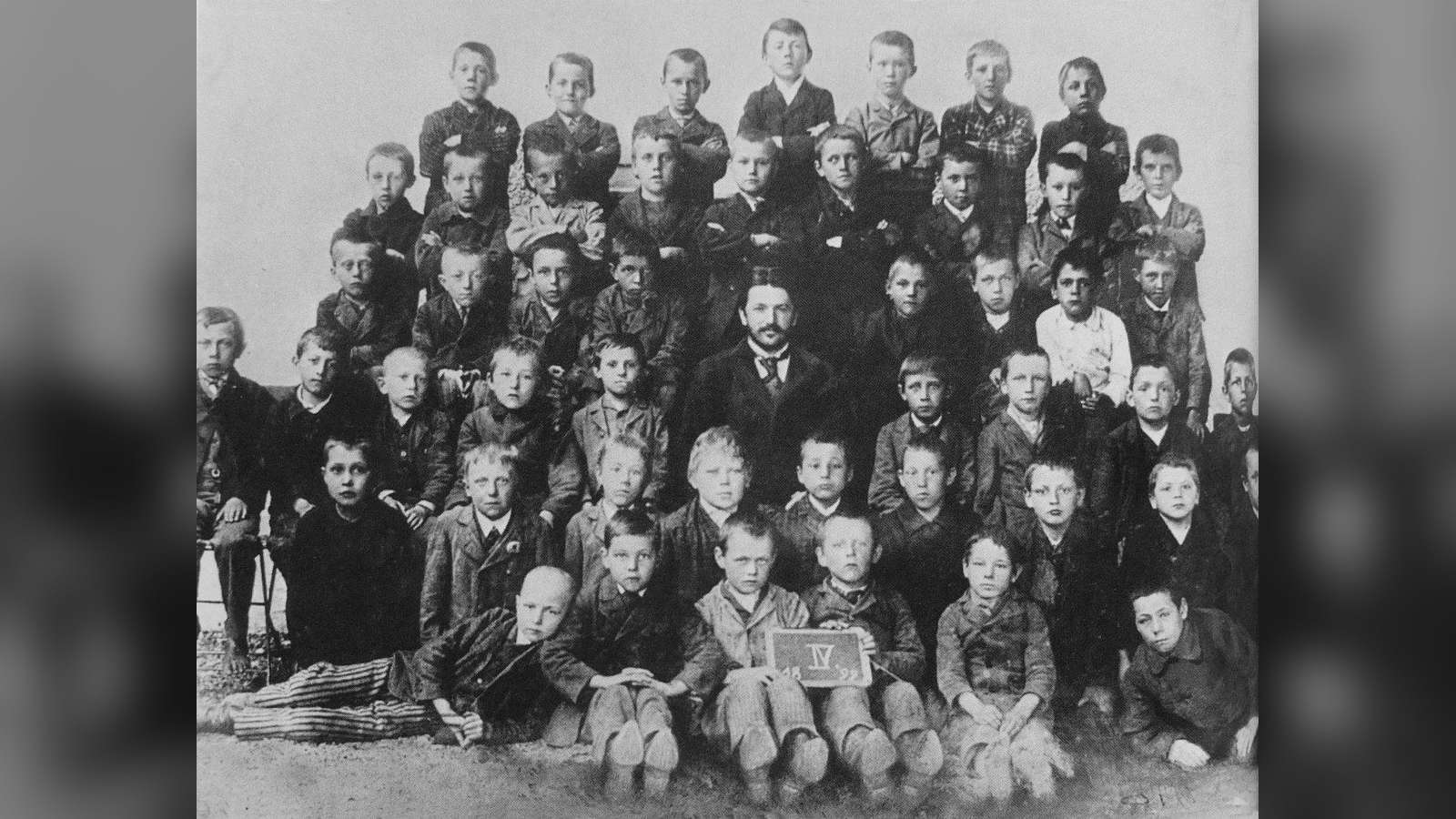
The photograph captures a frozen moment of late 19th-century provincial life: a class of young boys, dressed in the stiff, buttoned-up wool jackets and collars characteristic of Austrian primary education in the 1890s, posed for a formal group portrait. In the center of the back row, standing with a posture that is neither particularly defiant nor submissive, is a ten-year-old Adolf Hitler. His expression is neutral, his gaze directed toward the lens with the same focus as his classmates. The image, taken in 1899 in the village of Leonding, near Linz, is a stark visual record of a boy who was, at that precise moment, indistinguishable from the other children of the Austro-Hungarian Empire. The photograph is a primary document that forces the viewer to confront the terrifying ordinariness of the origins of one of history’s most destructive figures.
What the photograph shows
Visually, the photograph is a classic example of turn-of-the-century studio or school photography. The composition is rigid, with the children arranged in tiered rows to ensure every face is visible. The lighting is flat, typical of early amateur or semi-professional portraiture, emphasizing the texture of the boys’ clothing and the stark backdrop of the school wall. Hitler’s face, while young, already possesses the sharp, somewhat intense features that would later become recognizable to the entire world. There is no sinister aura here; instead, there is the palpable stillness of childhood. The boys are caught in a moment of forced discipline—their hands are placed on their knees or at their sides, and their expressions range from mild curiosity to boredom. It is this very lack of distinctiveness that makes the photograph so unsettling for the modern observer.
The moment behind the image
In 1899, the Hitler family was navigating a period of transition. Adolf’s father, Alois, had retired from his career in the customs service in 1895 and had moved the family to Hafeld, and later to Leonding. This period was marked by the young Hitler’s growing resistance to his father’s rigid expectations. Alois had hoped his son would follow in his bureaucratic footsteps, but Adolf was increasingly drawn to the arts and history, a conflict that defined his adolescence. The photograph was likely taken as a standard annual record for the school, a common practice in the Austrian school system at the time. It captures a time when the young Adolf was still navigating his father’s authoritarian influence and the early stages of his own developing sense of self. The shutter click was merely a routine event in a quiet village, far removed from the geopolitical catastrophes he would later ignite.
Photographer and provenance
The provenance of this specific photograph remains tied to the archives of the period. Like many images of Hitler’s childhood, it was likely kept by the family or within the school records before being unearthed by historians and researchers in the decades following the Second World War. The identity of the photographer is not definitively recorded, as many such school portraits were taken by local itinerant photographers or studio owners commissioned by the school administration. These images were intended for private family albums or as keepsakes for the students. The survival and subsequent circulation of this specific frame are due to its historical value as a visual record of the future Führer’s early life, providing researchers with insight into his environment and social standing before the radicalization he would later undergo in Vienna.
Historical context
The late 1890s in Austria were a time of rising German nationalism. While this classroom appears idyllic, the cultural currents of the time were shifting. The Habsburg Empire was a fragile, multi-ethnic entity, and many young people in the German-speaking regions were beginning to adopt pan-German nationalist ideas, rejecting the perceived decline of the monarchy. Hitler’s own development during these years was shaped by his school experiences and his internal rebellion against his father. Historians, including Ian Kershaw, have analyzed this period to understand how a child from such a common, rural background could eventually become the embodiment of modern political evil. The photograph serves as a reminder that the seeds of radicalization often grow in the soil of ordinary, everyday life, far from the halls of power where their consequences are eventually felt.
Why it still matters
This photograph remains powerful because it resists the urge to project the monster onto the child. It is a document of potential. In 1899, Adolf Hitler was a boy with a future that was not yet written in blood. The image challenges the viewer to look past the historical weight of his name and see the child. It reminds us that history is not a series of inevitable events driven by demons, but a sequence of choices made by individuals who emerge from the most common of beginnings. The distance between this classroom in Leonding and the bunkers of 1945 is vast, yet this photograph bridges that gap, showing us that the most profound tragedies often start with the most unremarkable faces.