


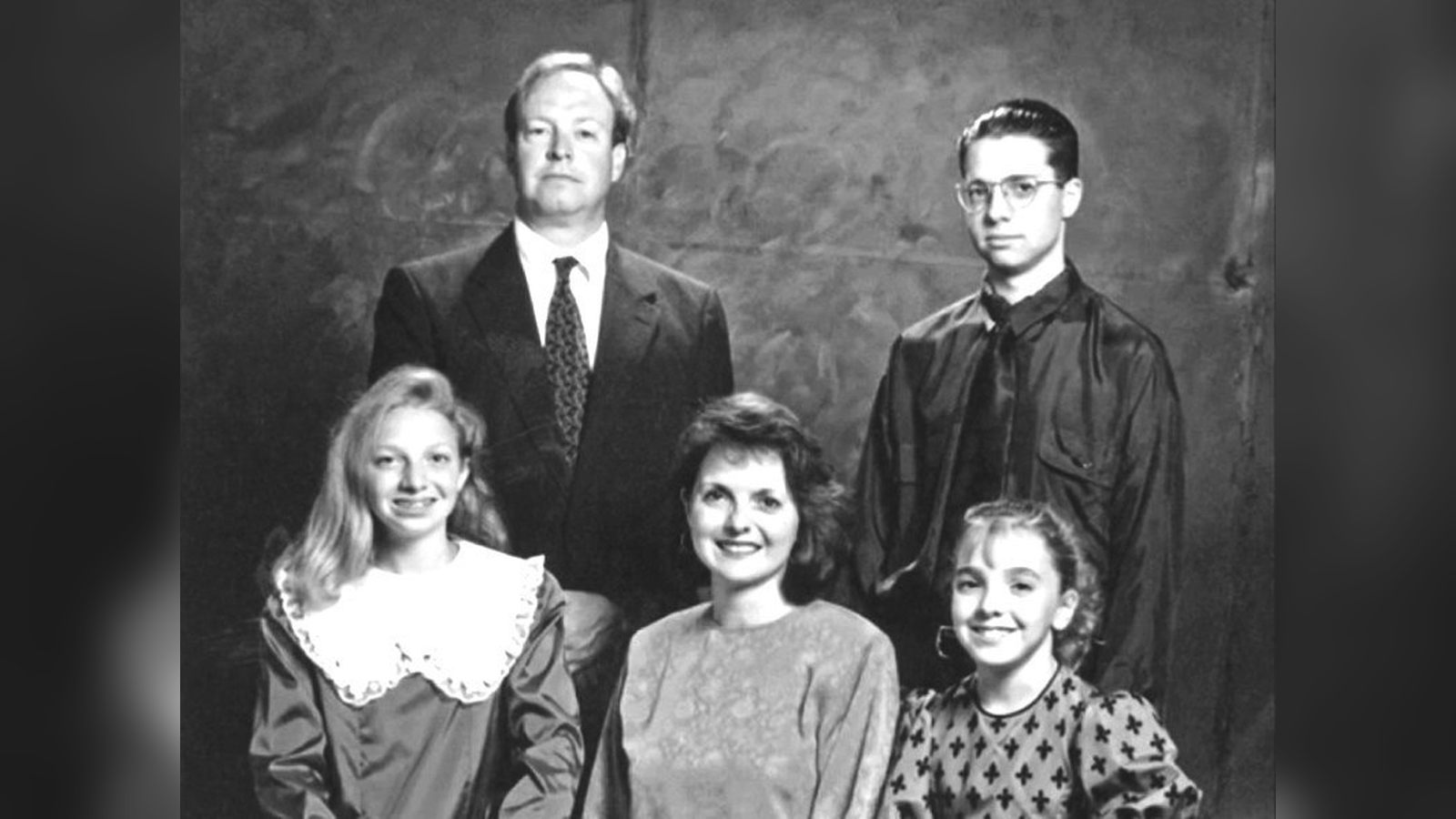
This haunting family portrait captures members of the Shrout household posing together, preserving an ordinary domestic moment just weeks before an unimaginable domestic catastrophe unfolded in Kent, Washington. At first glance, the frame presents a standard suburban family grouping, marked by the typical expressions, relaxed postures, and casual interior settings characteristic of mid-1990s domestic photography. Yet, knowing the historical outcome completely transforms the visual reading of every face, gaze, and spatial arrangement within the composition. The photograph serves as a chilling reminder of how ordinary domestic archives can suddenly intersect with profound tragedy, forcing viewers to look past the surface calm into a terrifying psychological abyss.
What the photograph shows
In the frame, family members are arranged in a classic portrait composition, reflecting the informal conventions of American family portraiture from the mid-1990s. The lighting is soft and domestic, highlighting casual clothing, unremarkable indoor surroundings, and domestic furnishings that give no hint of the violence to come. The subjects look toward the camera lens with neutral, composed, or faintly smiling expressions, embodying the standard visual tropes of familial harmony. Separating direct visual observation from the tragic history behind the image, nothing in their physical appearance, posture, or immediate environment betrays the dark motivations secretly harbored under the same roof. The background details remain indistinct and ordinary, anchored in the mundane reality of suburban life before it was shattered.
The moment behind the image
The photograph was captured shortly before May 26, 1994, inside the Shrout family home in Kent, Washington. On that fateful day, 17-year-old Clay Shrout turned a firearm against his family, executing his mother, father, and younger siblings in a meticulously planned domestic massacre. The immediate catalyst for the murders was not a sudden argument, an emotional outburst, or a fit of domestic rage, but a chillingly cold-blooded calculation. Clay had been secretly planning a mass shooting at his high school and grew increasingly convinced that his family members would discover his cache of weapons or otherwise intervene to stop his violent ambitions. Rather than abandoning his plan, he chose to eliminate the perceived obstacles within his own home, extinguishing his family to clear the path for a secondary act of violence.
Photographer and provenance
Like many domestic photographs associated with notorious American crimes, this image originated as an ordinary piece of private family history rather than a professional photojournalistic assignment. Commissioned or taken for personal keepsakes, holiday albums, or mantelpiece displays, the exact identity of the person behind the camera remains anonymous, reflecting the casual nature of home photography. The photograph survived the massacre because it was preserved in private family albums or later retrieved by law enforcement investigators, forensic psychologists, and archival researchers examining the case file. Over time, such haunting visual artifacts migrate from private memorialization into public archives, true-crime databases, and online research communities dedicated to documenting historical tragedies and mass violence.
Historical context
The 1994 Shrout family murders occurred during a transitional period when American society was just beginning to confront the rising shadow of adolescent alienation, youth violence, and suburban crime, directly preceding the more widely studied wave of late-1990s school shootings such as Columbine. The case shocked local law enforcement, school administrators, and the wider community due to its chillingly cold-blooded nature—the deliberate, preemptive slaughter of an entire family simply to clear the path for secondary school violence. Although Clay Shrout’s intended high school attack was ultimately averted because his family had already been murdered and his vehicle later broke down, the case remains a deeply disturbing historical study in adolescent detachment, meticulous planning, and profound psychological alienation.
Why it still matters
Photographs like the Shrout family portrait occupy a deeply unsettling space in visual history and cultural memory. They endure not as aesthetic achievements, but as psychological documents of a terrifying threshold. When viewed in hindsight, the frame forces the viewer to confront the extreme fragility of domestic life and the terrifying reality that immense, premeditated violence can be quietly cultivated behind closed doors, completely disguised by the mundane routines, gentle lighting, and familiar smiles of everyday family existence.