


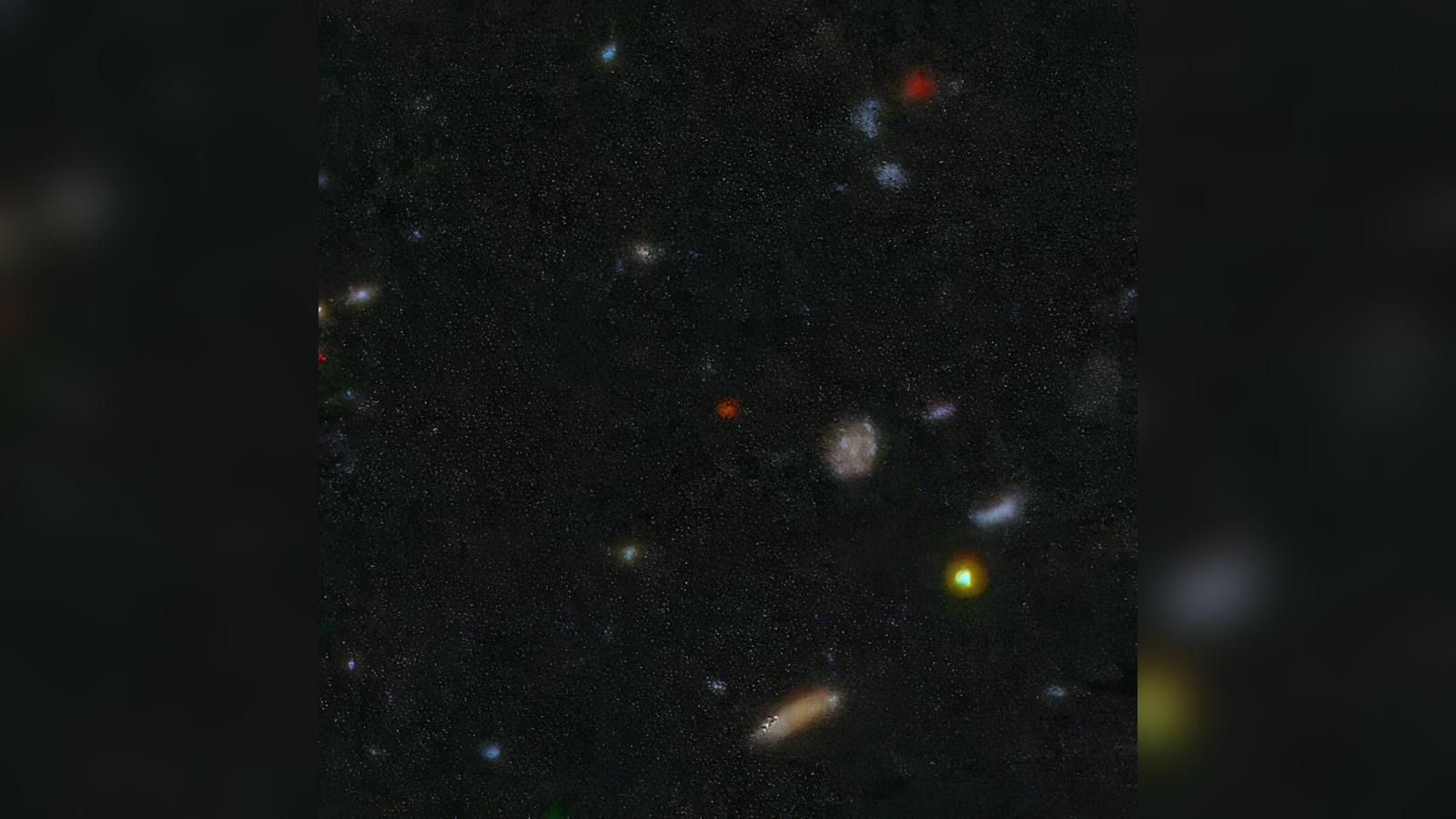
A New Frontier in Cosmic History
Astronomers have identified the oldest and most distant quasar ever observed, providing a new window into the early development of the universe. The object, designated Dún Aonghasa, dates to approximately 13.1 billion years ago, or roughly 630 million years after the Big Bang. This discovery, detailed in research published in the journal Astronomy and Astrophysics, establishes a new record, predating the previous record holder identified in July by 40 million years.
The research team, led by Julien Wolf of the European Southern Observatory, utilized the European Space Agency’s Euclid telescope to detect the object. Further characterization was conducted through a combination of ground- and space-based observatory data. Dún Aonghasa is powered by a supermassive black hole with a mass estimated at 360 million times that of the sun, a size that creates significant challenges for current astrophysical theories regarding the pace of black hole growth in the young universe.
Challenging Theoretical Growth Models
The existence of such a massive black hole within 630 million years of the Big Bang presents a structural dilemma for researchers. Typically, black holes are thought to grow through the slow accretion of surrounding gas, dust, and matter. However, the mass of Dún Aonghasa suggests an accelerated growth trajectory that traditional models struggle to replicate.
According to study co-author Silvia Belladitta of the Max Planck Institute for Astronomy and the INAF Bologna Observatory, there are two primary hypotheses for this rapid maturation. One possibility is that the black hole originated from the remnants of a first-generation star but consumed material at an unusually high rate. Alternatively, the black hole may have been born massive through a process known as “direct collapse,” where large gas clouds remain warm enough to bypass the normal star-formation fragmentation process, allowing for the creation of a singular, enormous celestial object.
The Epoch of Reionization
Dún Aonghasa existed during a transformative epoch of cosmic history, known as the period of reionization. Following the Big Bang, the universe was composed of a dark, dense, and neutral fog of hydrogen gas. As the first stars and galaxies ignited, their intense radiation began to burn through this fog, ultimately making the universe transparent. Finding a quasar of this magnitude during this specific phase provides critical data for understanding how galaxies and supermassive black holes influenced the transition of the early cosmos.
Researchers expect that the Euclid telescope will enable further discoveries, with theoretical models suggesting that even older quasars could date back to between 270 million and 470 million years post-Big Bang. Future observations are currently targeted at searching for these earlier, more distant objects to refine our understanding of galactic evolution.