


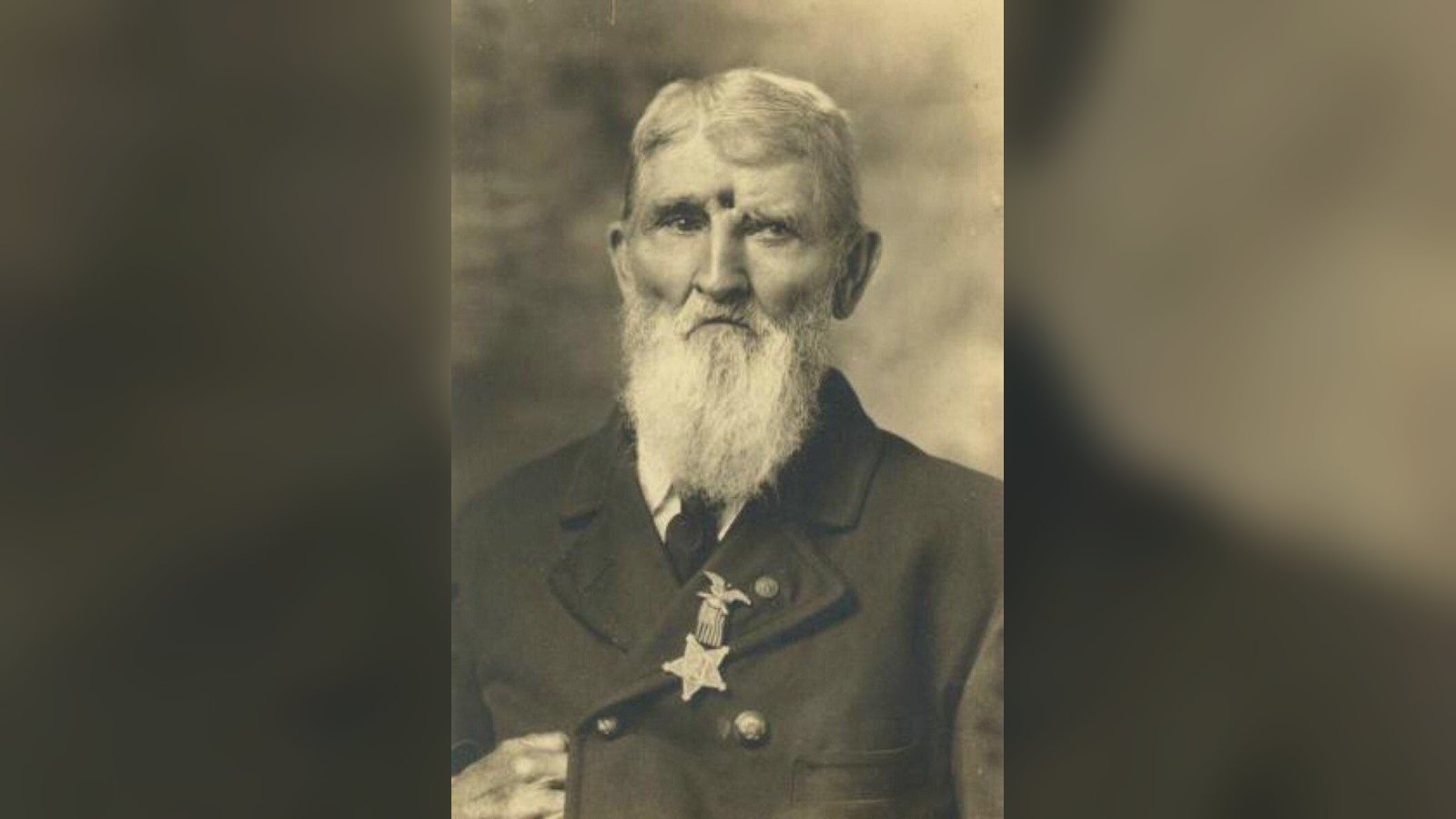
In this stark formal studio portrait, an elderly American Civil War veteran sits before the camera, gazing directly into the lens with an expression of quiet endurance. At first glance, his dark coat and trimmed beard resemble those of thousands of Union pensioners photographed in the late nineteenth and early twentieth centuries. Yet the center of his forehead commands immediate attention: a deep, hollow indentation sits squarely between his eyebrows, marking the exact spot where a Confederate musket ball pierced his skull during the Battle of Chickamauga on September 19, 1863. The photograph is more than a routine portrait; it is physical proof of one of the most astonishing human survivals in military history, posing the enduring question of how a man could carry an open skull wound and embedded lead for over half a century.
What the photograph shows
The image captures Jacob Miller in his later years, likely taken between the 1890s and 1910s when studio portraiture became accessible to veterans attending reunions and documenting their service. Visually, the central focus of the frame is the prominent cranial depression located just above the bridge of his nose. The frontal bone of his skull remains clearly collapsed inward, creating a smooth, bowl-like scar where doctors could once observe the physical pulsations of his brain. His left eye, which was dislodged by the force of the bullet impact, appears slightly lower and noticeably altered compared to his right eye. Miller’s posture is upright and firm, his hands neatly posed, presenting a calm dignity that contrasts sharply with the violent physical ruin preserved in his brow.
The battlefield moment behind the scar
The calamity recorded in this portrait unfolded during the bloodiest day of the Battle of Chickamauga in northern Georgia. Enlisting in 1861 from Logansport, Indiana, Miller served in Company K of the 9th Indiana Infantry and had already fought at Greenbrier, the siege of Corinth, Perryville, and Stones River. On September 19, 1863, a heavy musket ball struck Miller squarely between the eyes, knocking him violently backward onto his back. Believing the wound to be instantly fatal, his company captain famously remarked, “It’s no use to remove poor Miller, for he is dead,” and left his body behind as Union forces fell back under heavy Confederate fire.
When Miller eventually regained consciousness among the dead, he felt the gaping wound with his hands. Finding his left eye dislodged from its socket, he manually adjusted his crushed facial bones, forced the eye back into position, and tied a bandana tightly around his head. With his right eye severely swollen shut, he was essentially blind. Fearing capture and imprisonment by Southern forces, Miller crawled through the carnage on his hands and knees, eventually walking and dragging himself nearly 15 miles toward Union-held Chattanooga. By manually holding open the swollen eyelid of his remaining working eye, he navigated the dusty roads until a passing horseman rescued him and brought him to a field hospital.
Photographer and provenance
While the specific local photographer who exposed this cabinet card portrait remains uncredited in popular archives, the image was created as part of the widespread tradition of Civil War veteran portraiture in the Midwestern United States. Taken after Miller relocated to Joliet, Illinois, the portrait served both as a personal family record and as a visual aid when Miller shared his extraordinary story with local newspapers. The image circulated in regional Indiana and Illinois press accounts during Miller’s lifetime, notably accompanying a detailed first-person interview he gave to a Joliet newspaper in 1911. Today, the photograph is preserved in historical archives and digital military collections as one of the most remarkable primary visual documents of battlefield injury.
Survival, lead fragments, and medical limits
Nineteenth-century military surgeons who examined Miller immediately after the battle declared the wound inoperable, convinced that any attempt to extract the deeply embedded musket ball from his brain cavity would cause immediate death. He was sent home to Logansport, Indiana, where local physicians Dr. Graham Fitch and Dr. Henry Coleman managed to extract approximately one-third of the lead ball from the frontal bone. The remaining lead stayed inside his head for decades. Miller recalled that seventeen years after being wounded, a piece of buckshot naturally worked its way out of the open tissue; thirty-one years after the battle, two additional lead fragments dropped from his forehead wound. In total, the lead gradually migrated out of his body over a 14-year span.
Why it still matters
Jacob Miller lived for 54 years after being left for dead on the field at Chickamauga, passing away on January 13, 1917, at the age of 88. Throughout his civilian life, he married, raised a son, and received a government disability pension. However, the photograph captures a reality of constant suffering: Miller endured perpetual headaches, intense neurological pain, and occasional fits of disorientation. As Miller explained in 1911, he never needed a written diary to recall his war service, stating that the entire scene was “imprinted on my brain as with a steel engraving.” This photograph remains a profound visual document, anchoring an incredible narrative of battlefield survival directly onto the human body.