


China’s economic output expanded by 4.5% in the third quarter of 2026, rebounding from a three-year low of 4.3% recorded in the prior quarter. The rebound, confirmed in official data released by the National Bureau of Statistics on Monday, allowed the world’s second-largest economy to touch the lower band of Beijing’s full-year target range of 4.5% to 5.0%. However, the underlying data reveals a starkly unbalanced recovery driven almost entirely by the international race to build artificial intelligence infrastructure, even as domestic consumption and construction remain severely depressed.
According to the National Bureau of Statistics, the economy demonstrated “momentum with new growth drivers and improving structure” in the face of external and internal headwinds. Yet private economists caution that this performance masks structural imbalances. Rather than a broad-based revival, headline gross domestic product was insulated by an unprecedented boom in advanced hardware, components, and clean energy technology bound for export markets.
Export Engine Driven by Artificial Intelligence and Advanced Tech
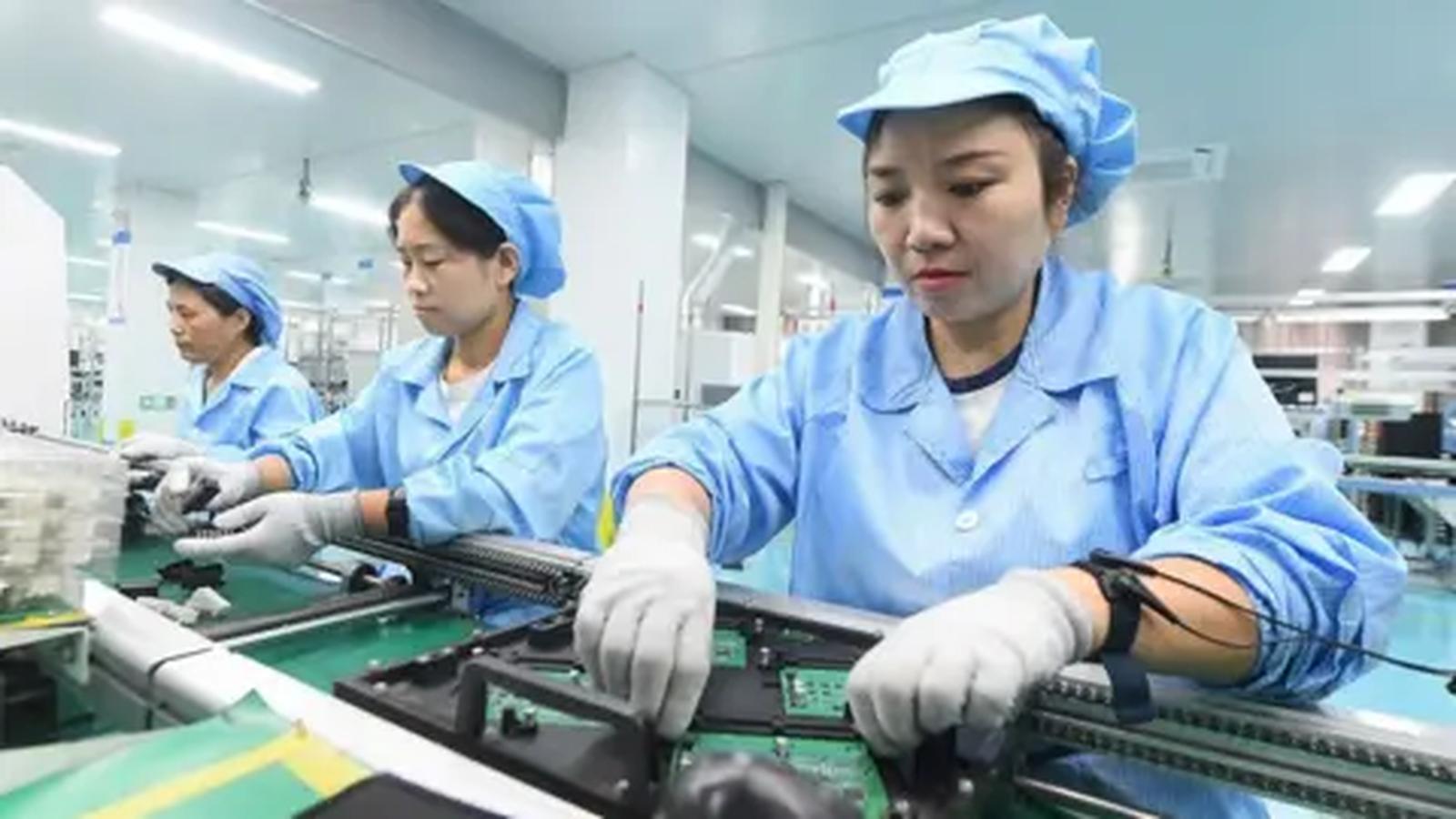
The manufacturing sector functioned as the primary stabilizer for overall growth between July and September. Official figures documented by the BBC revealed that sales of high-tech goods surged by 14.3% year-on-year during the quarter. Concurrently, domestic production of industrial robots and batteries both expanded by more than 29%, reflecting massive state-backed capital allocation into high-end fabrication.
Crucially, global demand for advanced semiconductors, networking equipment, and specialized power systems necessary for running AI data centers provided Chinese exporters with an unexpected lifeline. As hyperscale technology firms worldwide poured hundreds of billions into generative AI capacity, Chinese component suppliers capitalized on supply bottlenecks in tier-two and peripheral hardware components. This momentum helped generate a cumulative trade surplus of $938 billion for the first nine months of the year, putting China on track to eclipse its historical record surplus of $1.2 trillion set in 2025.
Further analysis from AOL noted that a 36% year-on-year leap in overall exports in the final month of the quarter underscored how aggressively Chinese factories have compensated for stagnant domestic order books by redirecting goods abroad.
The Deepening Real Estate Contraction and Consumer Stagnation
In contrast to the tech manufacturing boom, China’s domestic economy continues to suffer from an entrenched balance-sheet recession. Property investment plunged by more than 20% over the first nine months of the year compared to the same period in 2025. Years of developer over-leveraging and subsequent defaults have permanently altered homebuyer sentiment, rendering traditional real estate stimulus measures largely ineffective.
Sheana Yue, an economist at Oxford Economics, pointed out that manufacturing and tech shipments managed to support national growth metrics despite outright contraction in fixed-asset property formation. Yue emphasized that there are no tangible indications that the real estate crisis has found a floor, as domestic households—whose primary wealth store remains tied up in residential property—continue to cut discretionary spending in anticipation of protracted economic stagnation.
Depressed wage growth and persistent youth unemployment have compounded this caution. In response, Beijing introduced targeted interventions in September, including lowering key borrowing rates for small businesses and offering mortgage subsidies to prospective buyers. However, these fiscal and monetary cushions have thus far produced minimal lift in retail sales or consumer confidence metrics.
Trade Route Diversification and Geopolitical Resistance
The tech-driven export surge is escalating frictions with China’s largest trading counterparties. Facing elevated tariff barriers and regulatory scrutiny in the United States and the European Union over subsidized industrial overcapacity, Chinese exporters have increasingly rerouted their supply lines toward markets across Southeast Asia, Latin America, and non-aligned European nations.
Western policymakers argue that China is exporting its domestic deflation by flooding foreign markets with heavily discounted goods, from electric vehicles to semiconductor parts. Ecaterina Bigos, senior market strategist at BNP Paribas Asset Management, highlighted that this export-led, capital-intensive manufacturing framework creates very limited domestic employment compared to the services and construction sectors it displaced. As a consequence, high productivity in advanced tech plants has not translated into broader household purchasing power.
Sustainability Risks of a Single Economic Engine
The reliance on foreign capital spending poses acute vulnerability for Beijing heading into 2027. Dave Chia, an economist at Moody’s Analytics, observed that China is increasingly anchored to a “single external engine” at a juncture when international trade rules are hardening. If corporate enthusiasm for AI infrastructure cools or tech enterprises encounter delays in monetizing generative AI platforms, global capital expenditures could slow rapidly, leaving China without an alternative growth pillar.
The International Monetary Fund had already reduced its full-year 2026 expansion forecast for China to 4.5%, matching the bottom edge of Beijing’s target corridor. While the third-quarter rebound delays immediate institutional alarm, Beijing faces mounting pressure to deliver direct household stimulus rather than continuing to pour state resources into export-oriented industrial factories that exacerbate global trade disputes.