


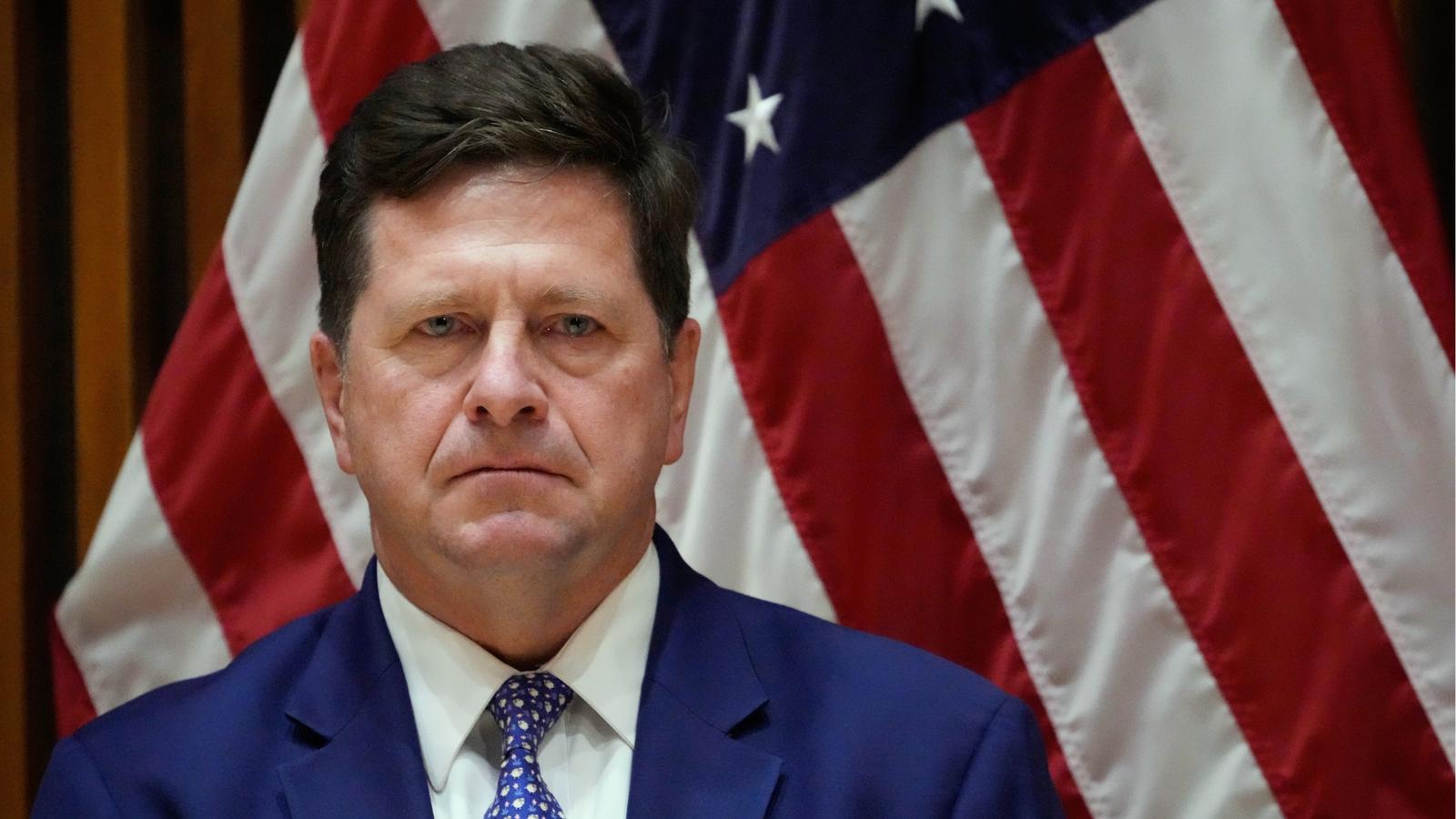
Director of National Intelligence Jay Clayton drew a sharp distinction regarding U.S. relations with Russia, stating that while President Donald Trump’s use of the term “friend” for Vladimir Putin was appropriate during nuclear security discussions, Putin “is not America’s friend in Ukraine.” Clayton’s remarks, delivered during an appearance on ABC News on Sunday, November 22, 2026, address ongoing political discussion following a high-level summit in China and subsequent social media posts by the White House.
The diplomatic friction emerged after President Trump greeted the Russian leader as his “friend” during multilateral meetings alongside Chinese President Xi Jinping. When pressed during a subsequent White House press briefing on Friday as to whether Putin could be characterized as a general friend to the United States, Trump declined to take a definitive stance, noting that he “can’t speak to America.” On Saturday, the president posted a photograph of himself and Putin on social media with the bolded text “My Friend.”
Context of Nuclear Talks and Strategic Framing
Addressing the terminology during his television interview, Clayton defended the president’s language within a strictly circumscribed multilateral framework. He explained to ABC News that the interaction involved the world’s primary nuclear powers convening to establish absolute safety parameters against escalation.
“That conversation, that picture — historic, historic picture — was in the context of the three nuclear powers, the three main nuclear powers, getting together and saying, ‘We cannot have a nuclear incident,’” Clayton said. “In that circle of that conversation, using the term ‘friend’ is entirely appropriate.”
However, when pressed directly by co-anchor Jonathan Karl on whether Putin is fundamentally an American friend, Clayton offered an unambiguous counter-framing regarding ongoing geopolitical conflicts, particularly the war in Eastern Europe. “Is Vladimir Putin America’s friend? He is not America’s friend in Ukraine. Not at all. Not at all,” Clayton responded.
Broader Intelligence and Cyber Updates
Beyond bilateral relations, Clayton addressed domestic security matters, including recent infrastructure vulnerabilities and federal cyber incidents. Following reports that the FBI and the U.S. Department of Agriculture faced cyberattacks late in the week, the intelligence director declined to provide specific tactical details while expressing confidence in federal response teams.
“We have highly professional people at the FBI who handle both private sector and public sector incidents like this, and I’m sure we’ll get the answers in due course, just as we’ve gotten the answers to the incidents that happened this past week at the NSA, at Microsoft, at other places,” Clayton stated.
Clayton attributed recent systemic technical disruptions to a combination of aging government digital frameworks and rapid technological shifts driven by artificial intelligence repairs. He emphasized that current outages are not coordinated or state-sponsored, noting that both private enterprises and federal authorities must prioritize transparent digital modernization to secure critical infrastructure against growing digital threats.
Analyzing the Administration’s Complex Diplomatic Positioning
The remarks from the Director of National Intelligence highlight a recurring challenge in contemporary American foreign policy management: balancing high-level personal diplomacy aimed at strategic risk reduction with long-standing geopolitical objectives and adversarial realities on the ground. When nuclear powers engage in summits to prevent catastrophic escalation, leaders frequently employ pragmatic or accommodating language to facilitate open communication channels. However, as Clayton’s intervention demonstrates, administrative officials often face immediate pressure from domestic commentators and media interviewers to clarify that diplomatic civility does not equate to an endorsement of foreign aggression.
The tension between President Trump’s social media framing and the intelligence director’s direct categorization underscores the multifaceted nature of executive messaging. While the president opted for ambiguous stances during press briefings and highlighted personal rapport online, Clayton’s role required a delineation of tangible national security boundaries. By explicitly isolating the friendly rhetoric to the narrow domain of nuclear safety frameworks, the administration sought to preserve the utility of great-power summits while reassuring international allies that the United States maintains an uncompromised position concerning sovereignty violations in Eastern Europe.
This dual approach reflects broader precedents in international relations where heads of state utilize personalized diplomacy to de-escalate specific existential threats, such as nuclear proliferation or accidental military clashes, while bureaucratic and intelligence apparatuses continue to manage ongoing conflicts. Clayton’s careful compartmentalization serves to insulate the critical dialogue required to prevent nuclear miscalculation from the broader, highly antagonistic realities governing the conflict in Ukraine. Observers note that such verbal acrobatics are typical when administrations attempt to navigate the competing demands of populist political branding and entrenched defense strategies.
Cybersecurity Vulnerabilities and Infrastructure Modernization
Transitioning from international diplomacy to domestic security, Clayton’s interview also shed light on the structural vulnerabilities facing American technological infrastructure. The recent cyber incidents reported across federal entities, including the FBI and the Department of Agriculture, have intensified scrutiny over the resilience of government networks. Clayton’s refusal to elaborate on tactical specifics aligns with standard intelligence protocols during active investigations, yet his public reassurances point to confidence in established interagency response mechanisms.
Significantly, Clayton contextualized these digital disruptions not merely as malicious foreign campaigns, but as symptoms of a broader systemic transition. The convergence of aging government digital frameworks and aggressive artificial intelligence-driven infrastructure repairs has created an environment prone to technical instability. By clarifying that these incidents were neither coordinated nor state-sponsored, Clayton attempted to temper public alarm while simultaneously issuing a stark warning regarding the urgent necessity of digital modernization.
The administrative narrative highlights that both the public and private sectors must confront the reality of exponential technological growth against a backdrop of outdated operating systems. As supercomputing power expands, the frequency and complexity of technological disruptions are projected to persist. Clayton’s commentary underscores that achieving true cybersecurity requires long-term capital investment and radical transparency between government agencies and commercial enterprises. Ultimately, whether addressing nuclear security semantics or domestic infrastructure vulnerabilities, the intelligence leadership’s stance emphasizes a calculated balance between maintaining strategic dialogue abroad and fortifying foundational systems at home.