


South Korean horror cinema is far more than a collection of supernatural jump scares and visceral gore. Over the decades, the country’s filmmakers have utilized the genre as a highly sophisticated narrative tool, blending folklore, psychological trauma, and intense melodrama to dissect the darker undercurrents of Korean society. According to an extensive historical retrospective by the cinema analysis platform High on Films, the trajectory of Korean horror is intimately bound to the nation’s political shifts, democratization, and evolving cultural anxieties.
The Early Foundations: Psychosexual Dread in the 1960s
The roots of modern Korean horror do not begin with the high-tech thrillers of the 2000s, but rather in the highly regulated cinematic landscape of the 1960s. During this era, pioneering directors like Kim Ki-young, Lee Yong-min, and Lee Man-hee laid the groundwork for the genre. Because overt political criticism was heavily restricted under authoritarian governance, filmmakers turned to psychosexual anxiety, domestic melodrama, and supernatural folklore to explore societal tensions.
A prime example of this period is Lee Man-hee’s 1964 classic, The Devil’s Stairway. Operating primarily as a psychological melodrama, the film tracks the moral descent of a cold-hearted surgeon, Dr. Hyeon Gwang-ho, who murders a nurse to secure his career advancement. As guilt manifests as terrifying hallucinations, the film uses a rickety hospital staircase as a physical and psychological metaphor for moral decay. This established a long-standing Korean horror tradition: horror is never isolated; it is a direct consequence of human greed, guilt, and social ambition.
Democratization and the Late 1990s Renaissance
The late 1990s marked a massive turning point for South Korean cinema. The country’s transition to democracy and the subsequent relaxation of strict state censorship granted filmmakers unprecedented creative freedom. Concurrently, the global explosion of Japanese horror (J-Horror) provided a powerful stylistic template. Korean directors adopted the atmospheric, technology-driven, and ghost-centric visual vocabulary of J-Horror, but infused it with distinct localized social commentary.
This era birthed the iconic Whispering Corridors franchise, which used supernatural hauntings to expose the brutal competitiveness, authoritarianism, and emotional isolation within South Korea’s high school system. The second installment, Memento Mori (1999), remains a landmark in commercial Korean cinema. By focusing on a tragic, repressed romantic relationship between two female students, the film elevated the standard school ghost story into a heavy critique of societal homophobia and conformity. The supernatural elements in Memento Mori were not arbitrary; they functioned as the return of the repressed—forcing a conservative institution to confront the truths it desperately tried to bury.
The Rise of Genre Hybrids and Dark Fairy Tales
As the 2000s progressed, Korean filmmakers increasingly rejected formulaic horror tropes in favor of genre hybridization. Directors realized that horror was most effective when folded into social satire, crime thrillers, or dark fantasy. Bong Joon-ho famously merged creature-feature tropes with political satire in The Host, while Park Chan-wook used vampirism to dissect religious guilt in Thirst.
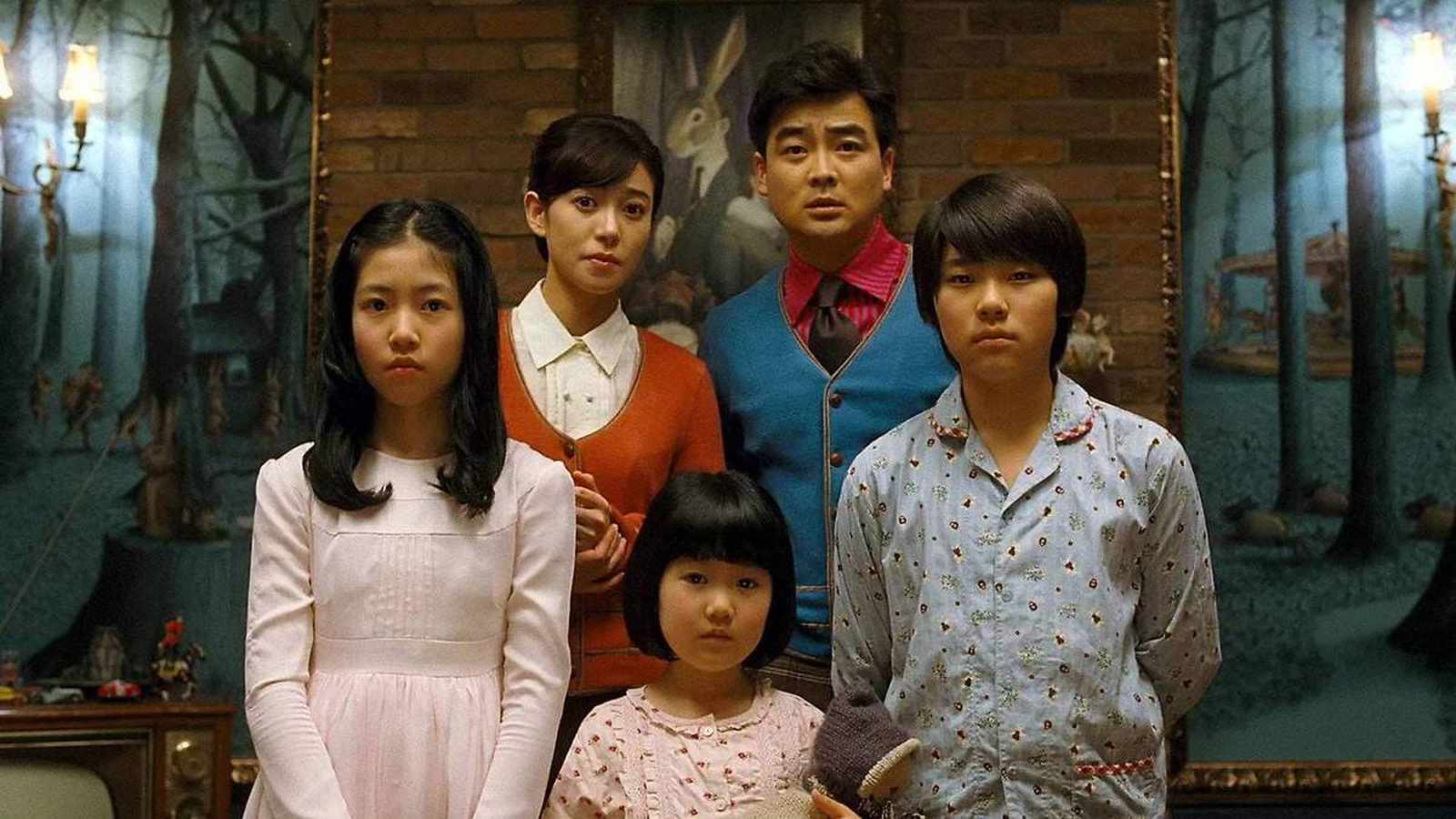
This period also saw a fascination with dark, European-style fairy tales. Yim Pil-sung’s Hansel and Gretel (2007) serves as a key example. Rather than simply transplanting the classic Brothers Grimm story into a domestic setting, Yim preserved the gothic, candy-colored aesthetic of Western fairy tales but reversed the power dynamics. In this version, an adult becomes the vulnerable outsider trapped in a surreal forest house controlled by children. The horror stems not from a cannibalistic witch, but from the deep, unresolved trauma of abused children who have frozen their world in a state of permanent, arrested childhood. By shifting the perspective, the film turned a simple scary story into a devastating commentary on child neglect and the loss of innocence.
Modern Allegories: From Aquariums to Occult Investigations
In the 2010s and beyond, South Korean horror continued to push boundaries by finding terror in the mundane and the deeply spiritual. Lee Dae-hee’s unique animated film Padak (2012), also known as Swimming to Sea, demonstrated that horror could thrive in the most unexpected places—specifically, a seafood restaurant aquarium. By adopting the perspective of a captured mackerel desperate to return to the ocean, the film crafts a brutal allegory of captivity, survival, and social hierarchy. The aquarium operates as a miniature authoritarian society where the fish accept their confinement to survive, positioning those who dare to dream of escape as dangerous disruptors. Through this anthropomorphic lens, the casual human act of consuming seafood is transformed into a harrowing survival horror.
On the other end of the spectrum, Jang Jae-hyun’s occult thriller Svaha: The Sixth Finger (2019) delves into the complexities of faith, obsession, and religious fanaticism. Structured like a detective procedural, the film follows a pastor exposing fraudulent cults, only to stumble into a multi-layered mystery involving ancient Buddhist prophecies, shamanism, and child sacrifice. Svaha blurs the lines between divinity and demonology, suggesting that the ultimate evil does not stem from supernatural entities, but from human vanity and the willingness to sacrifice the innocent in the pursuit of personal transcendence.
From the foundational melodramas of the 1960s to the global zombie phenomenon sparked by Train to Busan in 2016, South Korean horror has consistently proven that the most terrifying monsters are those born from human systems, historical traumas, and societal pressures. By keeping its monsters firmly rooted in human reality, the genre continues to capture the imagination of audiences worldwide.