


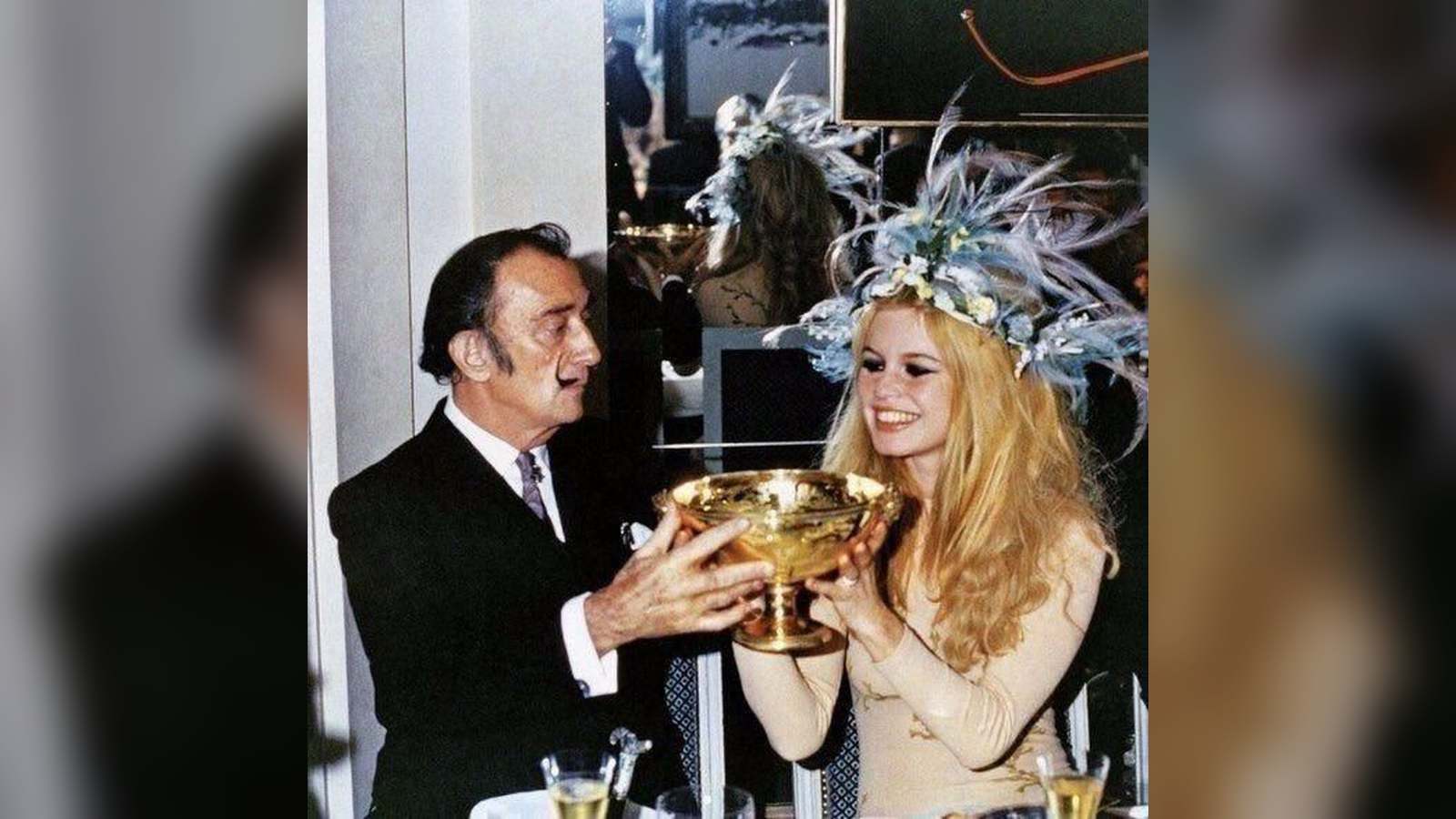
This striking vintage photograph captures a rare, unguarded collision of mid-century cultural powerhouses: the Spanish surrealist master Salvador Dalí and the quintessential French cinematic icon Brigitte Bardot. In the frame, Dalí leans forward with theatrical intensity, his famous upturned mustache cutting a sharp line through the air as he seemingly attempts to coax or playfully feed a drink to Bardot. The actress responds with a mixture of amusement and characteristic poise, her sun-kissed hair and effortless style contrasting sharply against the eccentric, high-strung energy of the artist. The composition highlights the stark visual duality between Dalí’s calculated performance art persona and Bardot’s natural, untamed glamour that defined European cinema in the 1960s. The original oversized print, measuring roughly 9.25 by 14.25 inches, carries the authentic credit stamp of Giancarlo Botti Studios on its reverse, marking it as a valued piece of mid-century photojournalistic history.
What the photograph shows
A closer visual inspection of the frame reveals a masterclass in spontaneous framing and psychological tension. Dalí occupies the left side of the composition, his upper body thrust forward into the personal space of Bardot with an aggressive yet comedic theatricality. His eyes bulge slightly under arched eyebrows, conveying the manic enthusiasm that he cultivated as part of his public brand. His hands, expressive and gesturing, command attention, while his tailored jacket anchors him as a figure of high-society eccentricity. Opposite him, Brigitte Bardot sits with a relaxed, almost nonchalant posture that acts as a stabilizing anchor for the frantic energy of the surrealist. Her head is tilted back slightly away from the vessel Dalí holds, creating a dynamic diagonal push-and-pull across the center of the image. The lighting is bright, typical of a high-end European social gathering or press reception, casting sharp shadows that define the architectural planes of Dalí’s face and the soft contours of Bardot’s visage. In the background, out-of-focus elements suggest a bustling room filled with journalists, admirers, or fellow elites, though the shallow depth of field successfully isolates the two titans from the surrounding chaos, rendering them the absolute focal point of the visual narrative.
Photographer and provenance
The image was captured by celebrated Italian photographer Giancarlo Botti, whose lens documented many of the most prominent cultural figures, actors, and artists of post-war Europe. Botti operated within elite artistic and cinematic circles, securing access to intimate, unscripted moments between celebrities who were normally heavily guarded by press agents and studio publicists. While exact details of the specific gathering remain lightly documented in general histories, the physical attributes of the piece—including its large format and authentic studio stamps on the back—testify to its provenance as a contemporary press or portfolio print rather than a modern reproduction. This specific vintage print later found its way into prestigious archives, notably circulated through specialized collections such as “The Cinema Screen,” an extensive holding of original entertainment photography preserving rare artifacts from the 20th century. Botti’s career was defined by an uncanny ability to catch subjects off-guard, stripping away the varnish of studio publicity to reveal the raw, often bizarre human dynamics operating behind the scenes of European high society. His working conditions required immense tact, speed, and an intuitive understanding of public figures who were simultaneously desperate for exposure and protective of their private facades.
The moment behind the image
The year 1960 found both Dalí and Bardot at the absolute zenith of their respective cultural influence. Dalí was deep into his flamboyant public persona, where performance art and grandiose gestures often rivaled his easel paintings in drawing media attention. Bardot, fresh off international blockbusters like And God Created Woman, was arguably the most photographed woman in the world, hounded constantly by paparazzi wherever she went. When these two gravitational forces crossed paths in Europe’s creative capitals, the resulting encounters were charged with mutual fascination and performative rivalry. This particular frame captures a fraction of a second where Dalí’s penchant for theatrical provocation meets Bardot’s cool, unflappable self-possession, turning a simple social gathering into a piece of living surrealism. Immediately prior to this shutter click, witnesses or historical records suggest the room was a cacophony of flashing bulbs, chattering reporters, and clinking glasses. Dalí, ever the showman, likely spotted an opportunity to stage an impromptu tableau vivant with the reigning sex symbol of the era, while Bardot, well-accustomed to men projecting their artistic fantasies upon her, played along with amused detachment. After the shutter clicked, the performance dissolved instantly back into standard cocktail party chatter, leaving Botti’s negative as the sole permanent witness to a fleeting collision of two entirely different artistic universes.
Historical context
During the late 1950s and early 1960s, European culture was undergoing a rapid transformation driven by the rise of modern mass media, celebrity culture, and the avant-garde. Salvador Dalí had long transitioned from the revolutionary surrealist group of Paris into a global media celebrity who gleefully commercialized his own myth. Simultaneously, Brigitte Bardot symbolized a new, liberated post-war femininity that scandalized traditionalists while captivating the global imagination. Encounters between figures of fine art and commercial cinema were increasingly common in this era, as the boundaries between high culture and mass entertainment began to dissolve in the glossy pages of international magazines, reflecting a society obsessed with image and spectacle. The convergence of Dalí and Bardot encapsulated the intersection of high avant-garde eccentricity and popular cinematic mythology. It was an era where the press functioned as an active participant in manufacturing cultural icons, and photographers like Botti were the primary architects of the visual mythology that continues to shape our perception of the mid-20th century. The photograph serves as a physical artifact of a cultural moment when art, cinema, and mass media merged into a single, highly lucrative global spectacle.
Why it still matters
Decades after the shutter clicked, photographs like Botti’s capture of Dalí and Bardot endure because they encapsulate the spirit of an entire artistic epoch. They remind us of an era when celebrity encounters were captured on physical film by observant photojournalists rather than curated through social media filters. The image survives not merely as a curiosity of two famous faces meeting, but as a visual document of how mid-century iconoclasm and cinematic glamour performed for the camera, leaving an indelible imprint on our visual memory. In an age dominated by digital staging and synthetic imagery, vintage silver gelatin prints of this caliber offer a tangible link to a time when charismatic personalities collided in real-world spaces, creating spontaneous art through the sheer friction of their respective myths. Botti’s frame remains a testament to the power of documentary photography to freeze time, holding open a window to an unrepeatable afternoon in European cultural history.