


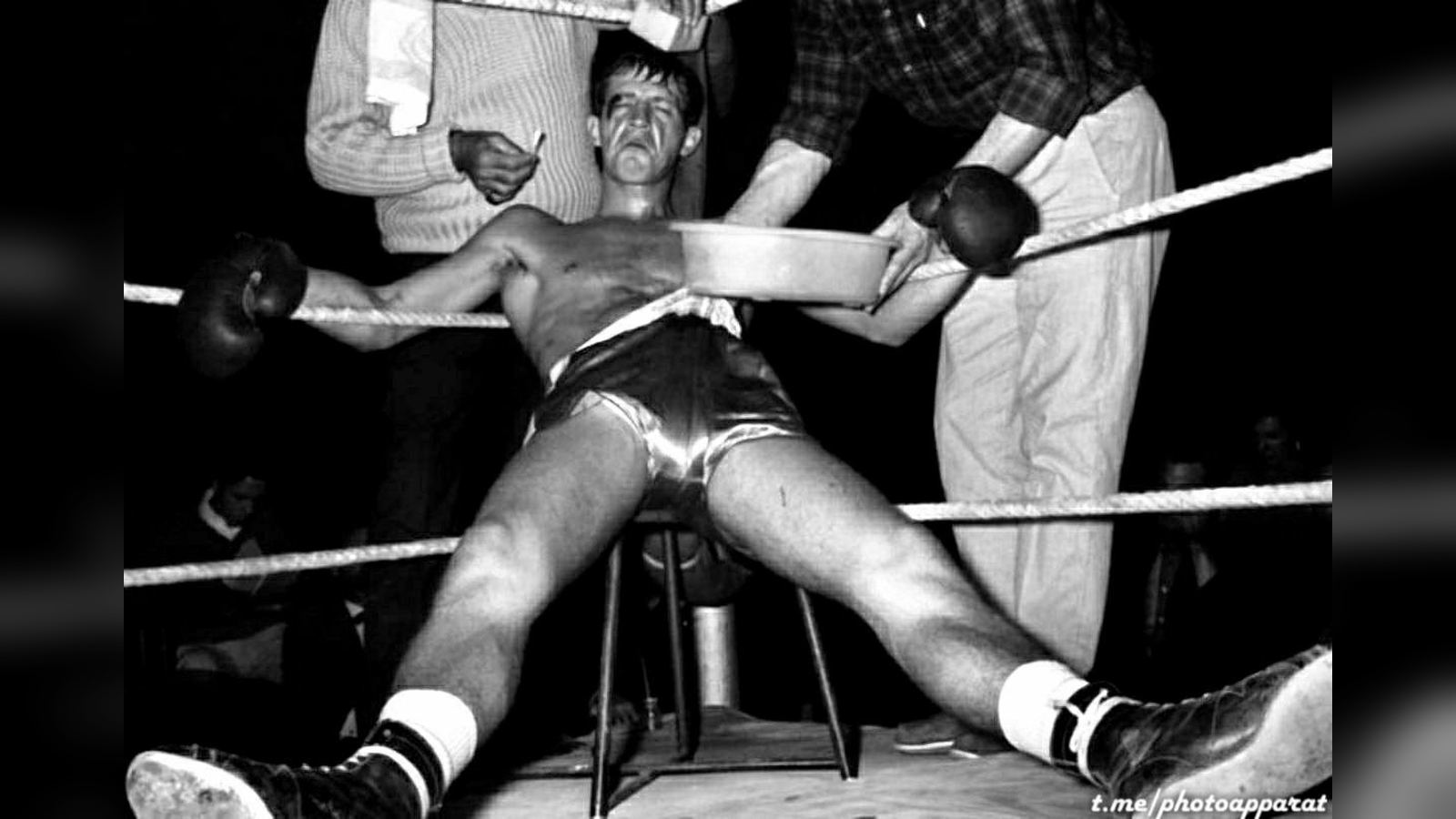
In this evocative black-and-white photograph, a young Jean-Paul Belmondo is captured in the heat of a boxing match in Paris, circa 1960. He is seen in a classic pugilistic stance, his body coiled with tension, sweat glistening on his forehead. His expression is one of intense focus, stripped of the characteristic smirk that would later define his persona in French New Wave cinema. The background is blurred, typical of the era’s sports photography, focusing all attention on the actor’s physical exertion. He wears standard amateur boxing gear, and his posture suggests a man who is not merely posing for a publicity shot but is genuinely engaged in the rhythmic, brutal dance of the ring. The lighting highlights the rugged contours of his face, a feature that would eventually lead critics to contrast him with the ‘chiseled’ beauty of his contemporary, Alain Delon.
The moment behind the image
By 1960, Belmondo’s life was at a pivotal intersection. He had just finished filming Jean-Luc Godard’s Breathless (À bout de souffle), a film that would shatter the conventions of European cinema and turn him into an overnight international sensation. This image, however, grounds him in the reality of his pre-fame life. While he had transitioned into acting by age 20, the discipline of the ring remained a constant. The photograph captures a moment of transition; he is no longer the struggling, unknown actor, yet he has not fully retreated into the cocoon of celebrity. The tension seen in his shoulders and the precision of his guard reflect the same energy he brought to his performance as Michel Poiccard—a kinetic, restless, and rebellious spirit. The atmosphere in the gym or ring where this was taken suggests a gritty, unglamorous environment, far from the red carpets of Cannes, revealing the raw, physical reality of his upbringing.
Photographer and provenance
The provenance of this specific image remains tied to the archives of mid-century French photojournalism. Much like many photographs of actors taken during the 1960s, it likely originated from a freelance assignment or a sports-lifestyle feature intended for a Parisian magazine. The lack of a specific, widely-credited photographer in the primary source material is common for this type of archival material, which often circulated through agencies before finding its way into modern digital collections. The image serves as a visual record of an era when the barrier between public figures and the gritty, everyday life of Paris was much more porous than it is today. We see here the work of a photographer who understood that Belmondo’s appeal lay not in his perfection, but in his imperfections. The photograph survived because it captures the ‘Bébel’ myth in its infancy—before the studio portraits and the carefully curated celebrity image took over.
Historical context
Belmondo’s connection to boxing was not just a passing phase; it was a fundamental aspect of his identity. Born in 1933, the son of a respected sculptor, Belmondo found school stifling, often acting out. Athletics, particularly football and boxing, provided the structure he lacked. His amateur boxing career was a period of trial and error—as the Telegram caption notes, his success in the ring was ‘variable.’ This vulnerability is what makes the photograph so compelling. It portrays a man who was comfortable with failure, a trait that allowed him to take the risks necessary to become the ‘louche’ face of the New Wave. He was not a polished product of a studio system; he was a man who knew how to take a hit, both in the ring and in the cutthroat world of 1950s Parisian theater. His boxing background informed his physical acting style, which relied on fluidity, speed, and a certain defensive posture that made him appear more human than the stiff actors of the previous generation. The New Wave directors, particularly Godard, exploited this physical intelligence, allowing Belmondo to perform his own stunts and move through the frame with an unpredictable, animal grace.
Why it still matters
This photograph endures because it humanizes an icon. It reminds us that before the stunts, the fame, and the international acclaim, Belmondo was a young man testing his limits. It serves as a visual thesis for his career: he was always the fighter, the one who moved with a physical urgency that felt entirely new to audiences accustomed to the rigid formality of classical acting. Looking at this frame, we see the blueprint for his later work—the resilience, the intensity, and the refusal to be contained by a single role. It is a portrait of a man who, even when the cameras were off, lived life with his guard up and his eyes on the target. The image captures the essence of the ‘Bébel’ persona: a blend of toughness, vulnerability, and a dash of reckless charm that defined an entire generation of French cinema. It reminds us that at the heart of French cool, there was always the sweat and discipline of a man who knew exactly what it felt like to be in the ring.