


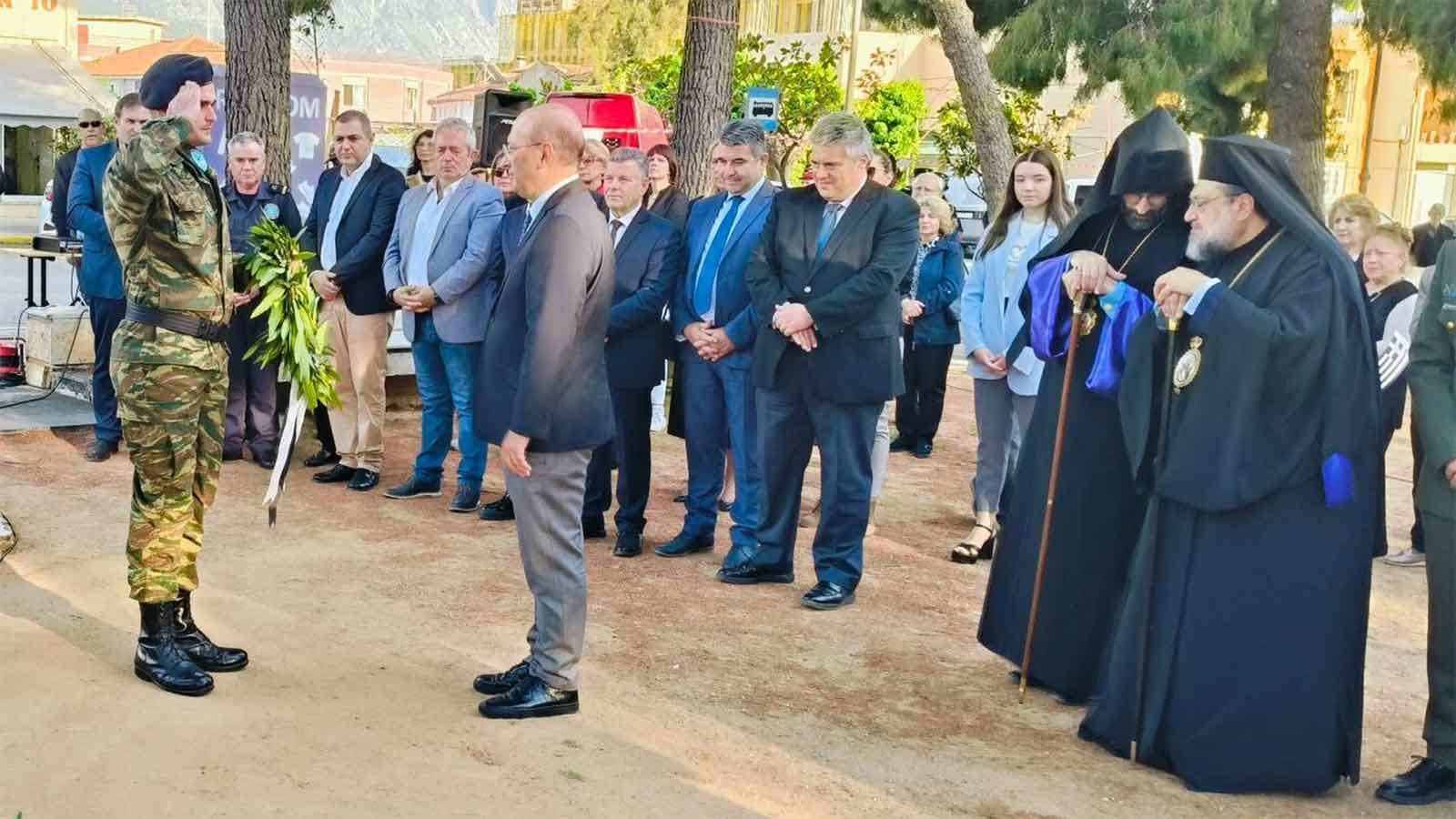
- A commemoration event for the 110th Armenian Genocide anniversary was held in Kalamata, Greece.
- The Municipality of Kalamata initiated the event, which took place at a monument for Genocide victims.
- Attendees included Armenian Ambassador Tigran Mkrtchyan, Armenian and Greek clergy, and Greek officials.
- Ambassador Mkrtchyan spoke on fighting denial, teaching genocide, and the importance of commemoration days for prevention.
- The event featured a requiem service and a wreath-laying ceremony.
Kalamata, Greece Commemorates Armenian Genocide 110th Anniversary with Official and Community Presence – 2025
On the occasion of the 110th anniversary of the Armenian Genocide, a commemoration event was organized in the city of Kalamata, Greece. The initiative for holding this event came from the Municipality of Kalamata. The ceremony took place at a monument specifically dedicated to the memory of the victims of the Armenian Genocide, providing a focal point for remembrance and tribute in the Greek city.
Wide Range of Participants at the Ceremony
The commemoration event in Kalamata was attended by a diverse group of individuals, including representatives from both Armenian and Greek official structures, religious institutions, and community organizations. Among the attendees was the Ambassador Extraordinary and Plenipotentiary of the Republic of Armenia to Greece, Tigran Mkrtchyan. The Armenian Church was represented by the Primate of the Armenian Diocese of Greece, His Grace Bishop Sahak Yeghiazaryan. From the Greek Orthodox Church, the event saw the participation of the Bishop of Kalamata, Chrysostomos Savvatos. The Greek Parliament had a representative in Miltos Chrysomallis, a Member of Parliament. The Municipality of Kalamata was represented by its Deputy Mayor, Sarantos Marinakis, who also likely served as a key figure given the Municipality’s role as organizer. The regional administration of Messinia was represented by its Deputy Governor, Statis Anastasopoulos. The Armenian National Committee (Hay Dat) of Greece had its representative, Sergo Kaplanyan, in attendance. The President of the local Armenian community of Kalamata, Sofia Margaryan, also participated. The event also included other regional deputy mayors and representatives from the armed forces and the media, highlighting broad participation from various sectors.
Requiem Service Held Prior to Official Speeches
According to a message conveyed by the Embassy of Armenia in Greece, the official program of the commemoration event was preceded by a religious service. His Grace Bishop Sahak Yeghiazaryan, the Primate of the Armenian Diocese of Greece, conducted a requiem service. This spiritual service is a traditional part of Armenian Genocide commemorations, offering prayers for the souls of the victims and providing a moment of solemn reflection for the attendees. The requiem service took place before the series of official speeches were delivered at the monument site.
Ambassador Tigran Mkrtchyan Addresses Genocide Prevention and Remembrance
Armenia’s Ambassador to Greece, Tigran Mkrtchyan, delivered remarks during the commemoration ceremony. In his speech, he highlighted the importance of addressing genocide from a preventative perspective, outlining three main directions he considers crucial for the prevention of genocides in general. These directions provide a framework for understanding the multi-faceted efforts required to combat such crimes against humanity and ensure that the lessons of the past are learned and applied.
Emphasis on Fighting Denial as a Prevention Tool
One of the main directions for preventing genocides that Ambassador Mkrtchyan spoke about was the importance of fighting denial. Combating the denial of genocide is considered a critical aspect of prevention by many experts and advocates. Denial often seeks to distort historical facts, silence survivors and descendants, and create an environment where future atrocities could potentially be contemplated or carried out without consequence. The Ambassador’s emphasis on this point underscores the view that confronting denial is not just about historical accuracy but is directly linked to the ongoing effort to prevent similar crimes in the future.
Necessity of Teaching Genocide in Educational Institutions
Ambassador Mkrtchyan also stressed the necessity of teaching about genocide as a key preventative measure. He specifically pointed out the importance of this education extending beyond universities and being included in secondary schools as well. Teaching about genocides provides individuals, particularly younger generations, with knowledge of the historical events, their causes, mechanisms, and consequences. This understanding can help foster critical thinking about prejudice, discrimination, and mass violence, contributing to the development of a global citizenry more aware of the dangers of hatred and more committed to upholding human rights and preventing atrocities. The Ambassador’s call for including genocide education in secondary schools highlights the belief that this knowledge is fundamental and should be accessible to a broader segment of the population.
Meaning and Significance of Commemoration Days
The third main direction for preventing genocides, according to Ambassador Mkrtchyan’s speech, was the meaning and significance of commemoration days. Commemoration days, such as April 24 for the Armenian Genocide, serve multiple purposes. They provide a dedicated time for collective remembrance of the victims, honoring their lives and the suffering they endured. They also serve as opportunities to reaffirm the commitment to “never again” and to reflect on the causes and consequences of genocide. Furthermore, commemoration events can raise public awareness, educate those less familiar with the history, and provide a platform for advocacy and continued efforts towards recognition and justice. The Ambassador’s emphasis on the meaning and significance of these days highlights their vital role in keeping the memory of the Genocide alive and mobilizing action towards prevention.
Source: Embassy of Armenia in Greece
Application of Prevention Directions in Greece
Ambassador Mkrtchyan noted that these three important circumstances—fighting denial, teaching about genocide, and the significance of commemoration days—are applied in the context of the Armenian Genocide in Greece. This remark indicates that efforts are being made within Greece to address these aspects related to the Armenian Genocide, whether through educational initiatives, public discourse, or the official observance of commemoration days. Given Greece’s own historical experiences and its relationship with Armenia, the application of these prevention strategies in the Greek context is notable.
Gratitude Expressed to the Government and People of Greece
In his speech, Ambassador Tigran Mkrtchyan also extended words of gratitude to Greece. He expressed thanks to the government and people of Greece. The reason for this gratitude was stated as Greece’s welcoming of and continuous support for Armenia and the Armenian people. This highlights the positive relationship and solidarity that exists between the two nations and their peoples, which is particularly significant in the context of commemorating the Armenian Genocide and acknowledging shared historical experiences and challenges in the region.
Tribute Paid to Metropolitan Chrysanthos Philippidis
Ambassador Mkrtchyan also paid a special tribute during the ceremony to a historical Greek figure, Metropolitan Chrysanthos Philippidis of Trabzon. He mentioned the timeframe of his service as Metropolitan, from 1913 to 1923. The Ambassador highlighted Metropolitan Philippidis’s actions during the period of the Armenian Genocide, specifically noting that he “came out in defense of Armenians” and “made efforts to create an Armenian-Greek alliance” in 1915-1916. This tribute acknowledges the historical solidarity shown by some Greek figures towards the Armenian population during a time of great peril and underscores the historical connections and mutual support between the two peoples.
Ambassador’s Concluding Thanks to Kalamata Municipality
Concluding his speech at the commemoration event, Ambassador Tigran Mkrtchyan directed words of gratitude specifically to the authorities of the Municipality of Kalamata. He thanked them for their role in organizing the event. This gesture of thanks acknowledges the initiative and effort undertaken by the municipal authorities to host the commemoration ceremony for the 110th anniversary of the Armenian Genocide in their city, recognizing their contribution to honoring the victims and facilitating the gathering.
Wreath-Laying Ceremony Marks the Conclusion of the Event
The commemoration ceremony at the monument in Kalamata concluded with a wreath-laying ceremony. Wreath-laying is a traditional act performed at memorials to pay respect to the deceased and honor their memory. At this event, wreaths were likely placed at the monument dedicated to the victims of the Armenian Genocide by various attendees, including officials and community representatives, as a final gesture of tribute and remembrance for those who perished in 1915 and the subsequent years.
Source of Information on the Kalamata Commemoration
The details concerning the commemoration event held in Kalamata were provided in a message issued by the Embassy of Armenia in Greece. This official diplomatic source served as the basis for the report on the event, conveying information about its organization, participants, the content of the speeches, and the various acts of remembrance that took place at the monument.
Significance of the Municipal-Led Commemoration in Greece
The fact that the commemoration of the 110th anniversary of the Armenian Genocide in Kalamata was organized by the Municipality is significant. It indicates a level of recognition and engagement at the local government level in Greece. The involvement of the Municipality, alongside participation from regional and parliamentary representatives, Greek clergy, and the Armenian diplomatic mission and community, highlights the importance placed on remembering the Armenian Genocide within Greek society. Such municipal initiatives contribute to broader public awareness and serve as an important gesture of solidarity with the Armenian people.
Kalamata Joins Global Remembrance with Emphasis on Prevention
In conclusion, the city of Kalamata in Greece marked the 110th anniversary of the Armenian Genocide with a commemoration ceremony held at a monument dedicated to the victims. The event, organized by the Municipality of Kalamata, brought together a range of Armenian and Greek officials, clergy, and community members. Armenia’s Ambassador to Greece, Tigran Mkrtchyan, delivered a speech focusing on essential directions for genocide prevention, including fighting denial, promoting education, and honoring commemoration days, noting their application in Greece. The ceremony, which included a requiem service and concluded with a wreath-laying, underscored the shared commitment to remembering the victims of the Armenian Genocide and working towards a future where such atrocities are prevented, reflecting the strong ties and mutual support between the Armenian and Greek peoples.