


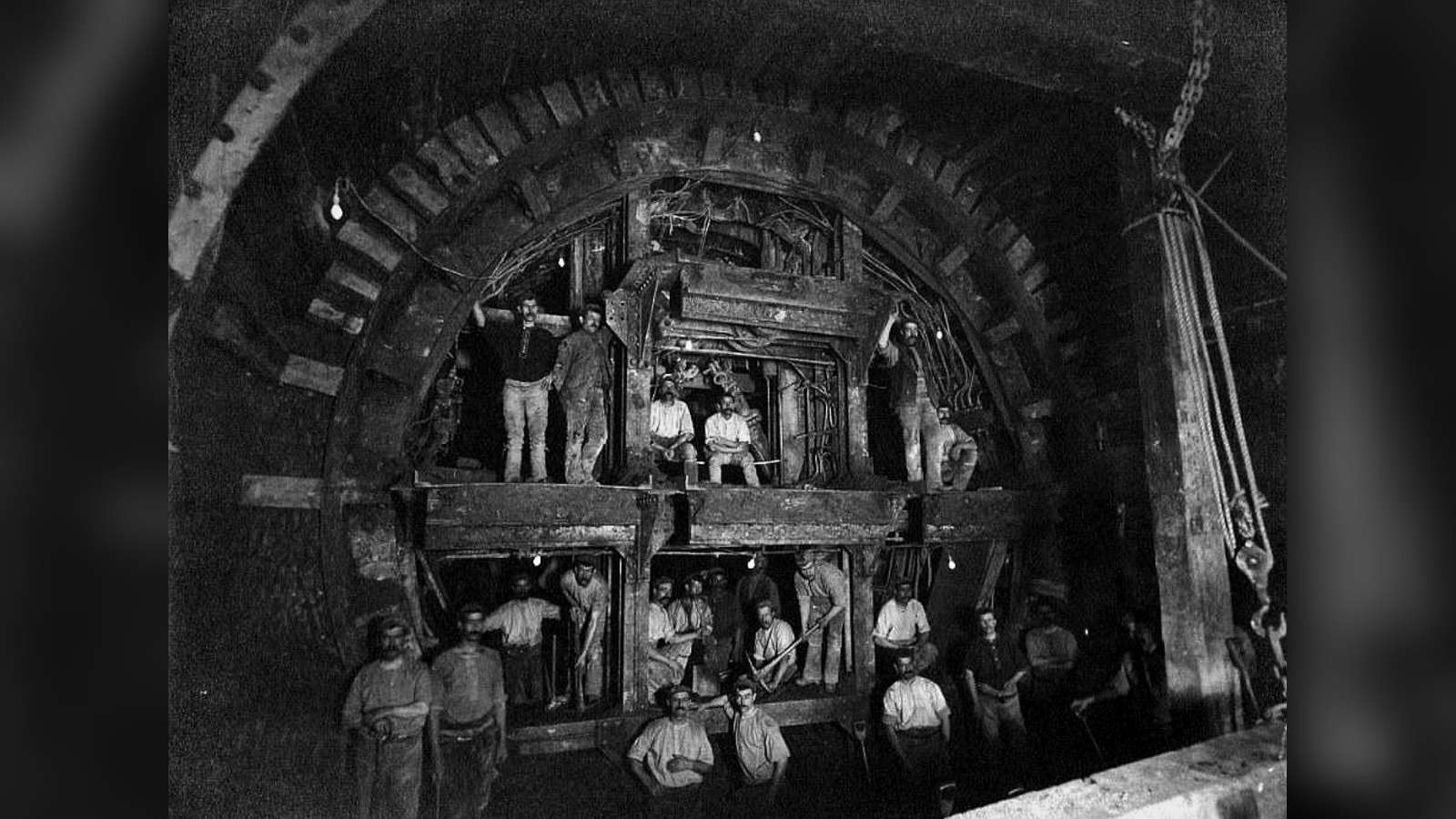
In this flash-illuminated photograph from 1898, a group of Victorian subterranean workers—historically referred to as navvies—pause inside a curved, newly driven tunnel shaft during the construction of the London Underground’s Central Line. Surrounded by heavy timber bracing, cast-iron tunneling segments, and soil-caked tools, these men turn toward the camera lens in a rare, deliberate moment of stillness deep beneath the British capital. The image captures the brutal manual reality required to construct the world’s early deep-level electric tube railways, posing a fundamental question for modern viewers: who were the unseen laborers who physically carved out the subterranean arteries that made modern London possible?
What the photograph shows
The photograph presents an intimate collective portrait set against a raw industrial backdrop. A group of men, dressed in heavy wool coats, waistcoats, cloth caps, and mud-stained trousers, stand tightly arranged inside the circular iron casing of an unfinished tunnel. Their faces, weathered and shadowed by dim working conditions, reveal varying expressions—some gaze directly into the camera with quiet defiance, while others maintain stern, exhausted countenances. In their hands and leaning against the metal framing are the fundamental implements of 19th-century excavation: heavy picks, shovels, and wooden support beams.
Visual observation highlights the contrasting textures of Victorian engineering and organic earth. The circular tunnel wall is composed of bolted cast-iron segments that form the lining of the tube, designed to hold back millions of tons of surrounding soil. Beneath their mud-caked boots, the ground remains unpaved, littered with clay debris, timber offcuts, and temporary iron rails used for carting muck back to the surface shaft. The illumination, likely generated by a bright magnesium flash powder flare or early portable electric arc equipment, casts harsh, theatrical shadows, accentuating the tight claustrophobia of working tens of meters below ground level.
The moment behind the image
This image was taken during the active construction phase of the Central London Railway (CLR), which would eventually become the modern Central Line. Work on the line began in 1896, utilizing Greathead tunneling shields—a cylindrical steel shield pushed forward by hydraulic jacks—to bore through the sticky bed of London Clay without disturbing the dense streetscape of historic London above.
For the workers in the frame, setting up this photograph meant a temporary halt in a relentless, dangerous shift. Deep-level tunneling was dark, humid, and airless work, carried out in pressurized atmospheres in certain sections to prevent water ingress. Navvies worked long hours clearing tons of clay, bolting iron rings into place, and shoring up excavation walls. Gathering for the photographer required brief coordination between the site engineers, foreman, and the photographic crew, pausing the heavy machinery and electric winches just long enough to capture a clean exposure without motion blur.
Photographer and provenance
The precise identity of the photographer who descended into the shaft in 1898 remains uncredited in popular registers, as was common for industrial promotional photography commissioned by railway companies or civil engineering firms like S. Pearson & Son. However, the image has been preserved in historical press collections, most notably preserved today within the TopFoto archive. In recent years, high-resolution digital scans and careful historical colorization have restored texture and detail to the photograph, allowing public audiences to appreciate the garments and materials as they appeared to the 1898 crew.
Creating an image in a subterranean tunnel in 1898 was a formidable technical feat. Early cameras required tripod stability, large glass plates, and chemical flash powder that produced thick smoke. Taking a single shot underground involved calculated lighting and risk, as open flame powder had to be managed safely in confined engineering spaces filled with wooden shoring.
Historical context
When the London Underground first opened in 1863 between Paddington and Farringdon, it operated steam locomotives through near-surface trenches dug using the cut-and-cover method. This early method disrupted city traffic and proved unfeasible for extending transit lines through the congested heart of Victorian London. The advent of deep-level tunneling technology in the late 1880s and early 1890s, paired with electric traction, revolutionized urban transit, giving rise to the iconic nickname “The Tube.”
The Central London Railway, running from Shepherd’s Bush to the Bank of England, was formally opened on June 27, 1900, by the Prince of Wales, and opened for public passenger service on July 30, 1900. Nicknamed the “Two-penny Tube” because of its flat two-pence fare, it quickly became one of the busiest lines on the network. The human foundation of this grand imperial engineering effort rested entirely on the muscles of men like those captured in the 1898 photograph, many of whom were itinerant laborers from across the British Isles.
Why it still matters
Over a century after this photograph was taken, the Central Line remains a critical backbone of London’s transit infrastructure, serving millions of passengers across 74 kilometers of track. While modern commuters travel through these tunnels in automated electric trains equipped with digital displays, this 1898 photograph anchors the network’s high-tech present in its grueling manual past.
The photograph serves as a vital historical bridge, reminding society that behind every great civil engineering marvel lies an anonymous human workforce. By fixing these men in time, the camera transformed a routine construction shift into an enduring monument to Victorian labor and urban transformation.