


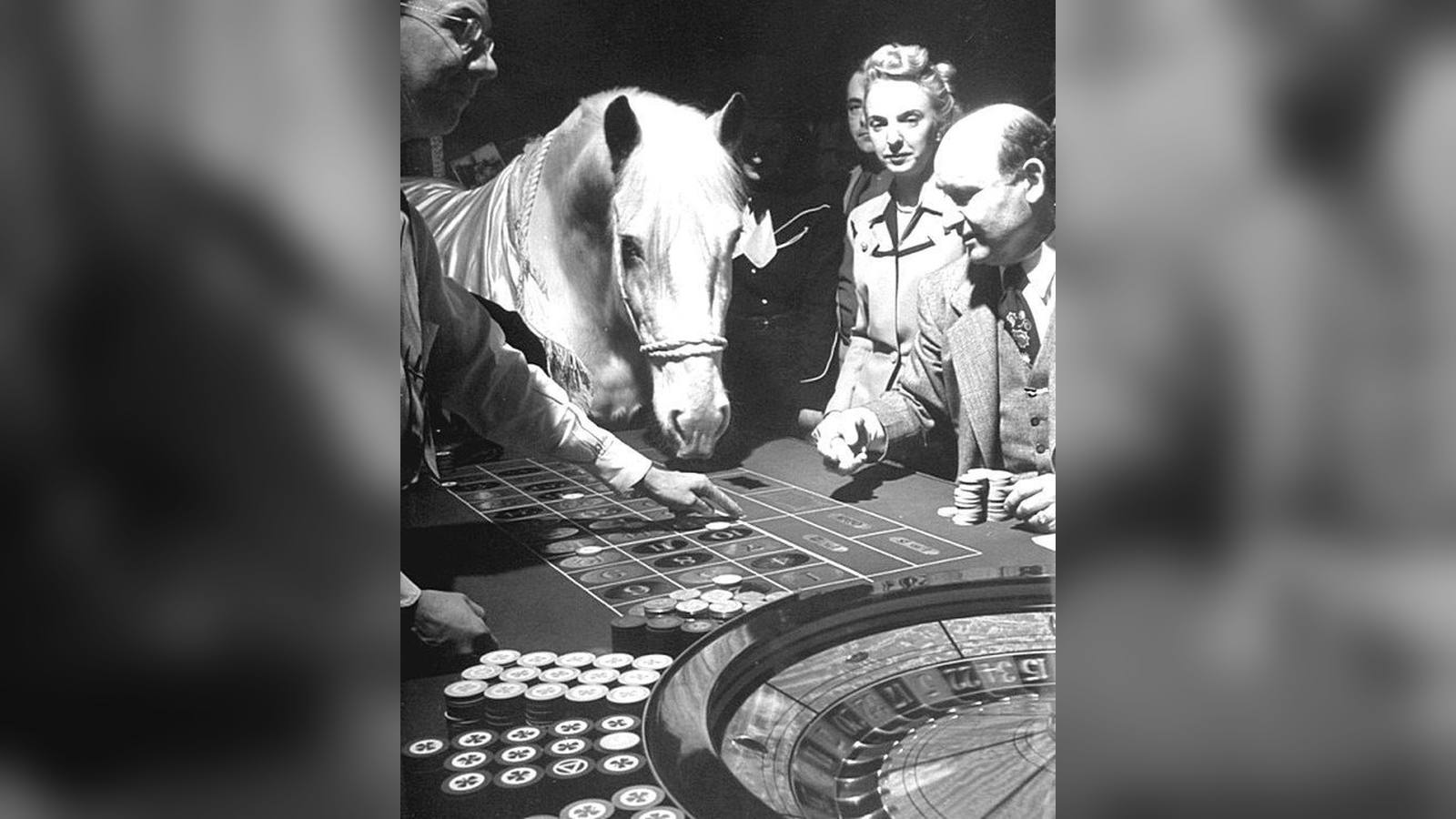
In this surreal 1947 photograph, a horse stands inside the plush, wood-paneled interior of the El Rancho Vegas, its head lowered toward a green felt roulette table. With a deliberate movement of its nose, the animal nudges a gambling chip toward a numbered slot, while onlookers—some leaning in with amusement—watch the spectacle. This singular moment, captured in the early years of the Las Vegas Strip, serves as a testament to the era’s desperate and imaginative quest to lure tourists into the desert. The image is not merely a curiosity; it is a document of the theatricality that built a gambling empire from sand and ambition.
What the photograph shows
The frame is dominated by the contrast between the animal’s raw, organic presence and the sterile, calculated precision of the casino environment. We see the horse positioned at the edge of the roulette table, its neck extended, nose pressed against a stack of chips. The composition highlights the absurdity of the scene: the polished wood of the table, the green felt, and the gambling paraphernalia are treated with the same visual weight as the horse’s mane and eyes. The onlookers, dressed in the sharp suits and hats of the late 1940s, appear almost as props in a vaudevillian performance, their expressions a mix of genuine astonishment and calculated participation. The lighting suggests an indoor setting, likely enhanced by the flash technology of the era, which creates high-contrast shadows that heighten the surreal nature of the interaction. The horse appears calm, suggesting it had been trained or conditioned for this specific routine, likely involving hidden rewards for its performance.
The moment behind the image
This photograph captures a promotional stunt designed to draw foot traffic into the El Rancho Vegas, the first resort to open on what would become the famous Las Vegas Strip. In the post-war boom of 1947, Las Vegas was transforming from a sleepy town into a gambling mecca. Casinos needed unique selling points to differentiate themselves from competitors. The image freezes a moment of pure spectacle: a trained animal performing a task that human croupiers usually managed, turning the high-stakes tension of the casino floor into a whimsical, almost vaudevillian performance. It was a time when the “Wild West” mythos was actively being repackaged into a luxury experience, and this horse was a living embodiment of that transition. Immediately before this, the horse likely waited in a backstage area or a nearby stable, and after the shutter clicked, the scene would have dissolved back into the mundane reality of cigarette smoke and clinking coins, though the memory of the ‘gambling horse’ would have been a potent marketing hook for the resort.
Photographer and provenance
The image is attributed to Burton Frasher Sr. (1888–1955), a photographer renowned for his extensive documentation of the American West. Frasher, who operated the Frasher Foto Postcard business based in Pomona, California, traveled extensively to capture unique vistas, architecture, and curiosities for his postcard line. This specific frame is preserved in the Pomona Public Library’s Frasher Foto Postcard Collection. The photograph was not intended as a news report, but as a commercial image meant to be sold as a souvenir, showcasing the oddities and glamour of the burgeoning Nevada destination. Because it was produced for a postcard series, the photograph was carefully staged to ensure maximum visual impact, reflecting the commercial motives behind the stunt itself. The provenance is well-documented through the Pomona Public Library, which serves as the primary repository for Frasher’s thousands of negatives.
Historical context
El Rancho Vegas opened in 1941, establishing the ‘ranch-style’ resort aesthetic that dominated the early Strip. By 1947, the hotel was a central hub for entertainment, attracting celebrities and travelers looking for an escape. The presence of a horse inside a casino highlights the informal, experimental atmosphere of the time, where the line between western frontier kitsch and modern luxury was blurred. These stunts were not merely for amusement; they were essential marketing tools in an age before mass digital advertising, relying on word-of-mouth and visual novelty to put a specific hotel on the map. The post-war era in America saw a massive increase in automobile travel, and the El Rancho Vegas needed to ensure that travelers driving through Nevada would stop at their location rather than continuing to the next town. The resort, which eventually burned down in 1960, remains a foundational legend in Las Vegas lore. The act of bringing a horse into a casino floor would be unthinkable in today’s strictly regulated gaming environment, making this image a unique time capsule of a less structured, more improvisational era of Nevada gambling.
Why it still matters
Today, this image serves as a window into the peculiar DNA of Las Vegas. It reflects a time when the city was still defining its identity, blending the rugged myth of the American West with the high-stakes allure of gambling. The horse, caught in its performance, represents the lengths to which early casino owners would go to create a spectacle, forever cementing the idea that in Las Vegas, anything—no matter how absurd—could happen at the table. It stands as a reminder that the spectacle of the Las Vegas Strip was built on the foundation of the unexpected, the bizarre, and the intentionally memorable. The photograph remains a fascinating artifact of a time when the ‘miracle in the desert’ was still an unproven gamble, and every trick was necessary to keep the neon lights burning. It forces us to look past the glitz of the modern strip and see the raw, experimental, and often strange foundations that allowed a desert outpost to become a global entertainment capital.