


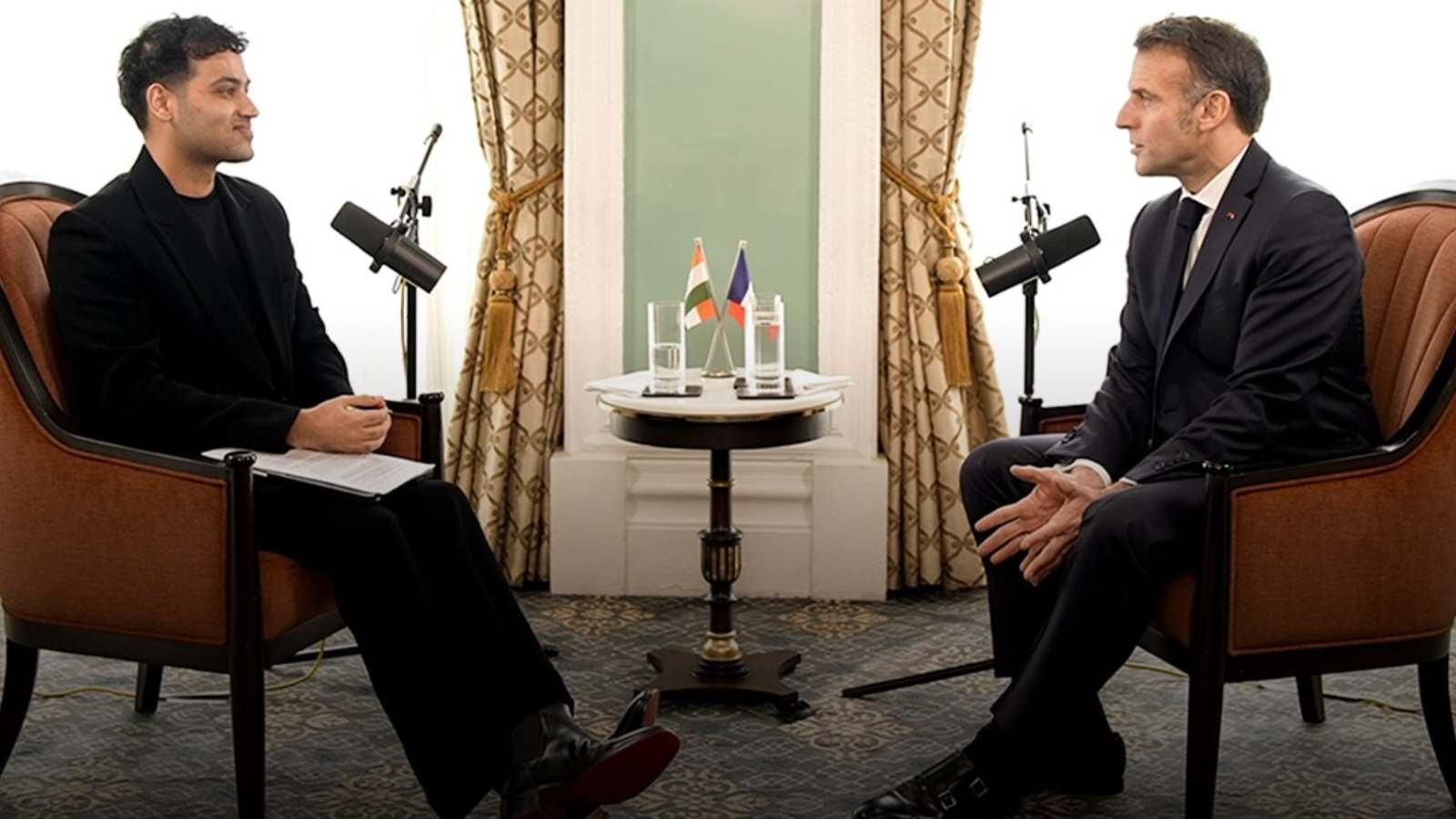
MUMBAI (Azat TV) – French President Emmanuel Macron appeared on Indian entrepreneur and content creator Raj Shamani’s popular podcast, “Figuring Out…”, during his official visit to India in February 2026. The episode, which premiered on February 19, 2026, provided a unique platform for President Macron to candidly discuss Europe’s structural challenges in the technology sector and contrast them with India’s rapid digital transformation, signaling a new era of global leaders engaging directly with massive digital audiences through the creator economy.
The podcast appearance was part of a broader diplomatic push, coinciding with the inauguration of the India-France Year of Innovation 2026 and the AI Impact Summit in New Delhi. President Macron utilized the digital-first format to articulate France’s strategic vision for technological sovereignty and foster deeper bilateral ties in emerging technologies, leveraging Shamani’s YouTube channel which boasts over 15 million subscribers.
President Macron on Europe’s Tech Challenges
During his conversation with Raj Shamani, President Emmanuel Macron attributed Europe’s lag behind the U.S. and China in producing major technology companies to three key structural constraints: a lack of scale, insufficient capital deployment, and a weaker appetite for risk. He explained that Europe’s fragmented market structure prevented rapid scaling, emphasizing the need to strengthen the single market to create a unified 450-million-inhabitant domestic market.
President Macron also highlighted issues with capital allocation, noting that while Europe possesses substantial savings, these are often channeled into bond markets or invested outside the continent rather than into high-growth tech sectors. Culturally, he stressed the importance of embracing risk and accepting failure as integral to innovation, stating, “If you don’t accept to fail and to start again, you will never succeed.”
India’s Digital Transformation and Bilateral Innovation
In stark contrast to Europe’s challenges, President Macron lauded India’s rapid digital transformation, particularly its advancements in financial inclusion and public digital infrastructure. He praised India’s capacity to train more engineers annually than the U.S. and Europe combined, calling it a “unique resource.” Specific examples included the Unique Identification Authority of India’s Aadhaar system and the National Payments Corporation of India’s UPI network, which he noted had achieved impressive scale in just a few years.
The podcast conversation also underscored the “India-France Year of Innovation 2026,” a bilateral initiative aimed at accelerating joint ventures in emerging technologies. President Macron told Shamani that India’s massive scale and France’s deep research capabilities make them natural partners for developing open-source AI, an approach intended to democratize technology and prevent monopolization by a few global tech giants. Initiatives such as the Indo-French Innovation Network, a new digital platform connecting startups, and exchange programs for tech talent focusing on ethical AI development were also highlighted.
“Sunglasses Diplomacy” and Creator Economy Engagement
The podcast episode gained significant viral traction online, partly due to a playful moment dubbed “sunglasses diplomacy.” In a teaser, Raj Shamani greeted President Macron while sporting dark aviator sunglasses, a humorous reference to Macron’s recent appearance at the World Economic Forum in Davos where he wore similar shades. President Macron, who had worn the sunglasses at Davos due to a burst blood vessel in his eye, laughed off the gesture, responding with a viral catchphrase, “For sure,” a nod to his Davos speech where he had criticized then-U.S. President Donald Trump.
This light-hearted exchange, widely interpreted as a subtle jab at Trump, exemplified President Macron’s broader strategy of using digital-first platforms, Instagram Reels, and popular Indian music to connect with a local audience of over 500 million internet users. His appearance on Shamani’s podcast signifies a notable shift in how global leaders are engaging with the creator economy to discuss high-stakes international policy and foster cultural diplomacy, reaching a younger, digitally native demographic directly.
France’s “Moonshot” and AI Investment
When asked about France’s potential “moonshot” technology by 2035, President Macron suggested quantum computing as an area where France could achieve leadership, citing the country’s strengths in mathematics, research labs, and startups. He reiterated that such ambitious projects require a tolerance for repeated setbacks and a willingness to try multiple times after initial failures.
President Macron also defended France’s €109 billion AI investment plan, emphasizing that technological sovereignty does not equate to isolation but rather to building domestic capability through strategic partnerships and attracting foreign direct investment. His remarks came as Europe actively pushes for greater technological independence amid intensifying global competition in AI, semiconductors, and advanced computing.
President Macron’s decision to engage with a prominent digital content creator like Raj Shamani reflects a growing recognition among global political figures of the creator economy’s power to shape public discourse and directly reach vast, diverse audiences, particularly in digitally advanced nations like India. This strategic embrace of new media platforms signals an evolving approach to diplomacy and public communication in the 21st century.