


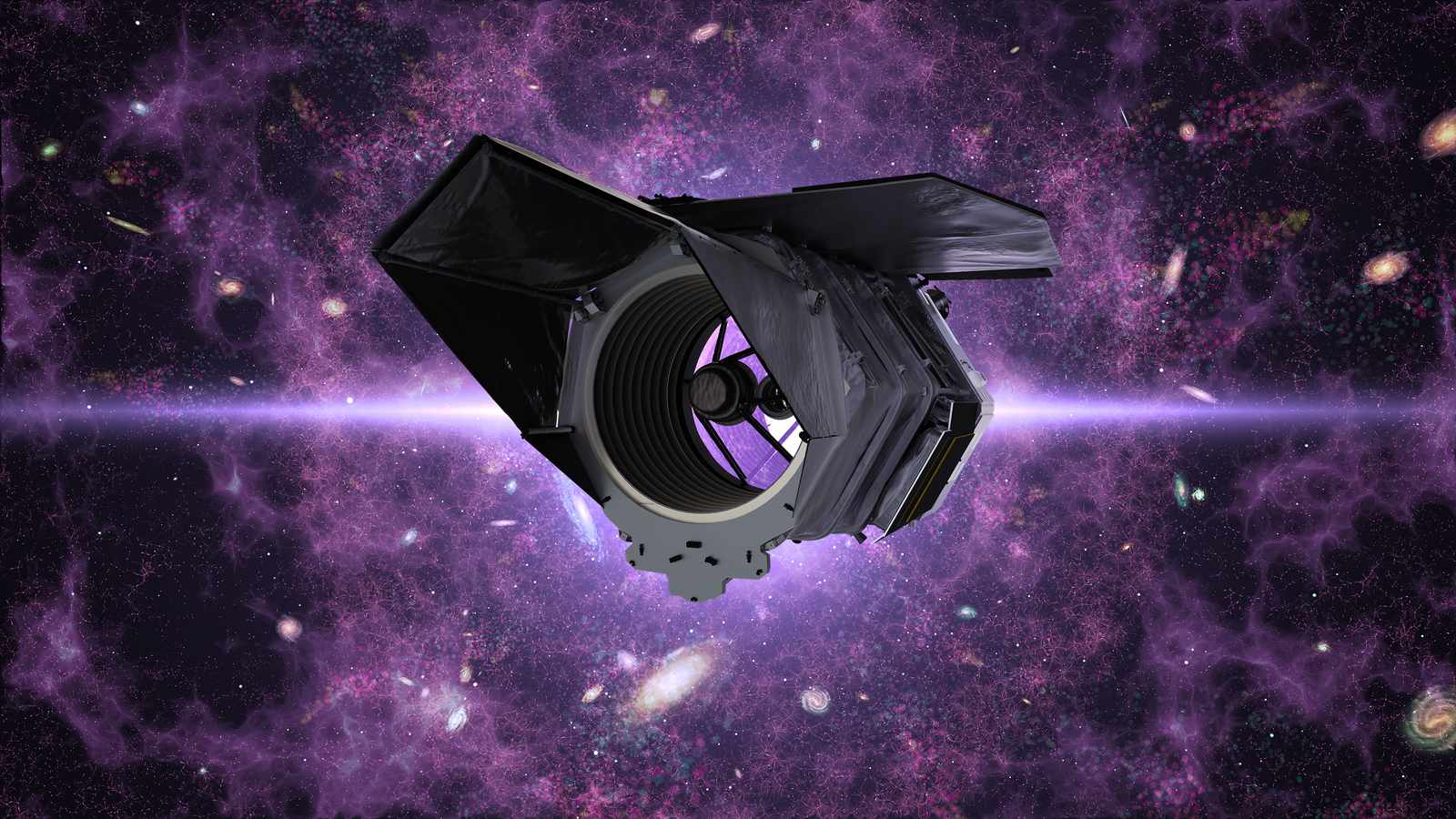
Public fascination with the mysterious cosmos is currently at an all-time high, driven in part by popular culture and the return of high-concept sci-fi dramas like the television series Dark Matter starring Jennifer Connelly, which delve into the speculative realms of the multiverse and alternative dimensions. Yet, while Hollywood constructs elaborate fictional worlds around these concepts, real-world astrophysics has just taken a historic leap to observe the actual structure of our universe. On August 30, 2026, NASA successfully launched its next-generation powerhouse, the Nancy Grace Roman Space Telescope, embarking on a $4.3 billion mission to map the cosmos, hunt for exoplanets, and solve the profound mysteries of dark matter and dark energy.
At 7:26 a.m. Eastern time on August 30, the 18,000-pound observatory lifted off aboard a SpaceX Falcon Heavy rocket from Florida’s Kennedy Space Center. It is now on a three-month journey to the second Lagrange point (L2), located approximately one million miles from Earth, where it will join the James Webb Space Telescope in exploring the deepest corners of space. While sci-fi fans contemplate the narrative possibilities of parallel universes, the scientific community is preparing for a flood of raw data that could fundamentally rewrite the standard model of cosmology.
Bridging Sci-Fi Imagination and Hard Astrophysics
In popular science fiction, dark matter is often treated as a mysterious gateway to alternative realities or a substance that can be manipulated to bend the laws of physics. In reality, astrophysicists describe dark matter as the invisible “cosmic glue” that holds galaxies together, while dark energy is the elusive force driving the universe’s accelerating expansion. Together, these two phenomena make up roughly 95 percent of the cosmos, yet they remain completely invisible to traditional instruments.
The Roman Space Telescope will not find portals to parallel lives, but it will capture something arguably more spectacular: a massive, high-resolution map of the universe that could prove our current understanding of physics is incomplete. According to Julie McEnery, a Roman Space Telescope senior project scientist at NASA Goddard Space Flight Center, recent observations suggest flaws in our theoretical framework. “There are hints that the distribution of matter, the structure of matter in the universe, is not quite right, and there are even hints that the cosmological constant, a constant property of space-time, is in fact not constant,” McEnery explained during a pre-launch briefing. With Roman’s data, scientists are poised to demonstrate where the standard model of cosmology fails, setting humanity on a path to discovering how the universe truly operates.
A Quantum Leap in Sky-Mapping Technology
Named after Nancy Grace Roman, NASA’s first chief of astronomy and the “mother of the Hubble Space Telescope,” the new observatory is roughly the size of a tour bus. Despite its physical size, its true power lies in its technological capabilities. Roman is equipped with a 300-megapixel Wide Field Instrument that operates in infrared light. While it possesses the same sensitivity and sharpness as the iconic Hubble Space Telescope, its field of view is at least 100 times larger, allowing it to observe the sky approximately 1,000 times faster.
To put this capability into perspective, McEnery noted that a comprehensive survey of the Milky Way galaxy that would take Hubble an entire century to complete can be accomplished by Roman in just a single month. Over its primary five-year mission, the telescope will conduct three major surveys: mapping one-eighth of the entire sky to capture data on more than one billion galaxies, examining stellar explosions (supernovas) to measure past cosmic expansion, and focusing on the dense cluster of stars at our galaxy’s core to search for exoplanets.
Additionally, Roman will test an ultra-advanced coronagraph designed to block out blinding starlight. This instrument will allow scientists to view the dim, reflected light of orbiting exoplanets with a sensitivity 100 to 1,000 times greater than any previous space-based coronagraph. This technology is a critical stepping stone for NASA’s future Habitable Worlds Observatory, which will actively search for chemical signatures of life on distant Earth-like planets.
Operational Efficiency and Open Science
In an era where major space missions are frequently plagued by delays and ballooning costs, the Roman Space Telescope stands out as a triumph of project management. According to program scientist Dominic Benford, the project has run several months ahead of schedule and remained a few million dollars under its $4.3 billion budget. This efficiency ensures that the scientific community can begin utilizing its data without the administrative strain that often accompanies delayed launches.
Once the telescope begins its official operations, it will transmit approximately one terabyte of data back to Earth every single day—an amount of data equivalent to streaming one million songs from a million miles away. Crucially, NASA has committed to making all Roman data immediately public. This open-science policy democratizes cosmic discovery, allowing independent researchers, students, and amateur astronomers worldwide to access the same high-resolution imagery simultaneously. As project manager Jackie Townsend noted, this immediate access could inspire “the next Dr. Nancy Grace Roman, sitting in a classroom somewhere next year,” to catch the science bug and transform our world.