


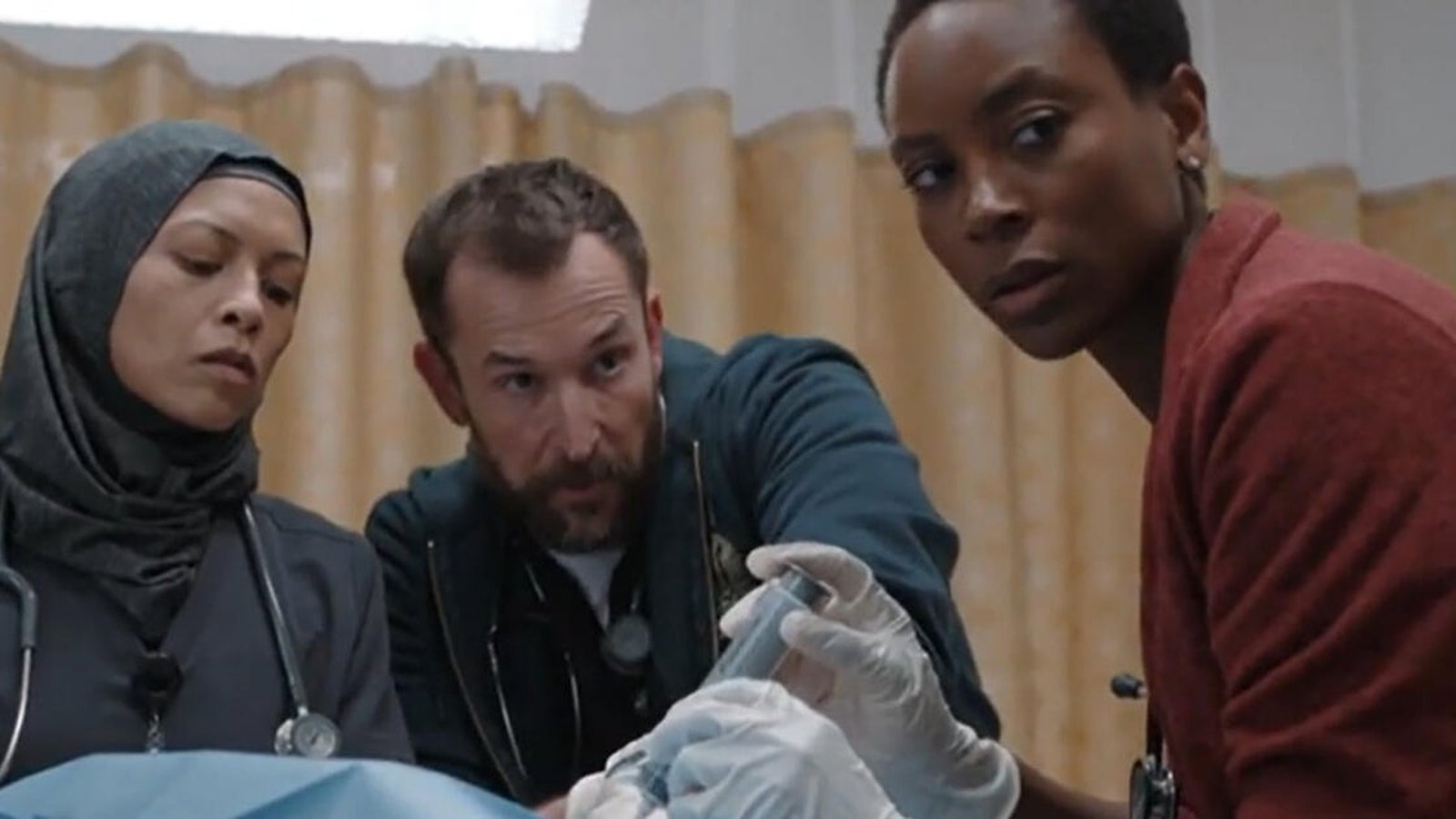
For decades, medical dramas have held a unique, almost sacred, place in the landscape of primetime television. From the groundbreaking narratives of ‘Dr. Kildare’ and ‘Marcus Welby’ to the irreverent humor of ‘M*A*S*H’ and the groundbreaking ensemble of ‘ER’, these shows have offered viewers a window into the high-stakes world of healing and heartbreak. Among the most iconic figures to emerge from this genre is Noah Wyle’s Dr. John Carter, a character whose journey from eager intern to seasoned physician captivated millions on ‘ER’ for fifteen seasons. Yet, when ‘ER’ concluded its historic run, Wyle was unequivocal about his future: the odds of him ever starring in another medical show were, as he put it, ‘zero percent.’
Fast forward to 2026, and Wyle has not only returned to the medical drama fold but has done so with resounding success, earning an Emmy for Outstanding Lead Actor in a Drama Series for his portrayal of Dr. Michael Robinavitch—affectionately known as ‘Dr. Robby’—in HBO Max’s hit series, ‘The Pitt’. The show itself swept five Emmys, including the coveted Outstanding Drama Series award, solidifying its place as a critical and popular phenomenon. What, then, prompted this dramatic shift from Wyle’s firm resolve? His answer is stark and simple: ‘COVID’.
From ‘ER’ to ‘The Pitt’: A New Chapter in Medical Drama
The global pandemic, Wyle explained to CBS News, profoundly altered his perspective, not just on life but on the stories that needed telling. He began receiving poignant messages from frontline healthcare workers, expressing a desperate wish for ‘Dr. Carter’ to be ‘out here’ or simply articulating the ‘awful’ reality they faced daily. These pleas resonated deeply, igniting a new sense of purpose that transcended his earlier professional boundaries. ‘COVID changed everything, certainly for me in thinking about there being another story to tell,’ Wyle reflected.
‘The Pitt’, which premiered in 2024, plunges viewers into the unrelenting environment of the fictional Pittsburgh Trauma Medical Center. Each episode unfolds over a single, intense hour within one emergency room shift, creating a palpable sense of urgency and claustrophobia. Wyle’s Dr. Robby, the Senior Emergency Attending Physician, is the anchor in this maelstrom, navigating a constant influx of patients and the intricate ethical dilemmas that define modern medicine. His Emmy win this past September for his compelling performance was not just a personal triumph but a testament to the show’s powerful storytelling and its ability to capture the zeitgeist of a post-pandemic world. As Collider noted, the show quickly garnered critical acclaim and a devoted fanbase, soaring high on HBO Max’s streaming charts in anticipation of its second season.
Behind the Hyper-Authenticity of Pittsburgh Trauma Medical Center
One of ‘The Pitt’s’ most striking features is its unwavering commitment to hyper-authenticity. Visiting the set at Warner Brothers Studios in Burbank, California, one is immediately struck by the meticulous recreation of a bustling hospital environment. Wyle emphasized the importance of creating a ‘totally immersive experience’. This isn’t just about superficial aesthetics; it extends to every minute detail. ‘You open a drawer, everything that’s supposed to be in the drawer is there. Everything feels real, and is exactly where it should go,’ he explained. This dedication ensures that viewers are not merely observing a performance but are drawn into a world that feels undeniably genuine.
The realism isn’t confined to the set design. Actors undergo an intensive two-week medical boot camp, a rigorous training regimen designed to imbue them with the fundamental skills and natural mechanics of healthcare professionals. Dr. Elizabeth Ferreira, an emergency room doctor herself and one of the show’s medical technical consultants, plays a crucial role in this process. She meticulously educates the cast on everything from CPR and suturing to intubation techniques. Her goal is to ensure that ‘when they are on screen and the camera is quite tight and close, everything looks finessed and refined, as if someone with experience has done it.’ This attention to detail is evident in scenes like Episode 10, where a patient suffers a baseball injury to the eye, with procedures and prosthetics crafted to look thoroughly real.
Wyle’s involvement in ‘The Pitt’ extends far beyond his starring role. He is not only the lead actor but also an executive producer, writer, and, on occasion, a director. This multifaceted engagement allows him to shape the narrative and the show’s overall vision, ensuring that its portrayal of healthcare remains as authentic and impactful as possible. This level of creative control is a significant factor in the show’s ability to resonate so deeply with audiences and critics alike, making it more than just another medical drama.
Reflecting Real-World Healthcare Crises
‘The Pitt’ distinguishes itself by fearlessly confronting the pressing, often uncomfortable, realities of contemporary healthcare. Executive producers John Wells and Scott Gemmill, both veterans of ‘ER’, highlight how the show addresses a range of critical issues exacerbated in the post-pandemic era. One particularly disturbing trend explored is the alarming rise in violence against healthcare providers. Wells observed, ‘Since COVID, there’s a kind of a stress level and anger that exists in the population. And that has translated particularly to violence against nurses, but against all the healthcare providers [as well].’ This stark portrayal sheds light on the dangerous environment many medical professionals now navigate daily.
Another significant theme is the erosion of public trust in public health institutions, fueled by a pervasive wave of disinformation. Gemmill noted, ‘Disinformation, that was one of the biggest changes, I think, besides COVID. I don’t remember the disinformation being at a level that it is these days.’ This sentiment is echoed by Wells, who spoke about the phenomenon of ‘Dr. Google’—patients arriving already convinced of their self-diagnoses based on unreliable internet searches. ‘The biggest thing that we talk about regularly is Dr. Google – this notion that everybody who comes in is already on their phone figuring out what it is that supposedly is wrong with them, and half the people have assumed that they’ve got the worst possible thing that could happen to them,’ Wells explained. This battle against misinformation and the challenge of defending against ‘artificial intelligence’ in diagnostic processes form a critical part of the show’s narrative fabric, illustrating how trust has become a commodity as precious as any medical supply.
Looking ahead to Season 2, which begins streaming on January 8, Wyle promises that ‘The Pitt’ will continue to reflect these real-life problems, painting a grim picture of an increasingly strained system. ‘People are going to lose their health insurance. People are going to delay care. People are going to continue to come in sicker. They’re going to be more volatile when they come in. That’s going to put more of a burden on staff. All this stuff is sort of moving towards this perfect storm of unsustainability,’ he warned. The second season, set on the Fourth of July in Pittsburgh—a city renowned for its fireworks, with a nearby town even dubbed the ‘Fireworks Capital’—is poised to tackle the inevitable influx of drunk firework victims, adding another layer of chaotic realism to the already high-pressure environment. This deliberate choice of setting amplifies the show’s commitment to portraying the raw, often messy, reality of emergency medicine.
A Personal Prescription: Wyle’s Connection and Renewal
Wyle’s deep connection to the medical world isn’t merely a matter of character study or script interpretation; it’s rooted in his personal history. His mother, Marjorie Speer, was an orthopedic and operating room nurse, a demanding profession that often kept her at the hospital all day. Wyle recalled walking home from school alone until his mother returned, a subtle early impression of the sacrifices made by healthcare workers. Years later, watching an episode of ‘The Pitt’, his mother had a profound reaction. ‘That rocked me,’ she told him, before listing names of patients she had seen die during her practice. Wyle was astonished, realizing he had never heard these stories before. ‘Oh, yeah,’ she responded, explaining that she had shielded her children from such traumatic experiences. ‘The Pitt’, however, chooses to show us ‘that stuff’, exploring the immense emotional toll on medical professionals and what happens when an empathetic doctor, like Dr. Robinavitch, stops having empathy for himself.
The show also critiques the long-standing, often damaging, culture within medicine that glorified enduring extreme conditions. Wyle recalled the ‘suck it up’ mentality, where working ‘four days straight’ became a ‘badge of honor’ rather than a sign of systemic stress. This ethos contributed to healthcare providers burying their own suffering, a theme powerfully explored through Dr. Robby’s eventual meltdown. As Gemmill noted, ‘We get feedback from people who, having seen the show, realize that they, too, are suffering and have buried it the same way that the Robby character did.’ This narrative arc offers a crucial validation for those in the medical field, acknowledging the human cost of their dedication.
For Wyle himself, ‘The Pitt’ has proven to be a deeply personal and restorative endeavor. He openly shared that there were two critical junctures in his career when the ‘flow’ was interrupted—during the pandemic and the recent writers’ and actors’ strike. These periods of forced inactivity ‘rattled’ him, leading to a significant self-discovery. ‘I remember saying to my wife, like, ‘I don’t think I work for money. I think I work for health, my own health. Like, I think this is where I get my orientation. And without it, I’m not sure I know what I do on this Earth,” he confessed. Now, immersed in ‘The Pitt’, taking on multiple creative roles, Wyle declares, ‘I’m the happiest I’ve been in a long time.’ When asked if this surprised him, he laughed, ‘It just confirms, you know, it confirms all my worst suspicions about myself, which is that I really need all this!’ For Noah Wyle, ‘The Pitt’ isn’t just a job; it’s a vital part of his own well-being, a prescription he ultimately wrote for himself.
‘The Pitt’ transcends the traditional medical drama by serving as a mirror to the profound challenges facing contemporary healthcare. Driven by Noah Wyle’s deeply personal connection and multifaceted involvement, the series not only entertains but also provokes crucial conversations about systemic issues, the toll on frontline workers, and the fragile trust between patients and providers, making it an indispensable reflection of our times.