


The Scope of the October 2026 Security Patch
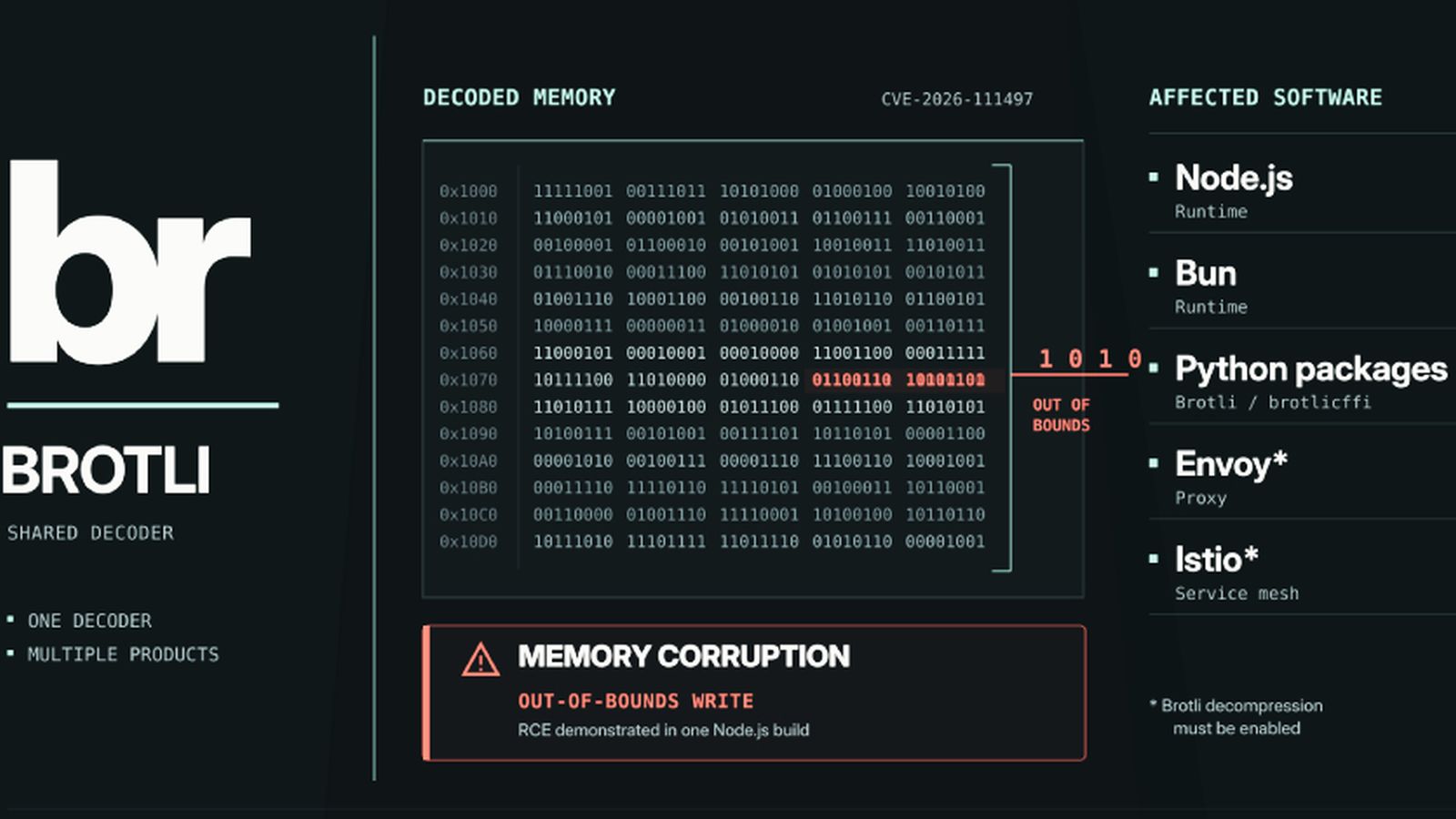
On October 21, 2026, a security patch for Node.js was released to address 10 distinct vulnerabilities, with four rated as having a “high” severity level Note. The core issue stems from a memory-corruption flaw tracked as CVE-2026-111497, which affects programs that unpack Brotli-compressed data The Hacker News. When decompressing externally received data, vulnerable applications may crash or, under certain conditions, permit arbitrary code execution Note.
The updated versions released by maintainers to address these concerns are v22.23.4, v24.22.1, and v26.12.1 Note. Because these security fixes are not backported to versions that have already reached end-of-life—such as Node.js 18, 20, 23, and 25—developers and system administrators must migrate their workloads to actively supported releases Note.
Background Processes and Active Runtimes
A primary challenge identified during remediation is that updating the global runtime version does not automatically terminate or refresh already running background instances Note. For instance, developers utilizing development servers like Astro and Next.js, or maintaining resident Model Context Protocol (MCP) servers used by AI tools like Claude Code, often find that multiple active processes continue executing binaries from pre-patch environments Note.
Audits of local development machines have revealed numerous instances where outdated Node.js processes remained active for weeks after the initial CLI or system update Note. Consequently, checking the terminal version via standard commands is insufficient if background daemons, containerized services, or embedded application runtimes continue referencing older binaries Note.
Production Deployments and Cloud Services
The risk extends beyond local developer workstations into cloud-hosted web applications Note. Environments deployed on services such as Google Cloud Run frequently rely on base container images or configuration files that specify older runtime versions Note.
Security reviews of published web applications demonstrate that automated development environment updates do not propagate to production servers automatically Note. Mitigating CVE-2026-111497 across production infrastructure requires explicitly rebuilding container images, updating deployment descriptors, and redeploying services to ensure that active server instances run patched binaries Note.
Ecosystem Impact Across Runtimes and Packages
The memory-corruption flaw in Google’s Brotli decoder is not isolated to Node.js environments. The vulnerability, which carries a CVSS score of up to 9.2, similarly affects other platforms and libraries that bundle or interface with Google’s C-based Brotli decompression code The Hacker News. Impacted software ecosystems include Bun, Envoy proxies, Istio service meshes, and specific Python packages such as Brotli and brotlicffi The Hacker News.
Because each affected software product maintains and compiles its own copy of the Brotli decoder library, updating one component does not automatically protect others. For instance, Python applications may be exposed if the underlying HTTP client libraries—such as requests, urllib3, httpx, or aiohttp—automatically unpack Brotli-compressed responses upon encountering the relevant compression headers The Hacker News. This widespread exposure underscores the necessity of conducting thorough dependency inventories across diverse application stacks rather than relying solely on language runtime updates The Hacker News.
Exploitation Mechanics and Security Research Context
Security researchers from Imperva demonstrated that the vulnerability, occasionally referenced as Node2Shell, can facilitate arbitrary code execution on unpatched Node.js builds under specific conditions The Hacker News. The flaw is triggered when an application processes untrusted, maliciously crafted compressed streams via mechanisms like built-in fetch calls or request body parsers such as Express and body-parser The Hacker News.
Despite the high severity designation and the capability to cause program crashes or memory corruption, security agencies and maintainers have noted a lack of widespread, in-the-wild exploitation at the time of disclosure The Hacker News. OpenAI’s Codex Security team, credited alongside researchers Khai Tran and Sylvie Mayer for identifying and reporting the issue, observed that the root cause had actually been addressed in the core Brotli source code months prior in February, but remained unrecognized as an exploitable security vulnerability until subsequent analysis linked it to downstream decoder implementations The Hacker News.
Actionable Remediation and Verification Strategies
Addressing CVE-2026-111497 demands a multi-layered verification protocol that goes beyond running standard version check commands in a terminal Note. System administrators and developers must verify that active processes, container images, and deployment targets have all been systematically refreshed Note. For containerized environments, this involves pulling updated base images, recompiling artifacts, and rolling out fresh instances to ensure zero reliance on outdated binaries Note.
In scenarios where immediate patching is unfeasible, temporary workarounds include disabling automatic Brotli decompression within HTTP clients or rejecting incoming requests that rely on content-encoding headers utilizing Brotli until formal updates can be applied across all dependent systems The Hacker News.