


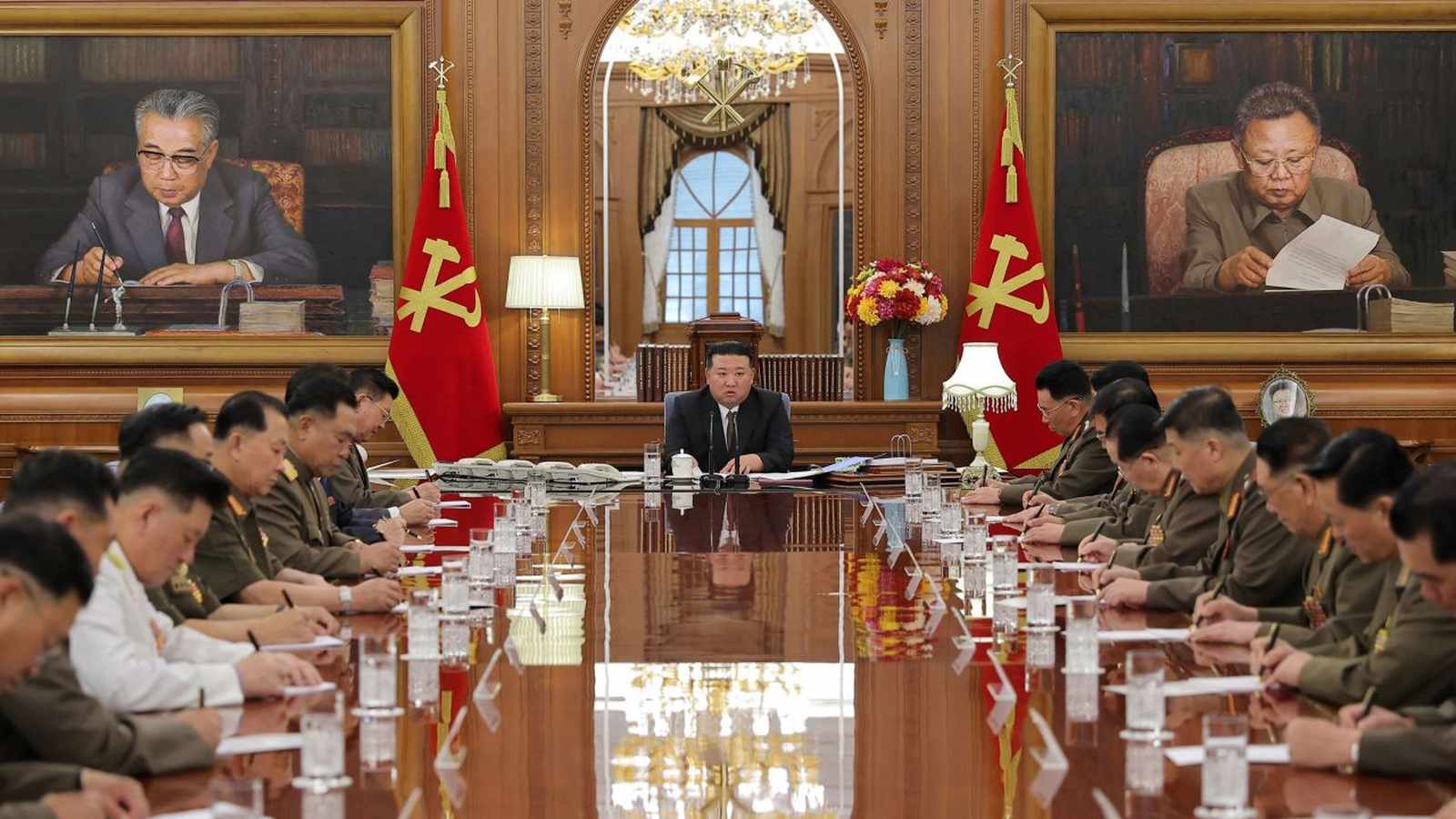
PYONGYANG (Azat TV) – North Korean leader Kim Jong-un has executed a sweeping reshuffle of his military high command, replacing Defense Minister No Kwang Chol with Kim Song Gi, a hardline commander closely aligned with Pyongyang’s deepening strategic alliance with Russia. The high-level military transition coincided with a blistering diplomatic rejection of U.S. President Donald Trump’s renewed summit overtures, as Pyongyang vowed to relentlessly expand its nuclear arsenal while warning South Korea of total destruction if its security is compromised.
The Command Shake-Up: Elevating Kim Song Gi
The replacement of No Kwang Chol with Kim Song Gi signals a decisive shift in North Korea’s strategic posture. Analysts view the appointment of Kim Song Gi as a direct effort to consolidate the country’s military apparatus around the recently signed Russia-DPRK mutual defense pact. As Pyongyang coordinates more closely with Moscow on global security issues, the military leadership is transitioning away from figures associated with past diplomatic engagements toward commanders prepared for direct, long-term confrontation with the West.
This reshuffle underlines a systemic pivot: North Korea is no longer positioning its military command as a bargaining chip for sanctions relief, but as a permanent, nuclear-armed pillar of an emerging revisionist bloc. The move is widely interpreted as an institutional adjustment to accommodate potential North Korean involvement in broader geopolitical conflicts, backed by Russian military-technical cooperation.
Rebuffing Washington’s Diplomatic Advances
Despite President Trump ordering a major scaling back of the joint U.S.-South Korea “Ulchi Freedom Shield” exercises in late August 2026 to foster goodwill, North Korea has flatly dismissed the gesture. Kim Yo Jong, the influential sister of the North Korean leader, characterized the reduction of the drills as “not even worth commenting on” and “completely uninteresting,” warning Washington that symbolic gestures would not yield the diplomatic concessions it desires.
In a statement released via the state-run Korean Central News Agency (KCNA), a Foreign Ministry spokesperson affirmed that Washington’s “hostile policy” remains entirely unchanged, describing U.S. demands for complete denuclearization as “pointless.” The ministry asserted that Pyongyang’s nuclear status is an “absolute guarantee” of its sovereignty that will never be negotiated away, rendering Trump’s hopes for a fourth diplomatic summit highly unrealistic.
Existential Threats to Seoul and the Nuclear Pivot
Concurrently, Kim Jong-un has intensified his hostile rhetoric toward Seoul, declaring that North Korea would not hesitate to destroy its southern neighbor if provoked. Speaking at a ruling party congress, Kim formally closed the door to dialogue with South Korea, classifying the state as a hostile adversary rather than a partner for reunification.
To back this stance, Kim called for the rapid development of advanced weapons systems, including underwater-launched intercontinental ballistic missiles (ICBMs) and an expanded arsenal of tactical nuclear weapons specifically calibrated to target South Korean infrastructure. While Kim theoretically left a narrow window open for strategic dialogue with Washington to exploit divisions between the allies, the immediate focus remains on military readiness. This posture is further tested by the upcoming “Freedom Edge” trilateral exercises between the U.S., South Korea, and Japan, scheduled for September 7 to 11, 2026, which Pyongyang continues to condemn as an existential threat.