


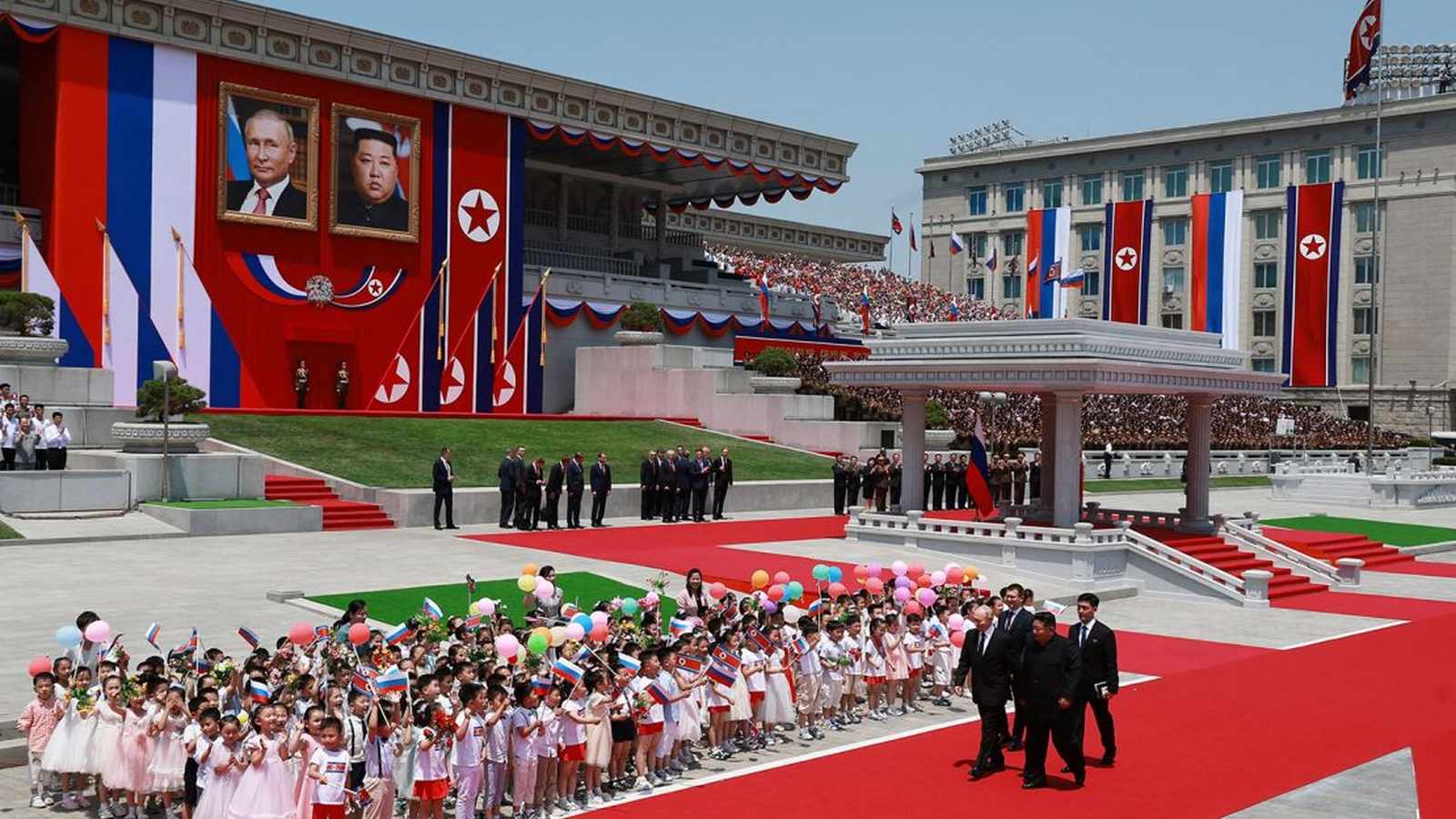
North Korea has revised the official proportions of its national flag for the first time since the regime’s establishment in 1948, shifting the height-to-width ratio from 1:2 to 1:1.65. The constitutional amendment, published on Friday, November 13, 2026, on the North Korean external propaganda website Naenara, effectively shortens the flag’s width while keeping its central design intact. According to reporting by the Korea Herald, the update represents a calculated effort by leader Kim Jong Un to institutionalize his ‘two hostile states’ doctrine and distance his regime from the legacy of Korean unification.
Constitutional Revisions and Symbolism
The redesigned flag is enshrined in Article 166 of the revised North Korean constitution, which reemerged online after remaining offline for two and a half years, as detailed by Newsweek. While the central red field, white and blue stripes, and the red five-pointed star inside a white circle remain, the altered geometry removes features established with the participation of Soviet specialists after World War II. Pyongyang’s state media explained that the central red field represents the blood shed by anti-Japanese revolutionary fighters, the white circle and stripes signify loyalty to the ruling Workers’ Party and the leadership, and the blue stripes symbolize anti-imperialist independence, world peace, and national sovereignty.
Institutionalizing the Two Hostile States Doctrine
Analysts emphasize that the flag modification is part of a broader, methodical campaign to erase symbols of Korean reconciliation from public life. Earlier actions under this campaign included amending the national anthem in 2024 to remove ‘samcholli’—a traditional geographical term encompassing the entire Korean Peninsula—and replacing it with ‘i sesang’, meaning ‘this world’. Furthermore, the regime excised reunification provisions from the constitution earlier in the year, formally defining South Korea as a permanent principal enemy rather than a partner in eventual state integration.
Lim Eul-chul, a professor at Kyungnam University’s Institute for Far Eastern Studies, noted that the flag revision balances continuity with previous leaders while asserting a distinct political identity under Kim Jong Un. Edward Howell, a lecturer and research fellow at the University of Oxford, observed that the constitutional updates reflect Pyongyang’s long-standing policy to sever all ties with Seoul.