


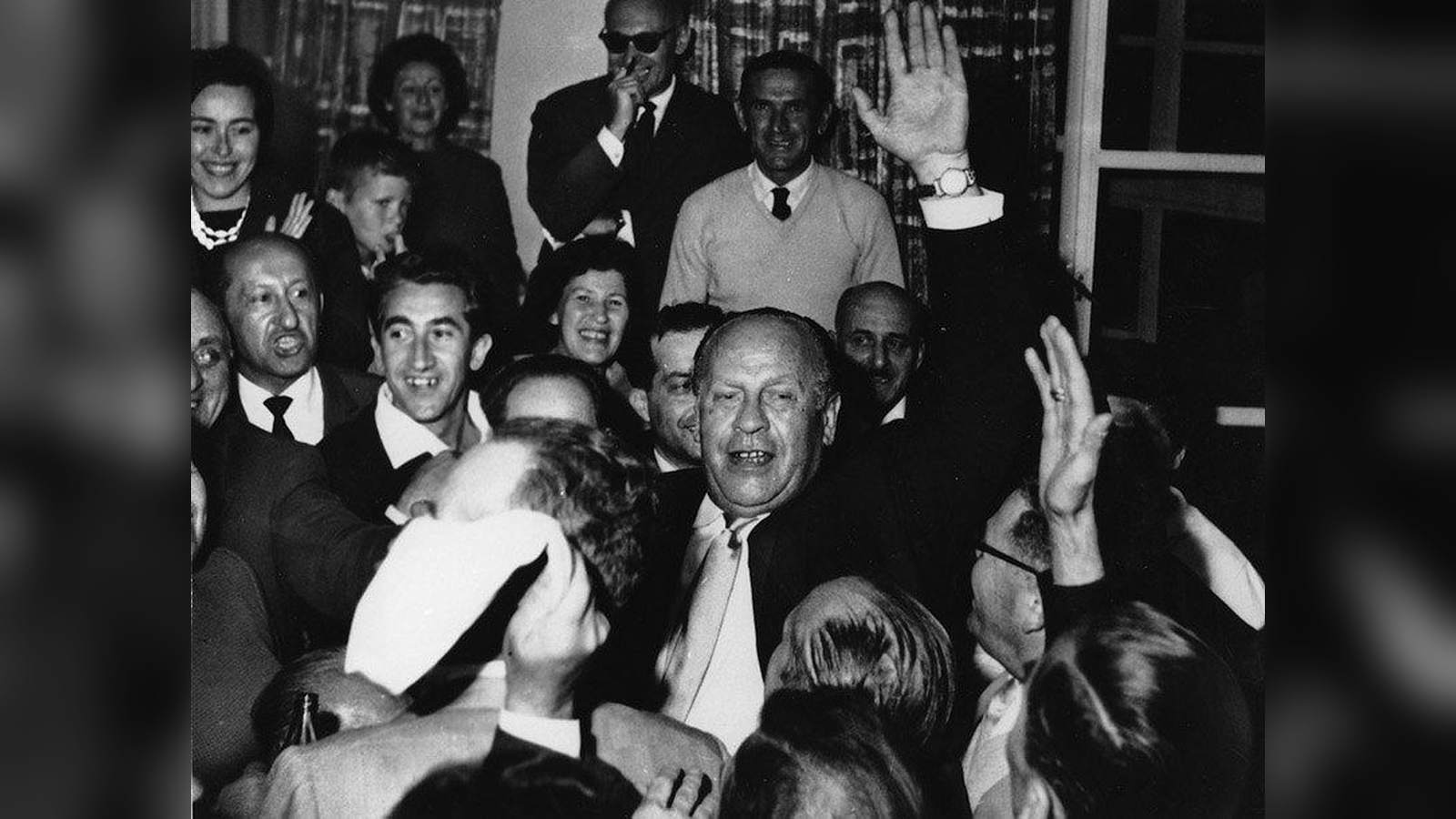
What the photograph shows
This evocative and historically resonant photograph captures German industrialist Oskar Schindler standing shoulder-to-shoulder with several Jewish men and women who survived the Holocaust because of his wartime intervention. Dressed in a sharply tailored suit and narrow tie, Schindler appears deeply moved, flanked by survivors who look toward him with expressions of profound warmth, gratitude, and enduring personal attachment. The photographic composition relies on unscripted human closeness rather than formal ceremonial staging: arms rest easily on shoulders, faces bear the lined history of shared trauma and survival, and the physical intimacy speaks volumes about the rare, almost impossible bond forged between a former Nazi Party intelligence operative and the human beings he risked everything to protect. Rather than presenting a stiff official portrait, the camera frame preserves a quiet, emotionally charged moment of recognition two decades after the industrialized terror of the Second World War tore Central Europe apart.
Looking closer at the visual elements within the frame, one notices the distinct absence of official pomp or bureaucratic distance. The lighting is natural, casting soft shadows across the faces of the group, highlighting the distinct individual features of people who had endured the Kraków Ghetto, the brutality of Płaszów, and the harrowing shadow of Auschwitz. Schindler’s expression is one of reflective humility rather than triumphant pride. The individuals gathered around him lean in close, creating a tight, protective circle that visually mirrors the protective enclosure Schindler once built around them inside his wartime factories. Every posture and gesture in the frame conveys an unspoken narrative of mutual loyalty, bridging the gap between a dark historical past and a fragile, hard-won post-war present.
The moment behind the image
The photograph was taken in May 1962 during Schindler’s emotional, highly anticipated first visit to the newly established State of Israel, where he had been formally invited by the Yad Vashem Holocaust Martyrs’ and Heroes’ Remembrance Authority to plant a carob tree on the Avenue of the Righteous. By this point in his life, Schindler was living in West Germany, struggling through a series of failed business ventures—including a cement enterprise—and relying largely on financial stipends and charitable support from the community of survivors he had saved. The trip to Israel was meticulously organized, coordinated, and funded by the Schindlerjuden—the roughly 1,200 Jewish workers whose lives he had safeguarded by employing them first at his enamelware factory in Kraków and later at the munitions plant in Brněnec.
Stepping onto Israeli soil, Schindler was greeted not as a distant historical benefactor, but as a beloved father figure, a savior, and a brother. Reuniting with key figures from his wartime past, including accountant Itzhak Stern and black-market contact Leopold Pfefferberg, Schindler walked through a land that had become a permanent sanctuary for many of the souls he had pulled away from the threshold of the gas chambers. In the moments immediately preceding and following the shutter click, conversations shifted rapidly between heavy wartime remembrances and joyous reunions of families that literally would not have existed had Schindler made different choices in 1939 or 1944. The atmosphere was charged with tears, embraces, and a collective realization of the miraculous nature of their survival against the backdrop of catastrophic historical loss.
Photographer and provenance
While individual press attributions and archival credits for mid-century photojournalistic coverage of Schindler’s 1962 Israeli trip are frequently dispersed across institutional collections, international news wire agencies, and private scrapbooks meticulously maintained by the Schindlerjuden themselves, the image circulated widely in contemporary press and commemorative publications. Photographs documenting this historic visit captured a rare, unprecedented instance of post-war reconciliation and human gratitude. Schindler’s travels to Israel subsequently became regular occurrences in his later years, as he spent weeks at a time visiting the families he rescued, cementing an extensive archive of visual testimony preserved today by historical societies, family albums, and Holocaust museums worldwide.
The institutional provenance of such photographs often reflects the fluid journalistic and archival practices of the early 1960s, where collective photo-reportage and wire services routinely overshadowed individual creator credits. Yet, the historical integrity and authenticity of the frame remain undisputed. Preserved across decades in personal memoirs, documentary films, and museum exhibits, this specific visual record serves as a primary touchstone for understanding how the Schindlerjuden chose to remember and honor their rescuer during his lifetime—long before global cinematic recognition permanently etched his story into popular culture.
Historical context
Oskar Schindler’s remarkable journey to this warm reunion spanned one of the most harrowing and darkest chapters of modern human history. An ambitious Sudeten German industrialist and former Abwehr military intelligence agent, Schindler initially arrived in Kraków in October 1939 primarily to exploit cheap Jewish labor for personal profit following the German military invasion of Poland. However, witnessing firsthand the brutal, mechanized liquidation of the Kraków Ghetto by Nazi SS forces transformed his moral outlook entirely. Leveraging his active Nazi Party membership, lucrative Wehrmacht armaments contracts, and extensive underground black market connections, Schindler systematically bribed SS officials—including infamous camp commandants like Amon Göth—to shield his workers from deportation and certain death.
When the Soviet Red Army advanced westward in the summer and autumn of 1944, Schindler successfully orchestrated the relocation of his entire factory and workforce to Brněnec in the Sudetenland, famously utilizing the compiled lists typed by Mietek Pemper and Marcel Goldberg to preserve nearly 1,200 lives. By the end of the Second World War in Europe in May 1945, Schindler had completely exhausted his entire personal fortune, reducing himself to financial destitution to procure food, raw materials, and continuous bribes necessary to keep his workforce alive. His post-war years in Argentina and Germany were marked by economic hardship and business failures, making the unwavering support and enduring gratitude of the Schindlerjuden his primary emotional and material lifeline.
Why it still matters
Decades after the photographic shutter clicked on this 1962 reunion in Jerusalem, the image remains a powerful, enduring counter-narrative to the overwhelming, industrialized machinery of the Holocaust. It stands as tangible visual proof that individual moral choice, empathy, and resistance were possible even within the terrifying confines of a totalitarian police state. Long before Thomas Keneally’s 1982 biographical novel Schindler’s Ark and Steven Spielberg’s landmark 1993 cinematic masterpiece Schindler’s List brought his extraordinary story to global prominence, photographs like this one preserved the living, breathing human reality of rescue and survival.
The frame transcends its immediate historical moment to offer a timeless meditation on human responsibility. It serves as a visual companion to the profound Talmudic maxim famously engraved on the golden ring gifted to Schindler by his workers at the end of the war: “Whoever saves one life saves the world entire.” In an era where the direct witnesses to the Holocaust are rapidly fading from the living world, this photograph endures as an unshakeable testament to the difference one resolute human being can make against the tide of systemic evil.