


What the photograph shows
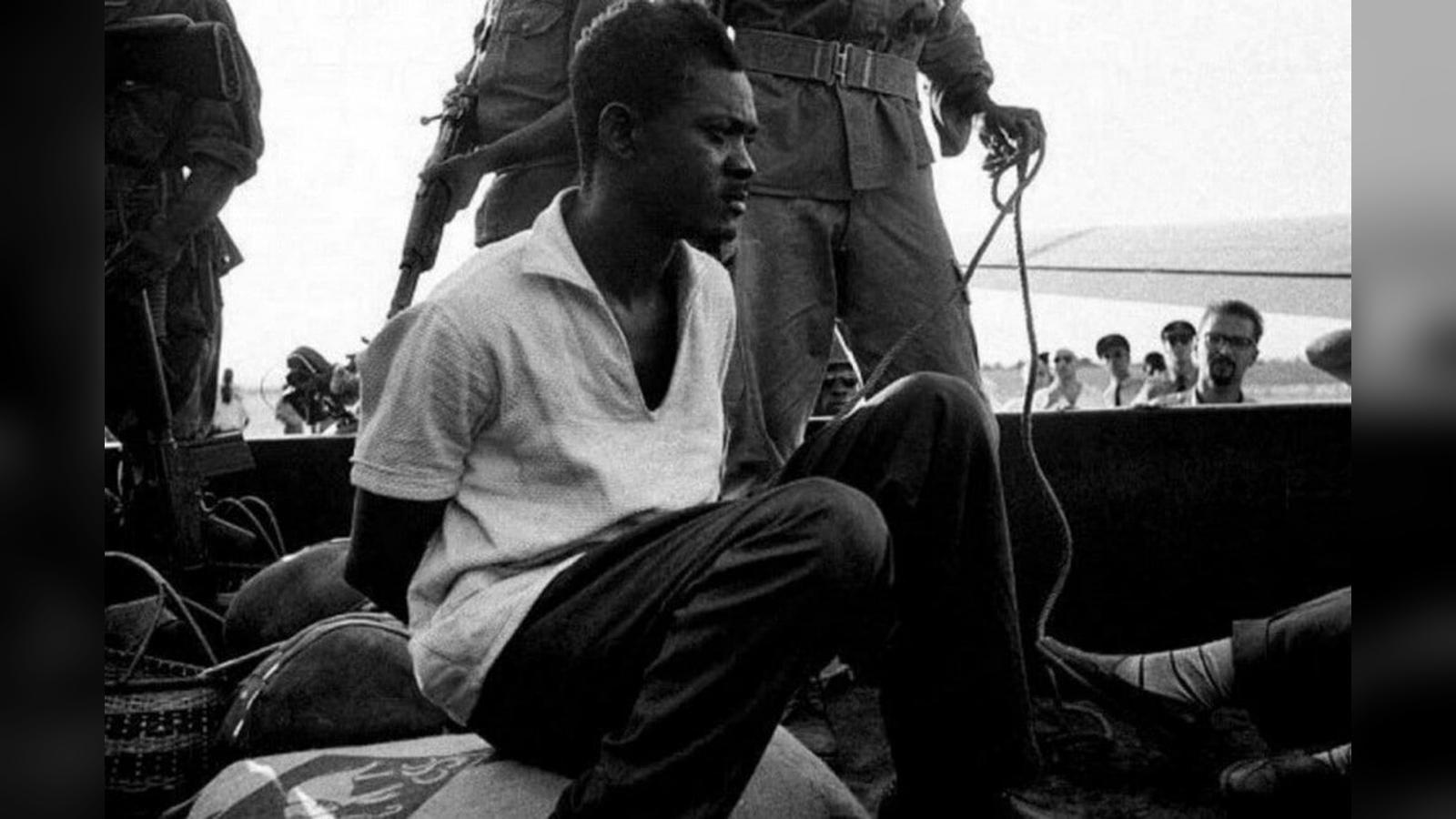
The photograph captures a harrowing, high-contrast moment on the tarmac of the Elizabethville airfield in the secessionist province of Katanga. In the center of the frame, Patrice Lumumba, the first Prime Minister of the independent Republic of the Congo, stands disheveled, his hands bound tightly behind his back. His white shirt is crumpled and soiled, and his posture—slightly hunched yet remarkably resilient—betrays the immense physical trauma he had already endured. He is surrounded by heavily armed soldiers, members of the Katangan gendarmerie or Mobutu’s forces, who guard him with cold, hostile vigilance. The harsh, unforgiving daylight of the African savannah casts sharp shadows across the concrete, emphasizing the isolation of the captive leader. This is not a formal portrait of statehood, but a raw, unvarnished document of captivity. The visual details—the ropes biting into his wrists, the swollen contours of his face, and the indifferent expressions of his captors—convey a profound sense of vulnerability and impending doom, marking the definitive transition of a national hero into a political prisoner.
The moment behind the image
This historic image was captured on January 17, 1961, during the final, agonizing journey of Patrice Lumumba. Arrested weeks earlier in December 1960 by the forces of his former chief of staff, Colonel Joseph Mobutu, Lumumba had been held at the military camp in Thysville. Fearing his enduring charisma and the potential for a military mutiny in his favor, his domestic rivals, in collusion with Belgian advisers, decided to transfer him to the breakaway province of Katanga—a territory ruled by his bitter enemy, Moise Tshombe. During the flight from Leopoldville to Elizabethville, Lumumba and his loyal companions, Joseph Okito and Maurice Mpolo, were subjected to such systematic and brutal beatings by their guards that the Belgian flight crew reportedly locked themselves in the cockpit to avoid witnessing the violence. Upon landing, the aircraft taxied to a remote corner of the airfield, away from the main terminal. The photograph captures the precise moment Lumumba was unloaded onto the tarmac, bruised and bound, shortly before being thrown into the back of a vehicle. From a distance of about three hundred yards, a Swedish non-commissioned officer and five UN soldiers watched this grim scene unfold through their binoculars, powerless to intervene due to their strict peacekeeping mandates.
Photographer and provenance
The exact identity of the photographer who captured this historic frame remains shrouded in the chaotic secrecy of the Congo Crisis. It is highly probable that the image was taken by a Belgian military adviser, a local journalist sympathetic to the Katangan secessionist regime, or a member of the security apparatus documenting the successful transfer of the ‘parcels’—the derogatory term used by President Joseph Kasa-Vubu to describe Lumumba and his aides. Despite the clandestine nature of the execution that followed, this photograph managed to escape the confines of the military airfield and quickly circulated globally. It was published by international news agencies, serving as undeniable visual proof of Lumumba’s captivity and physical abuse. The survival and widespread dissemination of this image transformed it from a tool of political intimidation into an indictment of the forces that orchestrated his downfall. Today, the photograph is preserved in major historical archives, including those of the United Nations and various international press agencies, standing as a permanent testament to the tragic end of Congolese democracy.
Historical context
To fully comprehend this photograph, one must look back to June 30, 1960, the day the Republic of the Congo gained its independence from Belgium. At the formal ceremonies, King Baudouin of Belgium delivered a highly paternalistic speech praising the colonial legacy of his ancestor, King Leopold II—whose brutal regime had resulted in the deaths of millions of Congolese. In response, the young and fiery Prime Minister Patrice Lumumba delivered an unscheduled, historic speech that electrified his country and horrified the colonial establishment. He spoke openly of the ‘ironies, insults, and blows’ that the Congolese had suffered under Belgian rule. Within days, the newly independent nation descended into chaos. The army mutinied against its white officers, Belgian paratroopers intervened under the guise of protecting civilians, and the mineral-rich province of Katanga seceded with Belgian backing. Caught in the geopolitical crossfire of the Cold War, Lumumba appealed to the United Nations for help. When the UN, led by Secretary-General Dag Hammarskjöld and his representative Ralph Bunche, refused to use force to crush the Katangan secession, a desperate Lumumba turned to the Soviet Union for logistical aid. This move sealed his fate, branding him a ‘Soviet stooge’ in the eyes of the United States and accelerating a CIA-backed plot to remove him from power.
Why it still matters
The photograph of Patrice Lumumba at Elizabethville airfield remains one of the most powerful and enduring symbols of the decolonization era. It captures the exact threshold between life and death, between the hope of African self-determination and the brutal reality of Cold War realpolitik. Hours after this image was taken, Lumumba, Okito, and Mpolo were driven to an isolated villa in the bush, where they were tortured by Katangan ministers and Belgian officers. That night, they were executed by a firing squad. To ensure that no physical trace of the leader could ever become a shrine for his followers, a Belgian police officer named Gerard Soete later exhumed the bodies, hacked them to pieces, and dissolved them in sulfuric acid, keeping only a single gold tooth as a macabre souvenir. This photograph survived where Lumumba’s physical body could not. It immortalized his martyrdom, turning him into a global icon of anti-colonial resistance and a symbol of the tragic compromises made by international institutions like the United Nations. Decades later, the image continues to demand a reckoning with the historical complicity of Western powers in the destabilization of the African continent.